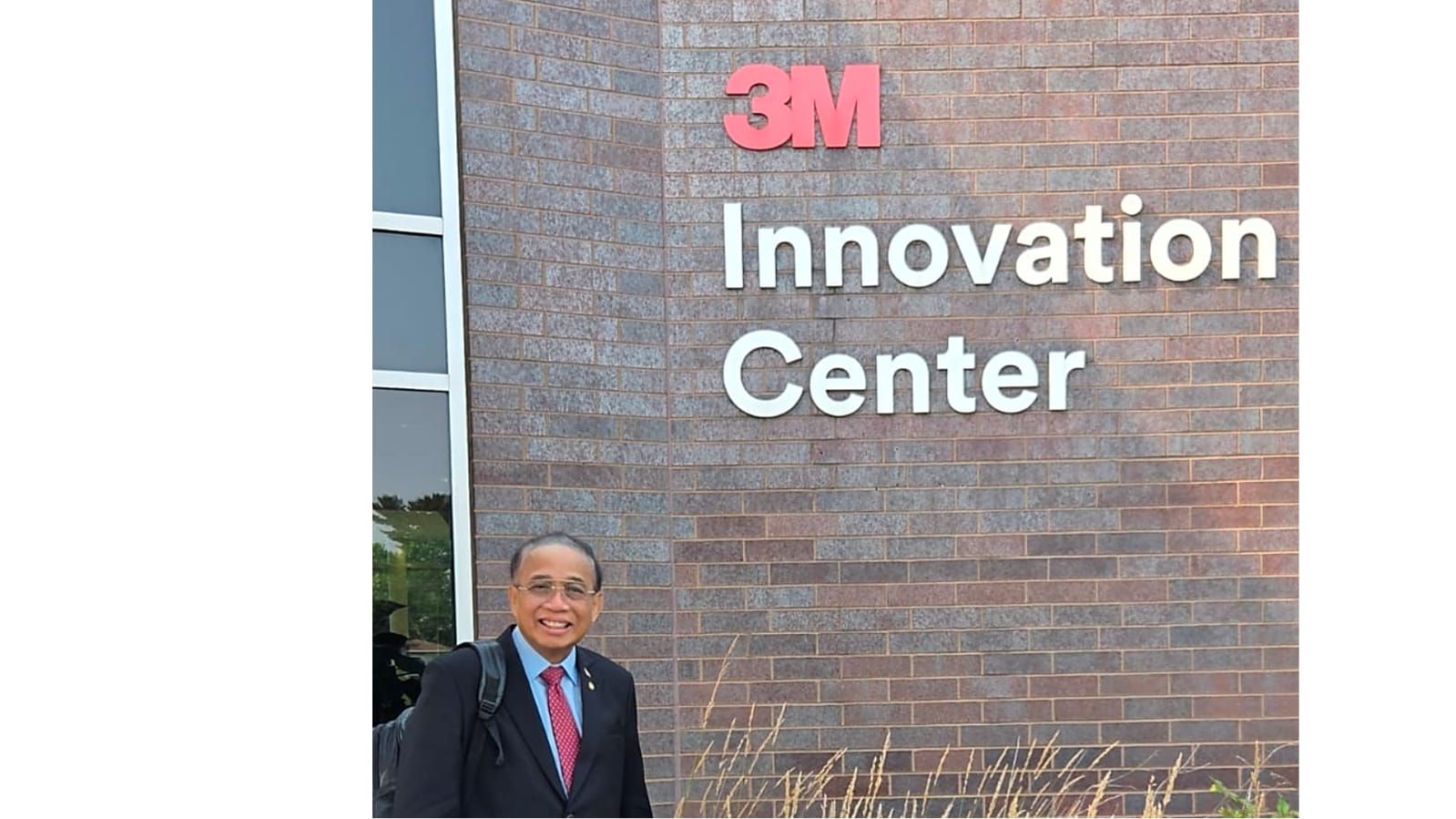
Enviro News Asia, Saint Paul — Indonesia is exploring a trilateral research and innovation partnership involving the National Research and Innovation Agency (BRIN), the University of Minnesota, and 3M as part of efforts to strengthen science diplomacy and expand Indonesia–United States cooperation in advanced technology and industrial innovation.
The initiative emerged during a visit by Indonesian Ambassador to the United States Indroyono Soesilo, together with ASEAN ambassadors in Washington, D.C., and US-ABC President Ambassador Brian McFeeters, to the 3M Innovation Center in Saint Paul, Minnesota.
The delegation was received by 3M Vice President Meagan Linn and the company’s senior leadership.
The proposed partnership would bring together three complementary strengths: BRIN’s research capabilities, the University of Minnesota’s academic and talent-development ecosystem, and 3M’s industrial research and commercialization expertise.
The initiative builds on a long history of innovation at 3M. Originally established as the Minnesota Mining and Manufacturing Company on June 13, 1902, in Two Harbors, Minnesota, the company initially sought to mine corundum for use in grinding wheels.
The mining venture, however, did not develop as expected because the deposits contained anorthosite, a mineral with little commercial value at the time. Rather than abandoning the business, the founders shifted toward sandpaper manufacturing, eventually transforming 3M into a global innovation company.
Over more than a century, 3M has developed products that have become part of everyday life, including Scotch transparent tape, Scotchgard fabric protection products and Post-it Notes. The company now employs thousands of scientists and researchers globally and operates across multiple technology platforms serving industries ranging from healthcare and safety to transportation and electronics.
3M has also maintained a presence in Indonesia since 1975, initially operating with only three employees. The company now operates a manufacturing facility in Karawang and a headquarters in Jakarta, with products serving household, automotive and industrial markets.
Among its automotive products, 3M’s AutoFilm line incorporates technologies designed to reduce solar heat while maintaining visibility. Its premium Crystalline series uses multilayer optical coating and nano-layer technology to reject significant solar heat while allowing high levels of visible light to pass through.
The technology illustrates the broader research capabilities that could become relevant to future cooperation between Indonesia, US academic institutions and industry.
The proposed trilateral framework would also build on more than five decades of collaboration between 3M and the University of Minnesota. Their cooperation has included talent development, joint research and doctoral scholarship programs in science and engineering.
The University of Minnesota is also recognized by Indonesia’s Education Endowment Fund (LPDP) as an overseas university destination for Indonesian recipients of master’s and doctoral scholarships. This could provide an additional pathway for developing Indonesian researchers who may contribute to future BRIN–3M research initiatives.
Several potential areas of cooperation were discussed during the initial talks, including advanced materials and next-generation adhesives, advanced personal protective equipment, optical films and coatings, and technologies relevant to electronics, semiconductors and automotive applications.
The discussions also included opportunities for researcher exchange programs and PhD scholarships for BRIN researchers in materials science and engineering. Such programs could provide Indonesian researchers with international experience and access to advanced research environments.
Beyond research and talent development, the proposed partnership could also explore technology transfer and precision manufacturing capabilities to strengthen 3M’s facility in Karawang.
The facility could potentially develop into an important node within regional supply chains while supporting Indonesia’s industrial downstreaming and sustainable innovation agenda.
The trilateral cooperation would therefore extend beyond the production of scientific knowledge. By connecting education, research, industrial innovation and manufacturing, the partnership could create a broader ecosystem for technology development and value creation in Indonesia.
The proposed BRIN–University of Minnesota–3M collaboration reflects an emerging model of science diplomacy in which diplomatic engagement serves as a bridge between research institutions, universities and industry.
For Indonesia, the initiative could provide an opportunity to strengthen research capacity, develop highly skilled human resources, accelerate technology transfer and increase domestic industrial value.
For the United States and its academic and business partners, closer engagement with Indonesia could open additional opportunities for research collaboration, talent development and innovation within one of Southeast Asia’s largest economies.
The next stage will require the parties to translate the initial discussions into concrete research priorities, institutional arrangements and collaborative programs. If successfully developed, the trilateral framework could become a platform linking Indonesian researchers, American academia and global industry in pursuit of advanced technologies and sustainable innovation. (*)