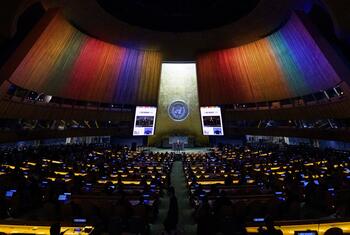
Enviro News Asia, New York — The United Nations Environment Programme (UNEP) is calling for faster implementation of climate solutions as governments, businesses and communities gather during Climate Week and the United Nations General Assembly in New York.
UNEP said climate action must remain high on the global agenda as countries confront overlapping environmental, economic and social challenges. It highlighted clean energy, climate finance, adaptation, sustainable cooling, forest protection, transport, methane reduction and energy-efficient buildings as areas where practical measures can accelerate progress.
Through its Climate Live Feed, UNEP is tracking climate-related policy announcements, scientific findings, financing initiatives and solutions during Climate Week, the UN General Assembly and the period beyond.
The agency said climate solutions can also support economic growth, create jobs, strengthen resilience and improve public health.
Turning Climate Commitments Into Action
UNEP is supporting Climate Promise: Forward, a UN-wide framework designed to help countries implement their Nationally Determined Contributions (NDCs) and National Adaptation Plans (NAPs).
The initiative follows support provided to more than 100 countries in developing third-generation NDCs under Climate Promise 2025. UNEP is now supporting sector-specific pathways covering sustainable cooling, forests, transport, methane and buildings.
The approach aims to integrate sectoral solutions into national climate plans and investment strategies, allowing countries to translate climate commitments into practical measures.
Food Waste Offers Immediate Opportunity
UNEP also highlighted food waste as an area where climate action can produce multiple benefits.
The agency said 19% of food available to consumers is wasted globally, with households accounting for 60% of food waste, followed by food services at 28% and retail at 12%.
Food loss and waste are estimated to contribute 8–10% of global greenhouse gas emissions. UNEP said reducing waste can help lower methane emissions, reduce pressure on land and water resources, protect ecosystems and make more food available.
Martin Krause, Director of UNEP’s Climate Change Division, said reducing food loss and waste can simultaneously support food security, emissions reductions, environmental protection and economic resilience.
The issue was placed on the agenda of Climate Week in New York through a session titled “Solving Food Waste is a Key Solution to the Climate Crisis.”
Cooling Becomes a Climate Priority
UNEP also highlighted sustainable cooling as a growing climate and development challenge.
The Global Cooling Pledge Assembly, held in Singapore from September 15–18, brought together governments, cities, businesses and experts to advance practical measures for heat resilience and efficient cooling.
UNEP said global cooling demand could more than triple by 2050 without accelerated action, increasing pressure on energy systems and potentially raising emissions.
The assembly focused on efficient and climate-friendly cooling technologies, passive cooling in buildings, nature-based solutions and financing for urban heat resilience.
More than 230 delegates participated in the final stages of the assembly. The outcomes included more than 55 country-led requests for implementation support, progress toward a Heat Resilience Roadmap for a Warming World and new initiatives to expand efficient cooling technologies and nature-based solutions.
The Gambia also joined the Global Cooling Pledge, bringing the number of signatories to 76.
Buildings and COP31
The COP31 Presidency of Türkiye has also placed implementation at the centre of preparations for the climate conference in Antalya in November.
During the Global Cooling Pledge Assembly, COP31 President-designate Murat Kurum highlighted energy-efficient buildings as a priority and presented the Antalya Compact for Energy Efficient Buildings, developed with the UNEP-hosted Global Alliance for Buildings and Construction.
The initiative seeks to encourage countries to adopt shared targets for improving building energy performance and reducing emissions.
With COP31 scheduled to open on November 9, UNEP said the focus is increasingly shifting from climate commitments toward implementation, investment and scalable solution. (*)