


Enviro News Asia, Jakarta — Indonesia could strengthen its ambition to achieve 8% economic growth by reforming electricity policies and accelerating solar power development, according to a joint study by four energy and economic research organisations.
The study, titled Powering Indonesia’s Growth: A More Electrified, More Renewable Economy with Solar at Its Core, was conducted by the Institute for Essential Services Reform (IESR), the Institute for Development of Economics and Finance (INDEF), the Energy Transitions Commission (ETC), and SYSTEMIQ. It found that a cleaner, more efficient electricity system could improve industrial competitiveness, lower energy costs, create jobs and reduce dependence on imported fossil fuels.
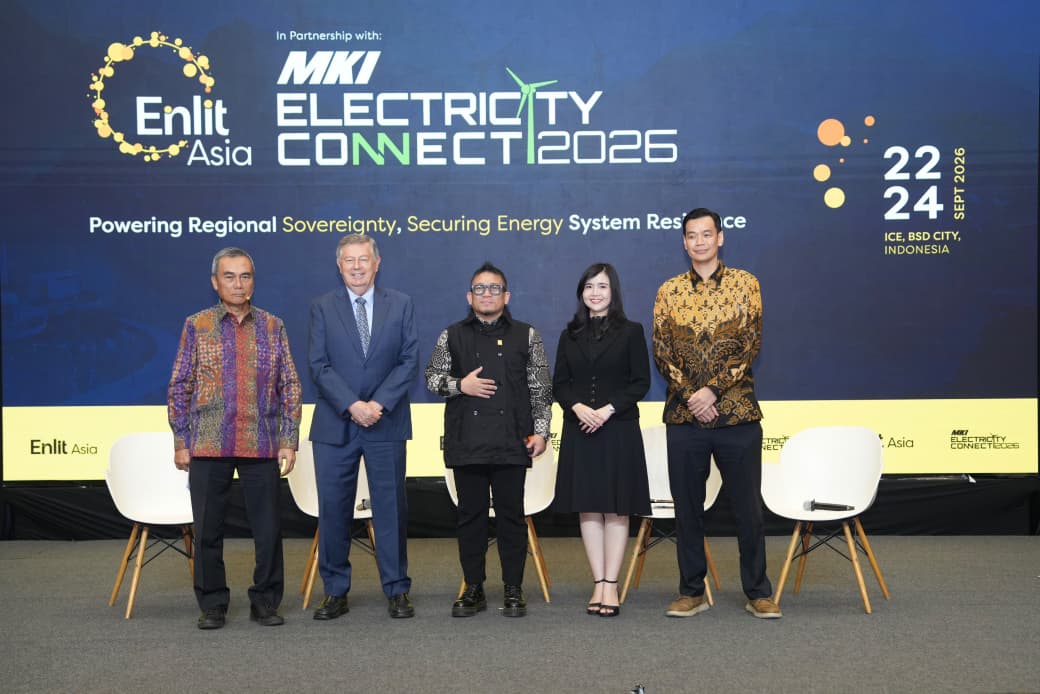
Published findings presented in Jakarta on October 13, 2026, indicate that Indonesia’s electricity demand will rise significantly as the economy expands and industrialisation accelerates. Under a business-as-usual scenario, demand is projected to increase from 440 terawatt-hours (TWh) in 2025 to 695 TWh in 2035. Under a high-electrification scenario, demand could reach 855 TWh by 2035, representing annual growth of approximately 7%.
The projected increase reflects wider electricity use across industry, transportation, households and other economic activities. Solar power could play a strategic role in meeting this demand because it can be developed more quickly than many other power-generation technologies.
IESR’s electricity system modelling suggests that expanding renewable energy could lower overall system costs. Under the lowest-cost, high-electrification scenario, installed solar power capacity could reach 69 gigawatts (GW) by 2035, with renewables accounting for 44% of electricity generation.
The average electricity system cost under this scenario is estimated at US$0.085 per kilowatt-hour (kWh), below the US$0.089 per kWh projected under the high-electrification scenario based on Indonesia’s Electricity Supply Business Plan (RUPTL). The findings suggest that increasing renewable energy capacity does not necessarily make electricity more expensive if development is planned and implemented efficiently.
Deon Arinaldo, IESR’s director of energy system transformation programmes, said solar power offered a speed advantage in meeting additional electricity demand. Solar installations for industrial use can be completed in approximately two to six months, while grid-connected solar projects typically require six months to two years. By comparison, grid-connected coal-fired power plants generally take four to six years to build.
However, solar development in Indonesia continues to face cost and regulatory barriers. The study estimates that large-scale solar electricity costs in Indonesia range from US$0.05 to US$0.10 per kWh, compared with approximately US$0.037 per kWh in India.
Land costs, grid limitations, connection expenses, permitting procedures and project development requirements contribute to the gap. Domestic content requirements, known as Tingkat Komponen Dalam Negeri (TKDN), may also raise component costs and delay deployment when they are not aligned with domestic manufacturing readiness, Deon said during a media briefing on October 13.
The study recommends four major policy measures to address these challenges. First, the government should accelerate strategic solar projects, including the proposed 100-gigawatt-peak (GWp) solar programme, through competitive and transparent renewable energy auctions held regularly, supported by predictable power purchase agreements.
Second, rooftop solar quota policies should be reformed to give households and industrial consumers greater opportunities to participate in renewable electricity generation.
Third, land and grid constraints should be addressed by simplifying land acquisition, accelerating electricity network construction, and clarifying power plant connection procedures and costs.
Fourth, domestic content requirements should be introduced progressively so that the development of Indonesia’s manufacturing industry can advance alongside faster solar deployment and lower technology costs.
Abindra Soemali, SYSTEMIQ’s manager and energy lead, said consistent policy reform could reduce solar generation costs in Indonesia from the current estimated range of US$0.05–US$0.10 per kWh to approximately US$0.035–US$0.05 per kWh over the longer term.
He said the reduction would depend on scaling up deployment, simplifying regulations, strengthening domestic supply chains, improving access to financing and upgrading grid infrastructure. Setting capacity targets alone would not be sufficient without regulatory certainty and procurement mechanisms capable of attracting investment and delivering competitive electricity prices.
The economic benefits could extend beyond the power sector. INDEF’s analysis estimates that the lowest-cost, high-electrification scenario could contribute approximately 8–10% of the additional gross domestic product (GDP) required to achieve Indonesia’s 8% economic growth target.
The scenario could also generate US$20 billion in energy subsidy savings between 2025 and 2035 and create approximately 48,000 additional jobs in the electricity sector.
Imaduddin Abdullah, director of INDEF’s Green Transition Initiative, said greater electrification and renewable energy use could also reduce oil import requirements, strengthen energy security and ease pressure on the state budget.
Access to affordable, clean electricity is increasingly important for attracting investment and maintaining Indonesia’s industrial competitiveness in global markets. International companies are increasingly considering renewable energy availability when choosing locations for investment and manufacturing.
IESR, INDEF, ETC and SYSTEMIQ said the government and state-owned electricity company PLN must therefore improve electricity sector governance, expand access to renewable power and coordinate grid and generation development.
The organisations stressed that Indonesia’s solar capacity targets must be supported by regulatory certainty, competitive procurement and adequate grid readiness to ensure the energy transition becomes a driver of sustainable economic growth. (*)