

Enviro News Asia, Jakarta — Indonesia is targeting 35 gigawatts (GW) of nuclear power generation capacity by 2060, with the Energy and Mineral Resources Ministry stressing the need to prepare skilled personnel, strengthen research and innovation, and ensure rigorous nuclear safety and security standards.
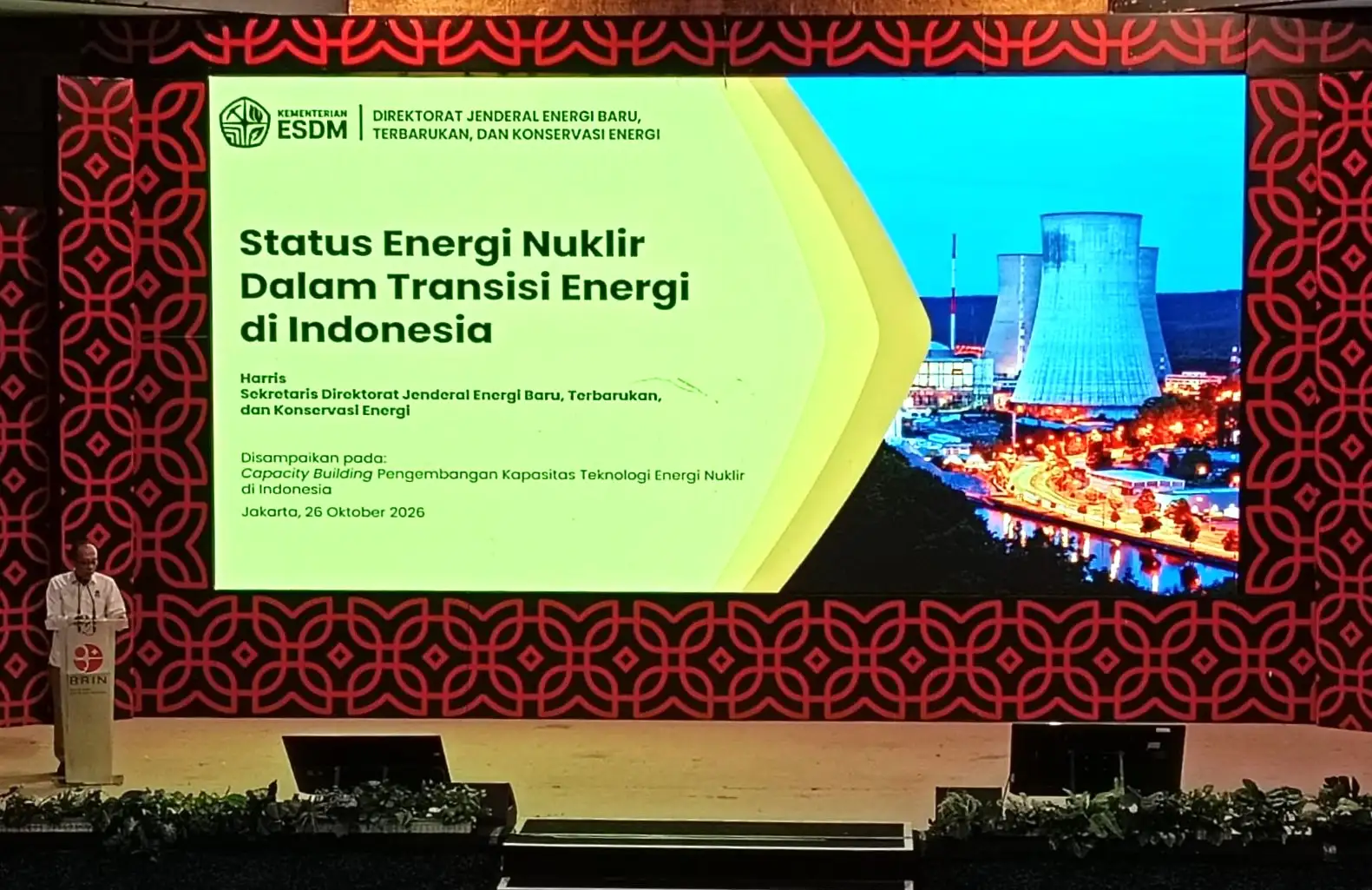
Harris, secretary of the ministry’s Directorate General of New, Renewable Energy and Energy Conservation, said nuclear power development required comprehensive preparation, including regulatory frameworks, institutional coordination, project readiness, supporting industries and transparent public communication.
He delivered the remarks during a capacity-building programme organised by the National Research and Innovation Agency’s (BRIN) Nuclear Energy Research Organisation in Jakarta on October 26, 2026. The event focused on the BerAKHLAK core values for civil servants, nuclear safety and security culture, and the development of Indonesia’s nuclear energy technology capabilities.
“Nuclear power plant readiness is not only about technology, but also institutions, human resources and public trust,” Harris said.
Nuclear energy is considered one of Indonesia’s strategic options for strengthening energy security while supporting the country’s transition towards net-zero emissions by 2060.
Under the electricity-sector energy transition roadmap stipulated in Energy and Mineral Resources Ministerial Regulation No. 10 of 2025, nuclear power capacity is targeted to reach 35 GW by 2060, equivalent to approximately 7.9% of the country’s total installed power generation capacity.
According to the National Electricity General Plan, Indonesia plans to begin nuclear power development in 2032 with an initial capacity of 0.25 GW. Capacity would then increase gradually in line with electricity demand and the readiness of the national power system.
The plan distributes the targeted capacity across four major regions: 15 GW in Sumatra, 10 GW across Java, Madura and Bali, 7 GW in Kalimantan, and 3 GW in Sulawesi.
Harris said nuclear power would complement Indonesia’s energy mix by providing reliable, low-carbon electricity. It would not replace the development of other renewable energy sources, including solar, wind, hydropower, geothermal and bioenergy.
Diversifying energy sources is becoming increasingly important as electricity demand is expected to rise, while Indonesia must also maintain reliable supplies and reduce emissions.
However, achieving the nuclear power target will require specialised personnel throughout the project lifecycle. Required competencies include project planning and development, site assessment, design and construction, testing and commissioning, operations and maintenance, nuclear fuel management, and radioactive waste handling.
Harris said workforce preparation should begin during the planning stage through competency mapping, training and qualifications tailored to each phase of nuclear power development.
He called for closer cooperation among the Energy and Mineral Resources Ministry, BRIN, the Nuclear Energy Regulatory Agency (BAPETEN), universities, state-owned electricity company PLN and industry stakeholders to strengthen scientific and technological capabilities.
Nuclear safety and security remain essential conditions for any future programme. Harris said projects must comply with requirements covering operational safety, security, nuclear safeguards, fuel supply assurance and radioactive waste management.
Construction and operation must also receive approval from an independent nuclear regulator. Site selection should account for disaster risks, population density and the protection of strategically important national food-production areas.
Public acceptance is another key factor in determining the programme’s readiness. Harris said communication must explain the benefits, risks and uncertainties of nuclear technology in a balanced and transparent manner, supported by scientific evidence.
Consistent information across government institutions, he added, could strengthen public confidence while maintaining a clear distinction between policy promotion, scientific assessment and regulatory oversight.
The government expects coordination in policymaking, research, workforce development and public communication to help establish the foundations for a nuclear energy programme that can be implemented safely, systematically and responsibly. (*)