Enviro News Asia, Jakarta — Indonesia’s efforts to accelerate solar power development will depend not only on expanding installed capacity but also on regulatory certainty, grid readiness and stronger electricity demand, energy analysts and industry representatives have warned.
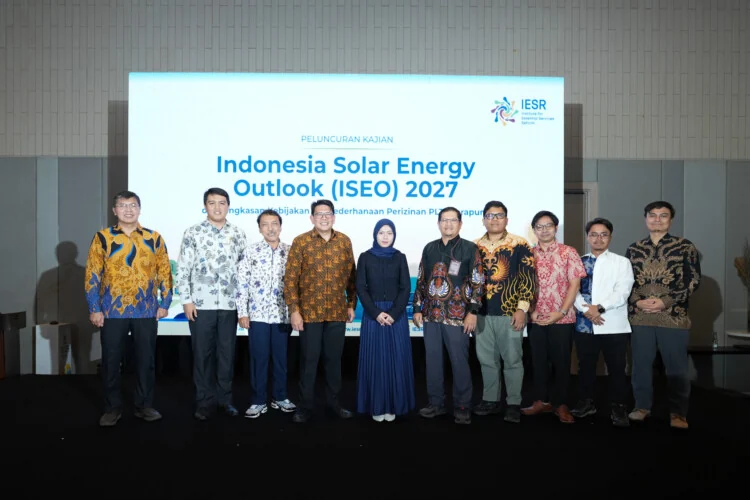
The challenges were highlighted at the launch of the Indonesia Solar Energy Outlook (ISEO) 2027 and the policy brief “Sun on Water: Recommendations for Scaling Up the Deployment of Floating Solar PV in Indonesia”, organised by the Institute for Essential Services Reform (IESR) on Nov. 18, 2026.
With technical solar energy potential exceeding 3.2 terawatts (TW), Indonesia has significant opportunities to reduce its dependence on fossil fuels, limit exposure to geopolitical disruptions in fuel markets and cut greenhouse gas emissions. However, turning that potential into electricity requires improvements in regulation, infrastructure and market demand.
IESR Chief Executive Officer Fabby Tumiwa said Indonesia had installed 1.59 gigawatts-peak (GWp) of solar power capacity by the first quarter of 2026. Rooftop solar accounted for the largest share at 0.9 GWp, followed by utility-scale installations at 0.33 GWp.
“Rooftop solar has grown organically without government incentives. Even with a quota system in place, industries and communities have continued to move forward,” Fabby said.
He urged the government to create new sources of electricity demand and ease restrictions on rooftop solar quotas, allowing households and businesses greater flexibility to adopt solar power.
Erick Ta’dung, coordinator for renewable energy business development and supervision at the Energy and Mineral Resources Ministry’s Directorate General of New, Renewable Energy and Energy Conservation, said the government was finalising a draft presidential regulation on the 100 GWp solar power programme following harmonisation with relevant ministries and agencies.
The government is also preparing revisions to Presidential Regulation No. 112/2022. Under the proposed framework, solar power provisions will be addressed separately through the new regulation targeting 100 GWp of installed capacity.
As an initial step towards the 2029 target, the government has identified solar projects with a combined capacity of around 5.3 GWp. However, Erick acknowledged that implementation still faced obstacles involving permits, land use and spatial planning, including overlaps with protected agricultural land and forest areas.
The Energy Ministry is coordinating with the Agrarian Affairs and Spatial Planning Ministry, the Forestry Ministry and local governments to clarify land status and accelerate permit processing.
Aryeshah Akbar, an electricity system modeller and analyst at IESR and an author of ISEO 2027, highlighted the gap between announced projects and their actual readiness. Of the approximately 5.3 GWp identified in the initial project pipeline, only 526 megawatts-peak (MWp) had a target commercial operation date. Around 4.2 GWp was ready for tender, while 441 MWp was already under construction.
“The challenge is to turn announced projects into financed and construction-ready developments through efficient tenders, clear land status and certainty over grid connections,” Aryeshah said.
Floating solar projects face similar challenges. His Muhammad Bintang, head of electricity and energy storage at IESR, presented findings from the organisation’s “Sun on Water” study, which identified 42.5 GW of economically viable floating solar potential across 143 locations.
However, development remains constrained by uncertainty over access to water bodies and complex licensing procedures involving multiple government agencies.
Drawing lessons from China and Singapore, Bintang recommended establishing a national database of suitable locations for floating solar projects. The information could be integrated into the Electricity Supply Business Plan (RUPTL) or the implementation framework for the 100 GWp solar programme to accelerate project preparation.
From the developer’s perspective, PT PLN Nusantara Renewables President Director Kuswara Harjowiyono said construction of the 133 MWp Karangkates floating solar power plant had reached 80 percent completion. He noted that physical construction of solar facilities could proceed relatively quickly, but licensing and the resolution of social issues often took considerably longer.
Kuswara said development of the Karangkates project began after the company received a letter of intent from state-owned electricity company PLN in August 2023. The power purchase agreement was signed in January 2024.
“One challenge that has not received sufficient attention is the social dimension of using reservoirs,” he said.
Electricity demand growth was another major concern raised during the discussion. Juniko Parhusip, coordinator of the electricity, downstream industry and economic zones working group at the Energy Ministry’s Directorate General of Electricity, said the expansion of data centres could create new demand and provide opportunities to support solar power development.
Zainal Arifin, director of the Centre for Energy Transition and Sustainability at PLN Institute of Technology, warned that additional generation capacity must be matched by the electricity system’s ability to absorb the output.
Assuming a capacity factor of 16 percent, a 100 GWp solar fleet could generate approximately 140 terawatt-hours (TWh) of electricity annually. Zainal estimated that absorbing this additional output through consumption growth over three years would require electricity demand to rise by around 12.74 percent annually, far above the average growth rate of 4.7 percent recorded in recent years.
“The issue is not simply building generation capacity. We must ensure that the 140 TWh is actually used,” he said.
Fandi Gunawan Sianipar, manager of independent power producer (IPP) projects at PLN, said transmission infrastructure serving industrial areas must be developed in line with electricity demand. New requirements not yet included in the RUPTL could be proposed through a supplementary planning mechanism, providing a basis for PLN to expand the necessary infrastructure.
IESR Research and Innovation Director Raditya Wiranegara said rooftop solar development would not place a burden on the state budget because households and businesses would contribute to financing and installing the systems. At the same time, wider adoption would increase the share of renewable energy in Indonesia’s energy mix.
The discussion underscored the need to align solar power targets with regulatory reform, project financing, land availability, grid infrastructure and actual electricity consumption. Without progress across these areas, Indonesia’s ambition to reach 100 GWp of solar capacity by 2029 could face significant implementation challenges. (*)