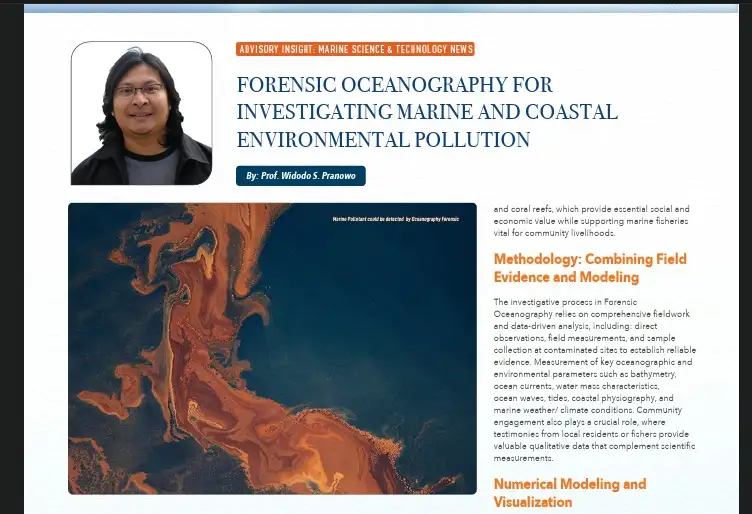
Enviro News Asia, Yogyakarta — Scientific modeling plays a crucial role in strengthening evidence-based approaches to resolving environmental disputes, according to researchers from Indonesia’s National Research and Innovation Agency (BRIN). Environmental models can help establish objective cause-and-effect relationships in pollution cases, supporting legal processes and environmental restoration efforts.
Speaking at a workshop on environmental dispute resolution organized by Indonesia’s Ministry of Environment and Environmental Control Agency (KLH/BPLH) in Sleman, Yogyakarta, BRIN senior researcher Widodo Setiyo Pranowo emphasized that environmental modeling provides a scientific framework for identifying pollution sources, mapping the spread of contamination, and estimating the extent of affected areas.
According to Widodo, scientific modeling enables investigators and policymakers to better understand environmental impacts through objective analysis supported by reliable data. Such approaches strengthen the evidentiary basis of environmental dispute cases and provide scientifically defensible conclusions.
He explained that environmental models can be used not only to reconstruct past pollution events but also to predict how contaminants may spread through air, rivers, coastal waters, and marine ecosystems. These insights are valuable for environmental risk assessments and for determining the most effective recovery and remediation measures.
Widodo stressed that accurate modeling depends on high-quality field observations, accredited laboratory testing, and scientifically sound sampling procedures. Integrating these different data sources is essential to producing credible assessments that can support policy decisions and legal proceedings.
“When field observations, laboratory results, and modeling outputs are properly integrated, they provide a more comprehensive picture of environmental pollution and degradation. This greatly supports verification processes, environmental damage assessments, and the development of recovery strategies,” he said.
The BRIN researcher also highlighted the importance of collaboration among scientists, local governments, environmental inspectors, and laboratories in strengthening environmental dispute resolution. He noted that improving human resource capacity in data interpretation and scientific analysis remains critical to ensuring effective handling of environmental cases.
A similar view was expressed by Dodi Kurniawan, Director of Environmental Dispute Resolution at KLH/BPLH. He stated that expert testimony and scientific evidence are fundamental components of objective and measurable environmental dispute resolution processes.
“Scientific studies provide an essential foundation to ensure environmental dispute resolution is conducted objectively, transparently, and based on robust evidence,” Dodi said.
Meanwhile, Ariwono, Head of Region II of the Environmental Control Center for Java, noted that the growing complexity of environmental pollution and degradation cases requires stronger technical competencies among stakeholders involved in field investigations and enforcement.
The workshop brought together representatives from provincial and district environmental agencies as well as technical units from Java, Bali, and Nusa Tenggara. Participants received training on the use of scientific evidence, environmental law enforcement, environmental damage valuation, and procedures for resolving environmental disputes.
The event reflects increasing recognition of science-based policymaking and evidence-driven environmental governance as Indonesia seeks to strengthen environmental protection and improve the effectiveness of environmental law enforcement. (*)