Enviro News Asia, Bonn – Partnerships are essential to accelerating the development and deployment of climate technologies and supporting the implementation of the Paris Agreement, participants heard at a UN Climate Change side event held during the June Climate Meetings (SB64).
The event, titled “Accelerating Climate Action through Partnerships under the Technology Mechanism,” brought together governments, climate funds, international organizations, research institutions, and industry representatives to showcase how collaboration is helping scale climate technology solutions for both mitigation and adaptation.
The Technology Mechanism, comprising the Technology Executive Committee (TEC) and the Climate Technology Centre and Network (CTCN), serves as the technology arm of the UNFCCC, supporting countries in identifying, developing, and deploying climate technologies to address climate change and advance sustainable development.
Opening the event, Sophie De Coninck, Director of the Means of Implementation Division at UN Climate Change, said no single institution can deliver the scale of transformation required by the Paris Agreement, stressing that turning innovation into impact requires collaboration across policy, finance, capacity-building, and implementation.
“This is precisely why partnerships are at the heart of the Technology Mechanism’s work,” De Coninck said.
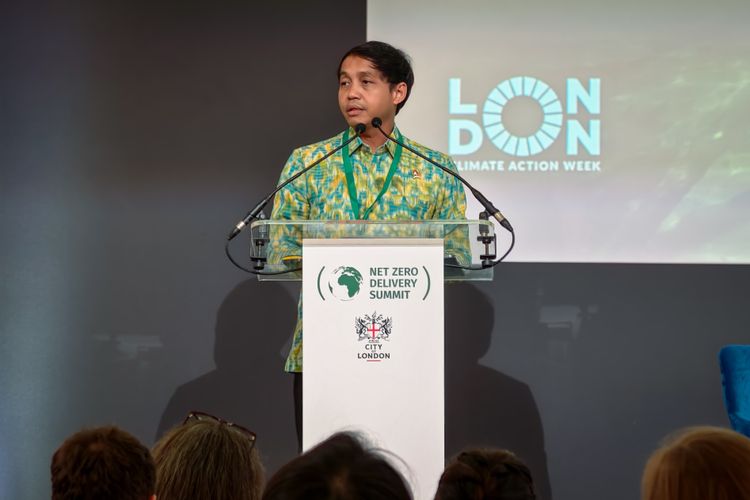
CTCN Director Ariesta Ningrum said partnerships enable the connection of governments, technology providers, financial institutions, and practitioners around practical solutions that can be scaled and replicated. Speakers shared examples of partnerships already delivering results, including Germany’s collaboration with the TEC on industrial decarbonization and the Republic of Korea’s support for the Technology Mechanism’s AI for Climate Action Initiative through the UNFCCC-KOICA Climate Future Partnership.
A key announcement at the event was the launch of the Technology Mechanism’s AI for Climate Action Award 2026, recognizing innovative applications of artificial intelligence supporting climate action, particularly in developing countries. UN Climate Change and the CTCN also announced they have joined the Digital Public Goods Alliance, a global network working to advance open, interoperable digital technologies for sustainable development.
Mikko Ollikainen of the Adaptation Fund emphasized the importance of strengthening links between technology support, innovation, and climate finance to help countries move from project concepts to implementation. Anne Dekeukelaer of the Cement and Concrete Breakthrough Agenda shared lessons from collaboration with the CTCN to accelerate decarbonization in one of the world’s most emissions-intensive sectors.
Participants also explored how partnerships can help strengthen implementation of the newly launched Belém Technology Implementation Programme, adopted at COP30, which aims to enhance support for technology priorities identified by developing countries.
Closing the event, TEC Chair Pedro Ivo Ferraz da Silva underscored that progress depends on connecting policy, finance, innovation, and implementation to help climate technologies reach the people, communities, and countries that need them most. (*)