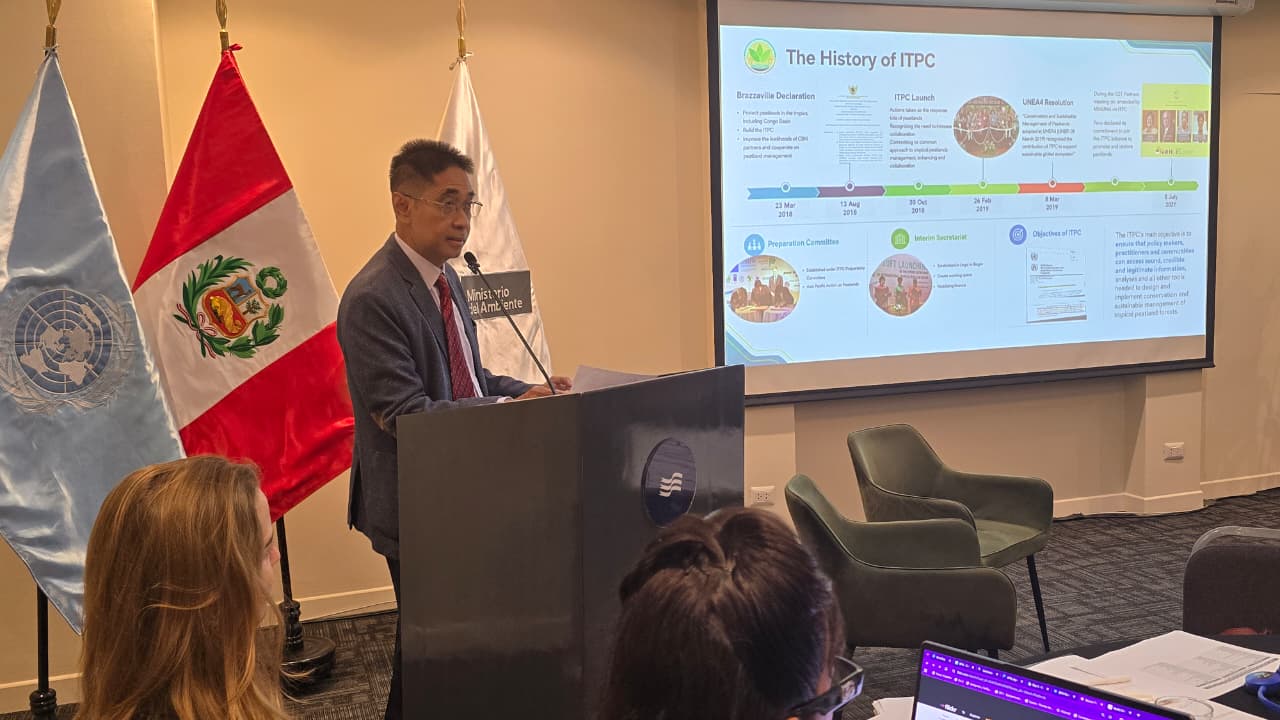
Enviro News Asia, Lima — Indonesia presented its experience in science- and data-based peatland ecosystem management during the third day of the Technical Level Meeting of the Global Peatlands Initiative (GPI) in Lima, Peru, highlighting the country’s integrated approach to hydrological management, carbon monitoring, greenhouse gas emission control, and digital mapping systems as key components of climate action.
Speaking at the forum, Agus Justianto said peatland conservation and sustainable management play a critical role in Indonesia’s low-carbon development strategy and support the country’s commitment to achieving its Nationally Determined Contribution (NDC) targets under the Paris Agreement.
“Peatland management is not only about protecting wetlands, but also about reducing greenhouse gas emissions, maintaining hydrological functions, conserving biodiversity, and ensuring that peatlands are utilized sustainably,” Agus said.
He explained that Indonesia’s peatland carbon management framework encompasses the protection of intact peatlands, sustainable land management, prevention of peatland degradation and excessive drainage, hydrological restoration, ecosystem rehabilitation, and the recovery of degraded peatland functions.
According to Agus, Indonesia’s experience demonstrates that peatland management must be implemented systematically and at the scale of Peat Hydrological Units (PHUs), enabling effective control of water balance, ecosystem functions, and carbon emissions.
“The ultimate objective is to achieve an optimal greenhouse gas balance. This requires maintaining groundwater levels, preventing excessive drainage, eliminating the use of fire, and promoting land-use practices that are compatible with peatland ecosystems,” he said.
Agus also highlighted Indonesia’s efforts to strengthen peatland restoration research and innovation through collaboration involving 17 universities and 10 research institutions. The initiatives cover peatland monitoring systems, water management technologies, paludiculture, carbon accounting, digital information systems, and demonstration sites that serve as learning and replication centers for best practices.
He added that Indonesia’s peatlands provide vital ecological services, serving as habitats for key wildlife species, conservation areas, community-managed landscapes, and natural buffers against climate change. As a result, peatland restoration should be viewed as an integrated environmental, social, and economic priority.
During a separate session, Bambang Supriyanto presented Indonesia’s hydrological mapping system, which uses peat dome depth and hydrological characteristics to determine priority areas for restoration and sustainable management.
Bambang explained that Indonesia divides Peat Hydrological Units into interconnected hydrological sub-zones, including peat dome conservation areas, buffer zones, and carefully managed production zones.
“Hydrological mapping provides the foundation for effective peatland restoration because each site has distinct water conditions, land cover, degradation levels, fire history, drainage infrastructure, and community involvement,” Bambang said.
He noted that restoration priorities are determined using multiple indicators, including peatland functions, land cover, forest status, degradation levels, fire occurrence, canal density, water bodies, peat classification, and hydrological response units.
The approach enables the government to implement site-specific restoration measures, including rewetting, revegetation, and community economic revitalization through capacity building, green economy initiatives, and sustainable peatland utilization.
“Peatland restoration is most effective when it is data-driven, based on hydrological conditions, and actively involves local communities, who play a crucial role in maintaining long-term restoration outcomes,” he said.
Bambang also emphasized the importance of Monitoring, Reporting, and Verification (MRV) systems in ensuring transparent and accountable restoration efforts. Indonesia has developed a range of digital platforms to support peatland restoration and mangrove rehabilitation, including groundwater monitoring systems, restoration information platforms, fire danger rating systems, and field-based monitoring technologies.
He said these digital tools provide essential information for decision-making, fire prevention, water management, and evaluation of restoration progress from local to national levels.
Through its presentations, Indonesia reaffirmed that successful peatland management requires an integrated combination of sound policy, scientific research, monitoring technology, restoration innovation, and community participation. The country expressed hope that its experience could serve as a valuable reference for other tropical peatland nations seeking to strengthen climate action, biodiversity conservation, and low-carbon development. (*)