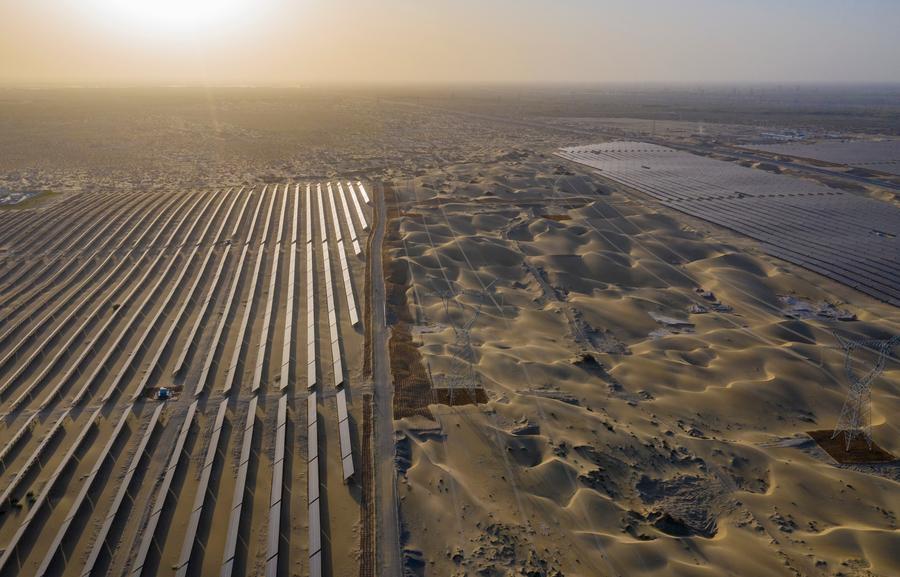
Enviro News Asia, Beijing – China on Friday reaffirmed the accelerating pace of its ecological transition during a press briefing in Beijing, highlighting wide-ranging progress across its energy system, industrial sectors, and national climate policy framework. The State Council Information Office convened the briefing to outline the country’s latest climate actions and their contribution to global mitigation efforts.
Officials stated that China has strengthened carbon-peaking and carbon-neutrality measures over recent years by restructuring energy and industrial systems, expanding renewable deployment, and improving overall energy efficiency. Li Gao, vice minister of ecology and environment, said that the ongoing transition reflects a nationwide effort to align development with long-term climate goals.
Wang Shancheng of the National Development and Reform Commission (NDRC) reported that China now operates the world’s largest and fastest-expanding renewable energy system. He stated that the country’s green and low-carbon industries have reached an estimated value of 11 trillion yuan, supported by a national equipment-renewal program and large-scale industrial upgrading initiatives.
China’s new-energy vehicle (NEV) sector also maintained global leadership. Production and sales both surpassed 12 million units annually, marking ten consecutive years in which China remained the world’s largest market for NEVs. More than half of all NEVs in use globally are currently operating in China, according to NDRC data.
Li Gao emphasized that China’s contribution extends beyond domestic efforts by supplying affordable low-carbon technologies to global markets and supporting climate action in developing countries. In September, China submitted its updated Nationally Determined Contributions (NDCs), which outline 2035 targets including a 7–10 percent reduction in net greenhouse gas emissions from peak levels, a non-fossil energy share exceeding 30 percent, and a sixfold increase in wind and solar installed capacity compared to 2020.
Li, who headed China’s delegation at the 30th UN Climate Change Conference (COP30) in Belem, Brazil, said the new NDCs received broad support and were incorporated into the conference’s decision text. He added that China expects to achieve peak carbon emissions by the end of the 15th Five-Year Plan period (2026–2030) by strengthening carbon-control mechanisms and accelerating construction of a modern clean-energy system.
During the briefing, Ren Yuzhi of the National Energy Administration (NEA) addressed questions on the rapid growth of artificial intelligence (AI) and its implications for the country’s power sector. Ren stated that the rising demand for computing power presents challenges but also drives innovation in clean energy expansion and power-system modernization.
Ren also outlined China’s progress in nuclear power development, affirming that new facilities will be advanced in a safe and orderly manner. China currently has 59 nuclear units in commercial operation and 53 approved for construction, with a total installed capacity of 125 million kilowatts, securing the country’s position as the world’s largest holder of nuclear power capacity.