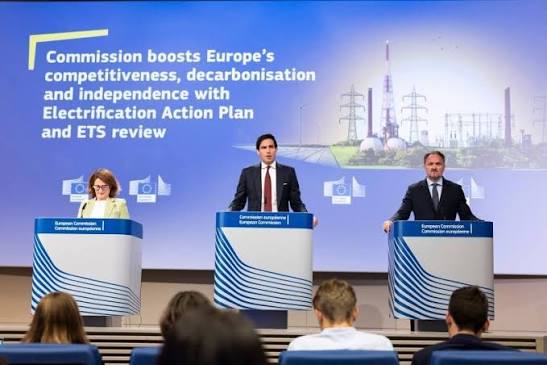
Enviro News Asia, Brussels – The European Commission has introduced a comprehensive Electrification Action Plan alongside a major review of the European Union Emissions Trading System (EU ETS) to accelerate industrial decarbonisation, strengthen Europe’s energy independence, and enhance economic competitiveness.
The package aims to reduce the European Union’s dependence on imported fossil fuels by accelerating the use of electricity across industry, transport, and buildings. Although around 70% of the EU’s electricity is now generated from domestic clean energy sources, the electrification rate of overall energy demand has remained at 23% over the past decade.
As part of the initiative, the Commission will assess an indicative electrification target of 46% by 2040 within the post-2030 Energy Union framework. Achieving this target could reduce the EU’s annual fossil fuel import bill by approximately €260 billion by 2040 while improving energy security, lowering energy costs, and increasing industrial competitiveness.
European Commission President Ursula von der Leyen said electrification represents the most effective pathway toward reducing Europe’s dependence on imported fossil fuels while supporting economic resilience.
“The best way to reduce Europe’s fossil energy dependency is to power our economy with electricity from clean, homegrown sources. Today we are proposing to make Europe the world’s first electro-powered continent,” she said.
Alongside the Electrification Action Plan, the Commission proposed reforms to the EU ETS to align the carbon market with the bloc’s 2040 climate objectives while maintaining support for industrial competitiveness.
The revised ETS introduces a more gradual emissions reduction pathway by adjusting the Linear Reduction Factor to 3.7% during 2031–2035 and 1.7% for 2036–2040. It also allows up to 2% of high-quality international carbon credits during 2036–2040 to provide additional flexibility for hard-to-abate sectors.
A central component of the reform is the establishment of a €100 billion Industrial Decarbonisation Bank to finance large-scale industrial decarbonisation projects across Europe. Before 2030, the ETS Investment Booster will serve as the bank’s first implementation phase, while the Innovation Fund will continue supporting commercial deployment of clean technologies.
The Commission also proposes that Member States allocate at least 50% of national ETS revenues to investments supporting decarbonisation in ETS-covered sectors, generating more than €100 billion in climate-related investments before 2030.
Free emission allowances for industries will continue beyond 2030 but will become increasingly linked to investments in decarbonisation within Europe. The proposal also integrates permanent carbon removals into the ETS, creating additional compliance flexibility while encouraging the deployment of carbon removal technologies.
Additional reforms include strengthening the Market Stability Reserve to improve market predictability and reduce price volatility, extending the ETS to waste incineration, and reinforcing emissions regulations for the aviation and maritime sectors.
To encourage electrification, the Action Plan addresses one of the largest barriers facing consumers and businesses—the price difference between electricity and fossil fuels.
The Commission proposes allowing Member States to reduce electricity network charges for selected consumer groups and lower electricity-related taxes for energy-intensive industries. It also seeks to accelerate the deployment of smart meters, enabling consumers to better manage energy consumption and reduce electricity bills.
The plan further promotes wider adoption of clean technologies, including electric vehicles, heat pumps, batteries, and electric industrial equipment. According to the Commission, battery electric vehicles can reduce driving costs by up to 78% compared with conventional fossil-fuel vehicles, while replacing gas boilers with heat pumps can lower household heating expenses by as much as 60%.
Recognizing that electricity infrastructure remains a critical challenge, the Commission emphasized the importance of rapidly expanding electricity grids and accelerating grid connection procedures. It called for swift adoption of the EU Grids Package proposed in 2025 to support large-scale electrification across the continent.
Beyond infrastructure investment, the Electrification Action Plan also focuses on strengthening clean technology manufacturing, promoting investment-ready projects, expanding workforce skills, and creating hundreds of thousands of new jobs linked to Europe’s clean energy transition.
The Commission said the combined policy package is designed to position Europe as a global leader in clean industrial development while supporting long-term economic growth, energy resilience, and climate neutrality. (*)