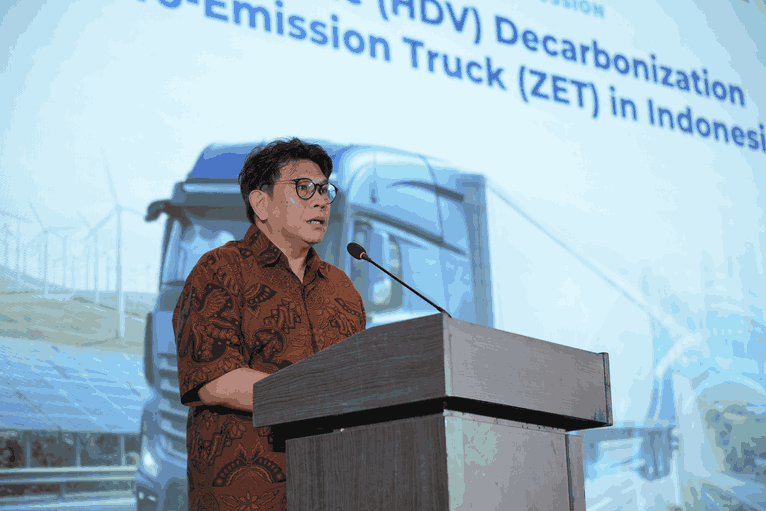
Enviro News Asia, Jakarta – The Institute for Essential Services Reform (IESR), with support from Transport & Environment (T&E) Asia Pacific, launched a study titled “Zero Emission Trucks in Indonesia: A Policy and Regulatory Roadmap for Heavy and Medium Duty Freight” on Wednesday (6/17). The study highlights the urgency of decarbonizing freight trucks as a key strategy for reducing transport sector emissions, strengthening national energy resilience, and easing the fiscal burden of fuel subsidies and compensation. It is also the first study on zero emission trucks in Indonesia and a roadmap for achieving decarbonization targets in the freight vehicle sector.
The transport sector is Indonesia’s third-largest source of energy sector emissions. In 2024, emissions from this sector reached 168 MtCO2e, roughly 25 percent of total national emissions, growing at an average rate of 1.56 percent per year. Road transport dominates transport sector emissions, accounting for around 88 percent or 148 MtCO2e.
IESR Chief Executive Officer Fabby Tumiwa noted that within the road transport category, trucks represent only around 4 percent of the national vehicle fleet but generate 31 percent of road transport emissions, or approximately 42.61 MtCO2e, equivalent to 28.8 percent of the entire transport sector’s carbon footprint. The largest contributors are medium-duty vehicles at 51 percent and heavy-duty vehicles at 13 percent of total freight emissions.
“Decarbonizing freight trucks needs to be a priority in Indonesia’s energy transition agenda given its enormous impact on economic competitiveness and national energy independence. Despite representing a relatively small share of the total vehicle fleet, trucks carry a disproportionately large emissions footprint while serving as the backbone of national logistics. Without strong policy intervention, growth in logistics activity will continue to drive up fossil fuel consumption, emissions, and the fuel subsidy burden,” Fabby said.
IESR’s modeling shows that a scenario of 100 percent zero emission truck (ZET) adoption by 2060 could reduce final energy demand by 78 percent compared to a business-as-usual scenario and cut tailpipe emissions by up to 99 percent. Electric trucks are 62 to 87 percent more efficient than diesel trucks, replacing consumption of 207.5 MMBOE of liquid fuel with just 29.2 MMBOE of electricity. The shift to grid electricity would also allow automatic integration with a power system planned to become increasingly low-carbon.
Reza Hertantyo, Acting Head of the Center for Sustainable Transportation Management (PPTB) at the Ministry of Transportation, said the ministry is preparing a Decarbonization and Energy Transition Roadmap for the Transport Sector as an initial step to guide action and strategy toward sustainable transportation.
Reza added that transport sector policy will also be directed through the implementation of Euro 4 emission standards, biodiesel program development, accelerated electrification of commercial vehicles, and the implementation of a Zero Over Dimension Over Loading (Zero ODOL) policy.
“This roadmap will contain emission baselines, targets and potential emission reductions, energy mix projections, and transport decarbonization strategies that can serve as a reference for stakeholders in accelerating the transition to a cleaner and more competitive transportation system,” Reza said.
IESR Head of Transition Policy and Decarbonization Ilham Rizqian Fahreza Surya warned that continued reliance on fuel oil will compound Indonesia’s fiscal and energy security risks, noting that the country’s fuel imports reached US$25.9 billion in 2024.
The IESR study estimates that each electric truck in operation could avoid around Rp 21 million per year in subsidy and compensation burdens by 2030, rising to around Rp 50 million per unit per year by 2060. Applied across a national fleet of 7.6 million zero emission trucks, potential fiscal savings could reach Rp 650 trillion per year by 2060, with cumulative savings of around Rp 5,000 trillion over the 2025–2060 period.
“The transition to zero emission trucks is not only relevant from an environmental standpoint but also from an economic and fiscal one. Truck electrification can help Indonesia reduce its dependence on diesel, dampen exposure to global oil price fluctuations, and open up greater fiscal space for development,” Ilham said.
IESR identified three policy recommendations Indonesia needs to pursue to accelerate ZET adoption. First, the implementation of fuel efficiency standards rising by at least 10 percent annually, aimed at reducing exhaust emissions and improving fuel consumption efficiency across the operating truck fleet through fleet-average energy consumption limits per manufacturer per period. Second, Indonesia needs to push original equipment manufacturers already operating in the country to bring ZET models already marketed abroad to the domestic market, including potentially reactivating a zero percent import duty incentive previously applied to imported completely built-up passenger electric vehicles and extending it to the ZET segment, coupled with ecosystem development obligations including charging infrastructure investment. Third, the construction of charging stations every 100 kilometers along major national road corridors is essential as an enabling condition for ZET adoption, with initial 2030 needs requiring 230 kW chargers at 27 indicative locations across Java and Sumatra, potentially generating a simultaneous peak load of 16.9 MW as a basis for prioritizing grid reinforcement.
IESR also noted that financial instrument reform remains key to accelerating ZET adoption, calling on the government and financial institutions to develop low-interest leasing schemes, battery-swapping models, and longer financing tenors to reduce operators’ upfront investment burden. With the right policies, electrifying freight trucks can serve as a strategic step to strengthen national logistics competitiveness, reduce air pollution, cut greenhouse gas emissions, and accelerate Indonesia’s energy transition targets. (*)