

Enviro News Asia, Jakarta — Indonesia recorded 100 high-confidence fire hotspots nationwide, with Central Kalimantan, Jambi, and West Kalimantan becoming the main focus of forest and land fire response efforts, according to the Ministry of Forestry.
Data from the ministry’s SiPongi monitoring system showed that the figure was recorded as of 9 p.m. Western Indonesia Time (WIB) on Sunday, November 1, 2026. The total represented a slight increase of four hotspots from the 96 recorded a day earlier.
Across the six priority provinces for forest and land fire control, the number of high-confidence hotspots rose from 19 to 34. Central Kalimantan recorded 19 hotspots, followed by Jambi with 10 and West Kalimantan with five. South Sumatra, South Kalimantan, and Riau reported no high-confidence hotspots.
The Ministry of Forestry emphasized that hotspot fluctuations must be assessed alongside actual conditions on the ground. Hotspots indicate surface temperature anomalies detected by NASA’s Terra/Aqua, SNPP, and NOAA-20 satellites. They cannot be directly equated with the number of fire incidents or the total area burned. All indications are subject to verification through patrols and ground checks.
A report from the Ministry of Forestry’s Forest Fire Control Command Post dated November 1 showed that firefighting operations were continuing at several locations.
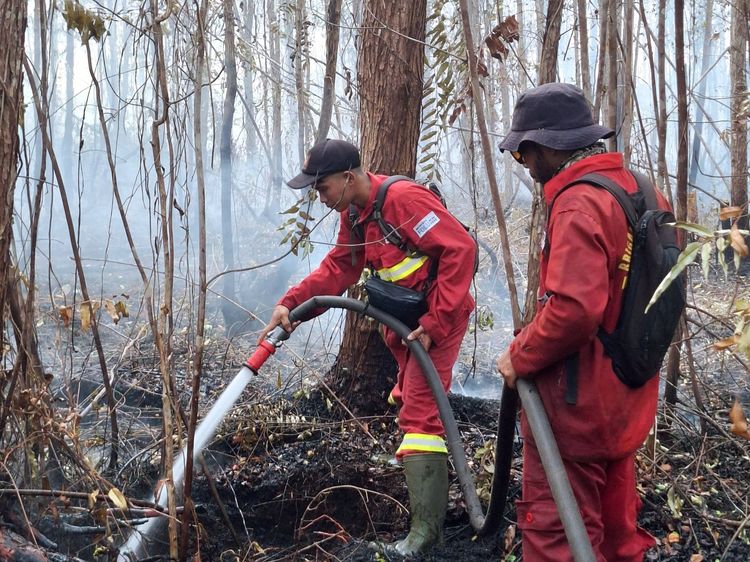
In Central Kalimantan, Manggala Agni firefighting teams were still working to extinguish fires at several sites in Pulang Pisau and Palangka Raya. In Sakakajang, the fire had not been completely extinguished, while numerous smoke plumes remained in peatland areas in Tanjung Taruna, requiring further firefighting operations.
At Tanjung Puting National Park, specifically in the Sei Sekonyer–Tanjung Harapan area, teams were also continuing to tackle underground fires in peatland. Similar conditions were reported in Sei Hambawang, Pulang Pisau, where several smoke spots remained. Meanwhile, the fire at Sungai Koran in Sebangau National Park had been declared extinguished following sustained firefighting operations.
In Jambi, conditions at several locations showed positive developments. Fires in Kilangan Village, Batang Hari, and Sepunggur Village, Bungo, had been declared extinguished following joint operations involving Manggala Agni teams, local governments, the National Police, and local communities.
In West Kalimantan, firefighting operations in Air Hitam Besar Village, Kendawangan District, Ketapang Regency, were continuing because embers remained in the peatland area. The operation involved Manggala Agni teams, Forestry Law Enforcement officials, the Indonesian Military, and the National Police.
Efforts to strengthen fire control in Central Kalimantan were also being directly supervised by Forestry Minister Raja Juli Antoni. During a working visit, the minister inspected a firebreak in Paring Lahung Village, North Barito Regency. The firebreak was constructed to prevent the spread of fires and protect the habitat of Bornean orangutans.
The firebreak was built through cooperation among Manggala Agni teams, the Regional Disaster Management Agency (BPBD), local firefighting units, communities, and other relevant parties after repeated firefighting efforts faced the risk of fires reigniting.
The minister had previously granted limited permission for the use of heavy equipment to help construct firebreaks in emergency situations, stressing that such equipment could only be used for fire-control purposes. He also instructed personnel to continue safeguarding the area to ensure that the firebreaks effectively protect the forest and wildlife habitat.
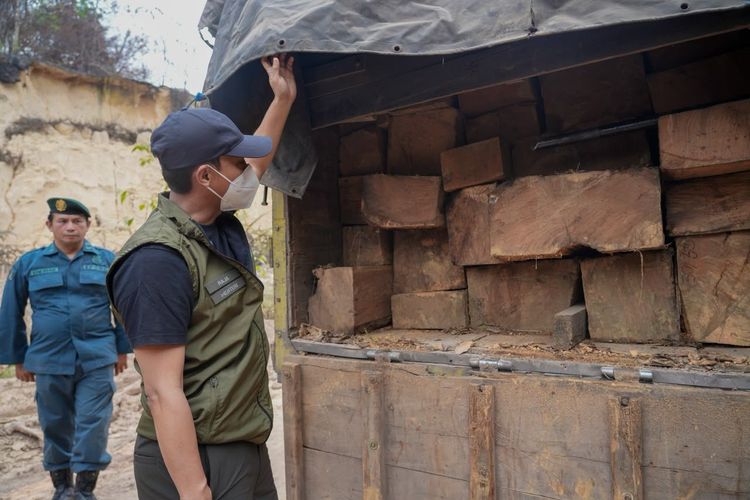
In addition to firefighting, the ministry has strengthened area security and law enforcement following forest and land fires. During a road trip to inspect fire-affected locations in Central Kalimantan, the minister and officials from the Directorate General of Forestry Law Enforcement discovered piles of logs suspected to have originated from illegal activities.
The site was subsequently secured for further investigation. Officers also inspected two trucks carrying timber and heavy equipment found within the forest area.
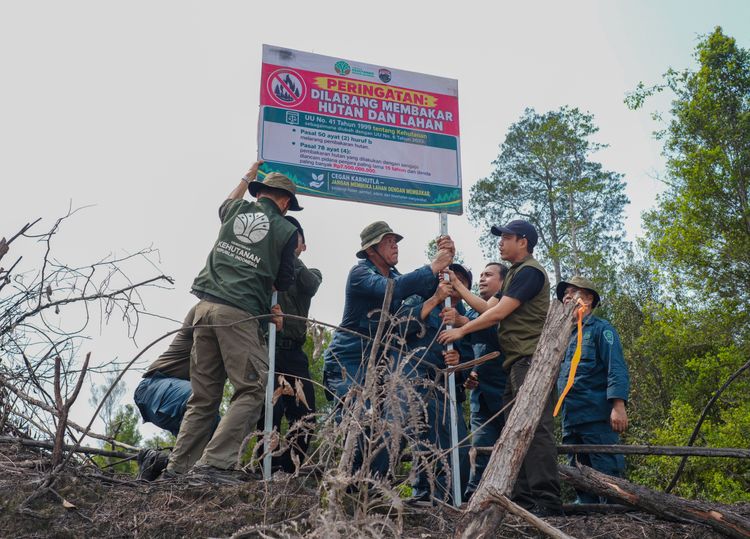
During inspections of previously burned areas, ministry officials also conducted drone monitoring, installed signs prohibiting unauthorized activities, and examined activities found in the field. The minister stressed that areas affected by fires must not subsequently be used for illegal activities or unlawfully occupied.
These measures form part of a comprehensive forest and land fire management strategy: extinguishing flames, eliminating remaining embers, securing affected areas, investigating the causes of fires, and pursuing legal action against violations.
Manggala Agni teams, together with the National Disaster Management Agency (BNPB), the Indonesian Military, the National Police, the Meteorology, Climatology, and Geophysics Agency (BMKG), regional disaster management agencies, local governments, Fire Awareness Communities, businesses, volunteers, and other stakeholders, continue to conduct patrols, ground checks, firefighting, wetting operations, ember searches, mopping-up activities, and cooling operations based on actual field conditions.
The Ministry of Forestry emphasized that the success of forest and land fire control should not be measured solely by increases or decreases in hotspot numbers. The key priorities are ensuring that fires and embers are completely extinguished, preventing fires from recurring, protecting communities and wildlife habitats, safeguarding burned areas, and following up on every indication of legal violations in accordance with applicable regulations. (*)