

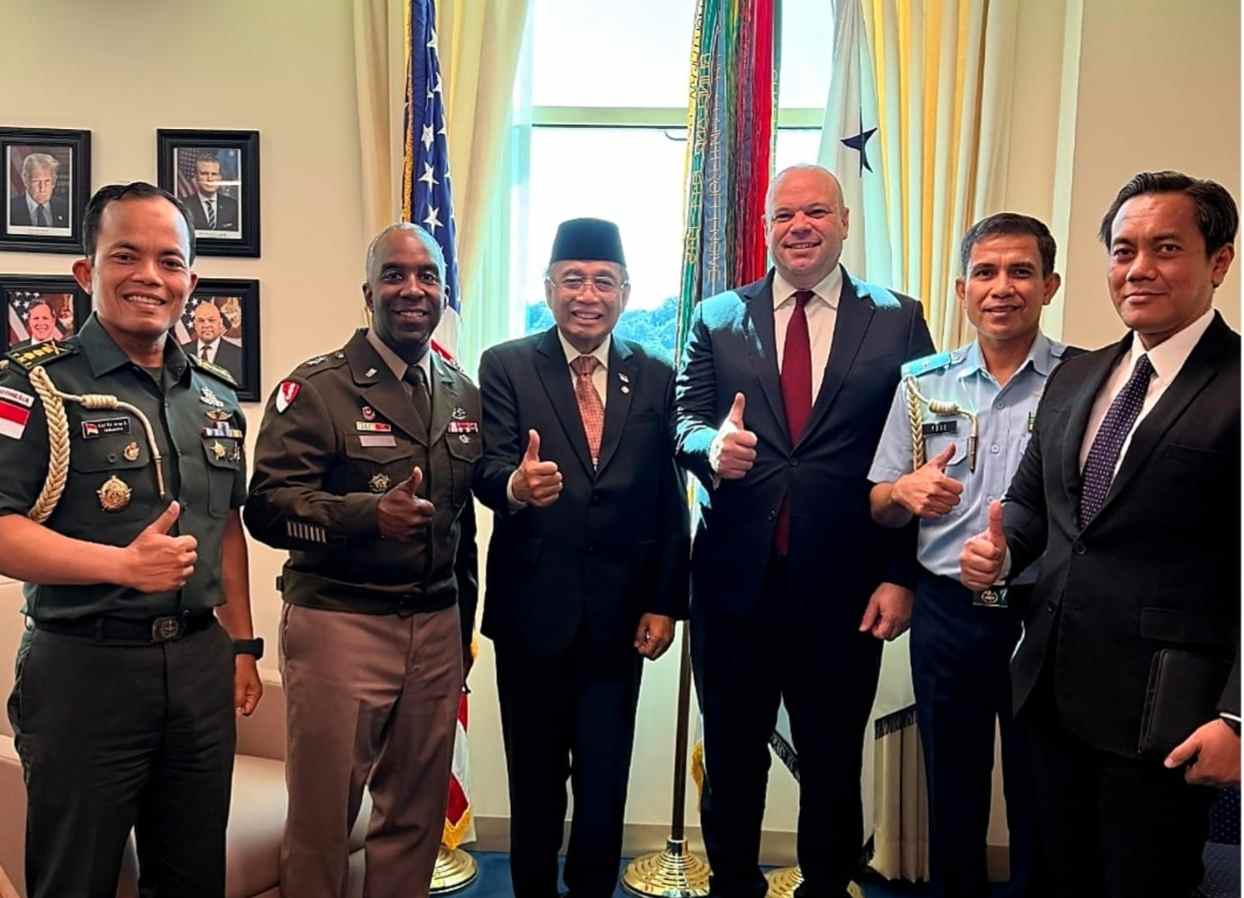
Enviro News Asia, Washington, D.C. – Indonesia and the United States are exploring expanded cooperation in military engineering to strengthen disaster preparedness and resilient infrastructure development following a meeting between Indonesian Ambassador to the United States Indroyono Soesilo and U.S. Assistant Secretary of the Army Adam M. Telle at the Pentagon on July 23.
The meeting followed discussions between Indonesian Defense Minister Sjafrie Sjamsoeddin and U.S. Secretary of the Army Daniel Driscoll in April 2026, reaffirming that bilateral defense cooperation extends beyond military exercises to include humanitarian assistance and disaster response.
Ambassador Indroyono was accompanied by Indonesia’s Defense Attaché to the United States, Air Vice Marshal Yose Ridha, Army Attaché Colonel Tri Arto Subagio, and Political Coordinator at the Indonesian Embassy in Washington, D.C., Fahmi Alli Sarosa. Telle was joined by Major General Jason Kelly, Deputy Commanding General of the U.S. Army Corps of Engineers (USACE).
As one of the world’s most disaster-prone countries located along the Pacific Ring of Fire, Indonesia regularly faces earthquakes, tsunamis, floods, landslides, and volcanic eruptions. Rapid restoration of damaged infrastructure has become a critical component of effective disaster response and community recovery.
The U.S. Army Corps of Engineers is internationally recognized for its expertise in designing, constructing, and restoring critical infrastructure, including ports, dams, bridges, and other essential public facilities that support emergency operations and post-disaster recovery.
Indonesia and USACE have previously collaborated through the Pacific Resilience and Disaster Response Exercise & Exchange (DREE) held in 2013 at the Indonesian Peacekeeping Mission Center in Sentul, West Java. The exercise involved USACE, U.S. Army Pacific, the Indonesian National Armed Forces (TNI), the National Disaster Management Agency (BNPB), USAID, and other partners.
The joint exercise focused on assessing critical infrastructure, conducting land and water search-and-rescue operations, and improving procedures for receiving and coordinating international humanitarian assistance during emergencies.
The experience demonstrated the importance of strengthening disaster preparedness through technical planning, joint training, and resilient infrastructure rather than relying solely on emergency response after disasters occur.
One of the most promising areas for future collaboration is bridge construction and rapid infrastructure recovery. Indonesia has thousands of bridges located in flood-, earthquake-, and landslide-prone regions, where damage can disrupt transportation, education, healthcare access, and the distribution of essential goods.
USACE’s expertise in modular bridge systems and emergency infrastructure restoration could support Indonesia’s efforts to restore connectivity more quickly following natural disasters.
Military engineering cooperation could also be expanded through joint activities under exercises such as Super Garuda Shield, where Indonesian and U.S. engineers work together on construction projects, facility renovations, and the development of community infrastructure that can also function as emergency shelters.
The article proposes the development of a “Disaster-Resilient Bridge” initiative that combines USACE’s modular bridge technology with local engineering innovations from Indonesia’s Ministry of Public Works and Housing, the Indonesian Army Corps of Engineers, the National Research and Innovation Agency (BRIN), and Indonesian universities.
Such collaboration could help accelerate emergency access restoration while strengthening Indonesia’s long-term disaster resilience.
Beyond bridge construction, future cooperation may also include training on emergency route clearance, river embankment engineering, and the development of smarter urban drainage systems to reduce disaster risks.
The initiative underscores that military engineering cooperation between Indonesia and the United States is increasingly focused on humanitarian resilience, ensuring that communities can rapidly regain access to schools, hospitals, markets, and essential public services after disasters.