Enviro News Asia, Jakarta — Indonesia’s Minister of Environment and Head of the Environmental Control Agency (KLH/BPLH), Moh Jumhur Hidayat, called on all sectors of society to strengthen the Ecological Repentance movement through concrete and measurable actions to restore the environment while supporting sustainable economic growth.
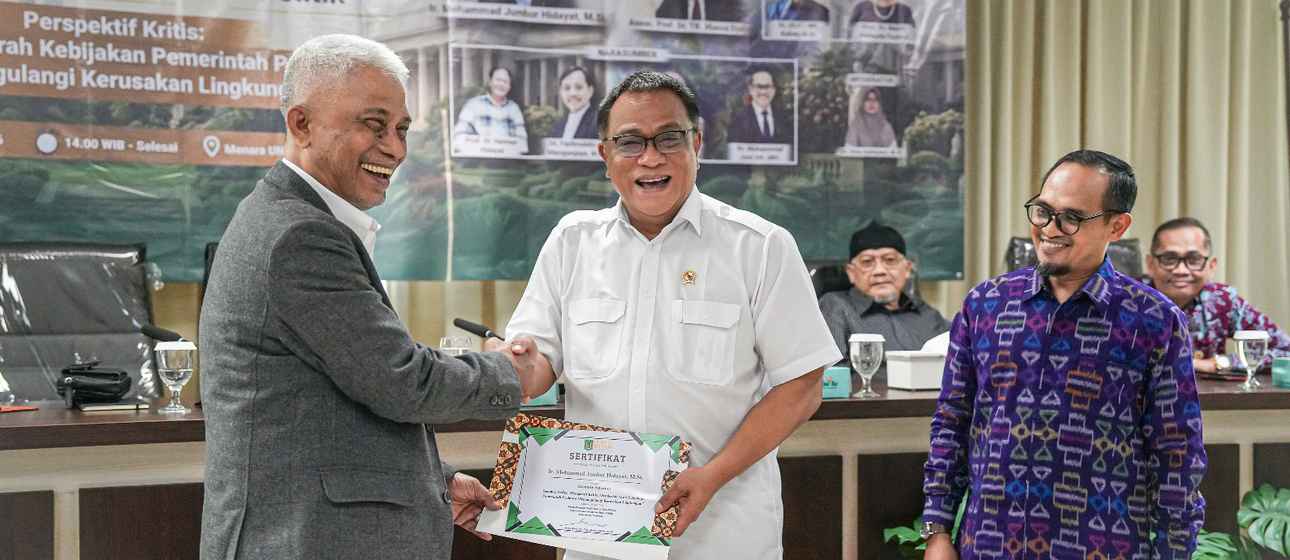
Speaking as the keynote speaker at the National Seminar of the Doctoral Program in Political Science at Universitas Nasional in Jakarta, Jumhur said environmental restoration should not only focus on reversing ecological degradation but also create opportunities for green investment, generate green jobs, and contribute to long-term economic development.
He emphasized that environmental issues are a shared responsibility involving the government, businesses, communities, and individuals. According to him, practical actions such as tree planting, river restoration, pollution control, and promoting responsible waste management must be carried out in a structured, coordinated, and sustainable manner.
Jumhur stressed that economic development and environmental protection should complement rather than compete with one another. National strategic priorities, including industrial development, downstream processing, food security, and energy security, must be implemented while respecting environmental carrying capacity and sustainability principles.
He said the approach aligns with President Prabowo Subianto’s Asta Cita development agenda, which promotes economic resilience, national self-reliance, sustainable development, and responsible natural resource management to improve public welfare.
Indonesia continues to face major environmental challenges, including water, air, and soil pollution, inadequate waste management, degradation of peatlands and mangrove ecosystems, declining watershed conditions, biodiversity loss, and the impacts of climate change. These issues threaten ecosystems as well as national food and energy security.
To address these challenges, the Ministry is implementing three strategic priorities: strengthening environmental supervision and law enforcement, introducing innovative policy solutions, and accelerating environmental restoration. The initiatives include stricter compliance monitoring, preventive environmental measures, enforcement of sanctions, and stronger collaboration with government institutions, regional administrations, academia, businesses, and local communities.
Jumhur also highlighted the economic value of environmental restoration, noting that activities such as bamboo planting and land rehabilitation can generate verified emission reductions eligible for domestic and international carbon markets. He reaffirmed the polluter pays principle, under which those responsible for environmental damage must finance restoration efforts.
He further encouraged universities and students to play a greater role in environmental recovery through research, scientific recommendations, constructive criticism, and evidence-based policy support.
According to Jumhur, the green economy approach positions environmental restoration as a core component of Indonesia’s national development strategy. The transition is expected to create added economic value, expand green employment opportunities, strengthen food and energy security, and ensure that development benefits are shared broadly across society.
The Minister concluded by reaffirming that the government will continue supporting businesses and regional governments committed to environmental compliance and innovation while taking firm legal action against parties responsible for environmental violations and ecological harm. (*)