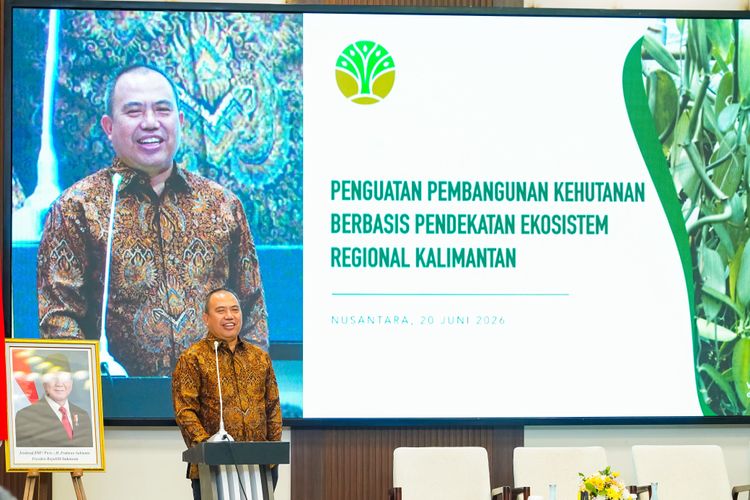
Enviro News Asia, Nusantara – The Ministry of Forestry has continued to reinforce an ecosystem-based approach to forestry development as a strategy for preserving forests while driving sustainable regional economic growth. The commitment was reaffirmed at the 2026 Kalimantan Regional Forestry Development Coordination Meeting held in Nusantara, East Kalimantan, on Saturday (6/20).
Ministry of Forestry Secretary General Mahfudz said forestry development can no longer be carried out in a purely sectoral or administrative manner but must instead be grounded in territorial characteristics and ecosystem approaches.
“The Kalimantan region holds a highly strategic position as one of the last strongholds of Indonesia’s tropical forests. That is why forestry development must be capable of maintaining the ecological functions of the forest while also delivering social and economic benefits for communities,” Mahfudz said.
The Ministry of Forestry currently manages around 125 million hectares of forest area comprising protected forests, production forests, and conservation forests. In its management, a new governance paradigm combining land-sparing and land-sharing approaches is being applied, aimed at ensuring areas of high ecological value remain protected while opening space for sustainable forest utilization through social forestry, multi-business forestry, environmental services, carbon trading, and green investment.
In line with the national development theme for 2027, “Accelerating Quality Growth through Productivity, Investment, and Industry,” forestry development carries the theme “Strengthening Ecosystem-Based Forest Governance to Support Sustainable Regional Economic Growth.”
Through this approach, the forestry sector is targeted to contribute to greenhouse gas emission reductions of more than 115 million tonnes of CO2 equivalent, while strengthening the welfare of communities around forests and increasing the added value and downstream processing of forest products on a sustainable basis.
The Secretary General also stressed the importance of strengthening three pillars of territory-based forestry development synergy, namely institutional governance strengthening, ecosystem-based regional development, and acceleration of national programs.
“The success of forestry development is very much determined by our ability to integrate policies, data, programs, and funding at the regional level. The synergy we build must produce real impact for communities and the environment,” he said.
The Ministry of Forestry is also continuing to strengthen governance transformation through digital technology, including through the launch of the Jaga Rimba Decision Support System (DSS), which serves as an instrument for integrating data across work units and geospatial information to support faster, more accurate, and more transparent policy decisions.
Closing his remarks, the Secretary General called on all Technical Implementation Units (UPT) in the Kalimantan region to strengthen collaboration and program integration in the field.
“The lifeblood of forestry development lies at the field level. There is no conservation without synergy, and no success without real collaboration on the ground,” he concluded. (*)