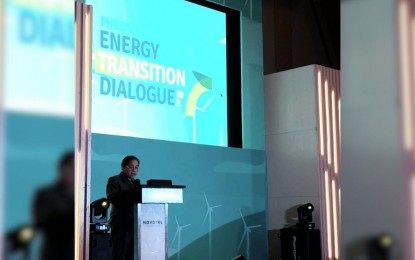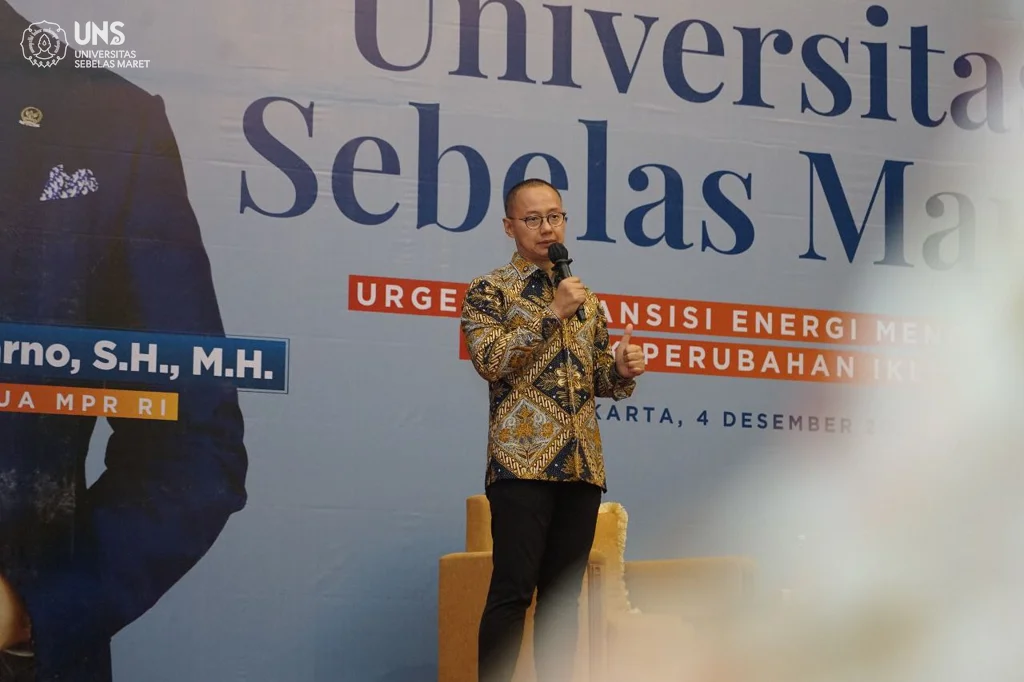
Enviro News Asia, Surakarta — Universitas Sebelas Maret (UNS) hosted the MPR RI Goes To Campus program on Thursday (4/12/2025) at the G.P.H. Haryo Mataram Auditorium. The session, held under the theme “The Urgency of Energy Transition to Prevent Climate Change Impacts,” featured Deputy Speaker of the People’s Consultative Assembly (MPR RI) Dr. Eddy Soeparno, who was welcomed by UNS Vice Rector for Planning, Cooperation, Internationalization, and Information, Prof. Irwan Trinugroho.
Dr. Eddy explained that the Prabowo–Gibran administration has set a national economic growth target of up to 8 percent, which will significantly increase energy demand. He stated that Indonesia must boost energy supply while addressing environmental concerns. The country’s renewable-energy mix remains at approximately 14 percent—far below the 23 percent target set for 2025. He warned that failure to accelerate the energy transition will leave Indonesia behind other nations advancing toward clean energy.
He added that Indonesia faces major challenges in energy security. Although endowed with abundant renewable resources such as geothermal, solar, and wind energy, Indonesia continues to rely heavily on imported fossil fuels. This dependence makes national energy resilience vulnerable to global market fluctuations.
Dr. Eddy urged the government to prioritize energy-security measures to reduce reliance on imports. He emphasized that Indonesia has the potential to achieve energy independence by accelerating the development of domestic renewable resources. “Energy security is the foundation of national resilience. Continued dependence on imports will keep us exposed to external shocks,” he said.
Prof. Irwan Trinugroho welcomed the MPR RI delegation and stated that the seminar aligns with ongoing national and global sustainability challenges. He reaffirmed UNS’s commitment to becoming a sustainable campus. UNS is the only Indonesian university with a Subdirectorate for Green Campus and Sustainable Development Goals (SDGs). It also houses the Center for Environmental Studies (PSLH), the Center for Energy Policy and Law Studies, and the Center of Excellence for Electrical Energy Storage Technology (TPEL), all of which focus on advancing research and innovation in future energy systems.
In the academic sphere, UNS strengthens its curriculum by offering the Environmental Science study program and integrating environmental and sustainability topics across multiple disciplines. Through institutional initiatives, research development, and academic programs, UNS continues to contribute to sustainable development at local, national, and global levels. (*)