Enviro News Asia, Jakarta – The National Forestry Symposium, serving as the culmination of the International Forestry Students’ Symposium (IFSS) 2025, was officially held at the Manggala Wanabakti Building, Jakarta, on Tuesday (August 19, 2025).
Carrying the overarching theme “Green Heroes: Achieving Net Zero Emission for Sustainable Forestry”, the event brought together more than 300 participants from 21 countries, consisting of government representatives, the private sector, academia, civil society organizations, and aspiring global forestry professionals.
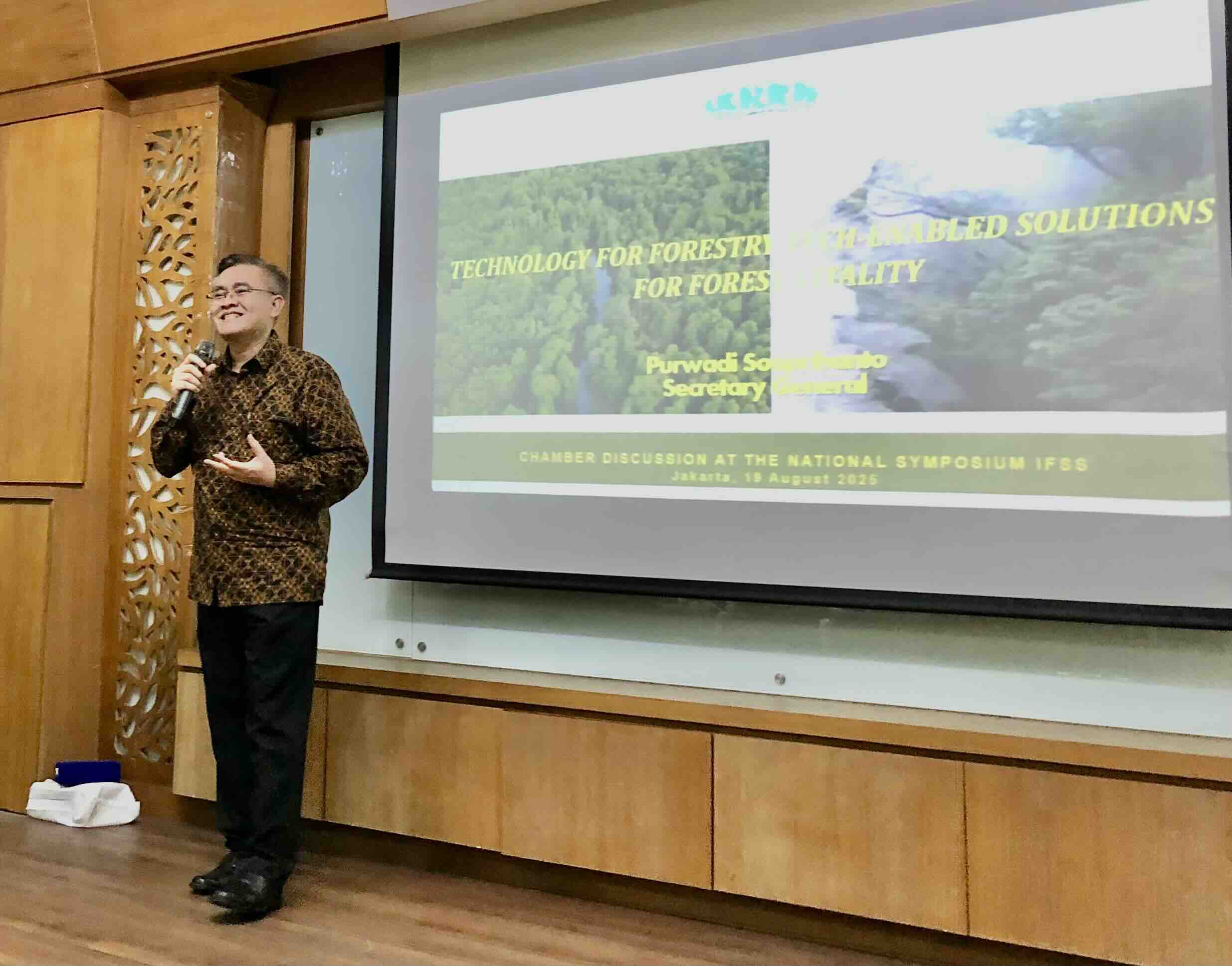
As part of the agenda, Chamber Discussion II was held with a focus on “Technology for Forestry: Tech-Enabled Solutions for Forest Vitality.”
This session highlighted how digital innovation and precision technology can support the achievement of Net Zero Emission targets while at the same time opening new sustainability-based economic opportunities.
The Secretary General of the Indonesian Forest Concessionaires Association (APHI), Ir. Purwadi Soeprihanto, M.E., IPU., in his presentation emphasized that the use of technology is a crucial instrument in improving forest governance and emission mitigation.
“Indonesia targets emission reductions of up to 31 percent unconditionally and 43 percent with international support by 2030. The national forest monitoring technology serves as a major umbrella that underpins the achievement of these ambitious targets,” he stated.
Purwadi cited the use of high-resolution satellite imagery, digital forest inventory systems, and timber tracking now integrated with the Timber Legality Verification System (SVLK) and geolocation.
“With this system, the entire timber supply chain—from standing trees in the forest to industry and export markets—can be transparently traced. This is particularly crucial in responding to the European Union’s deforestation-related regulations,” he explained.
In addition, he stressed the importance of collaboration between the private sector and local communities, social forestry groups, and young innovators. According to him, technology can unlock multi-forestry business opportunities not only based on timber but also on non-timber forest products and ecosystem services.
“The transformation of the paradigm from relying solely on timber to diversifying forestry businesses is a necessity. Technology can serve as a bridge connecting companies, communities, and global markets,” he elaborated.
Purwadi concluded his presentation with a call to build a more inclusive and sustainable forestry business ecosystem.
“Cross-sector collaboration and the courage to invest in technology will determine whether we can safeguard forest vitality while also generating tangible economic benefits for communities and younger generations,” he emphasized.