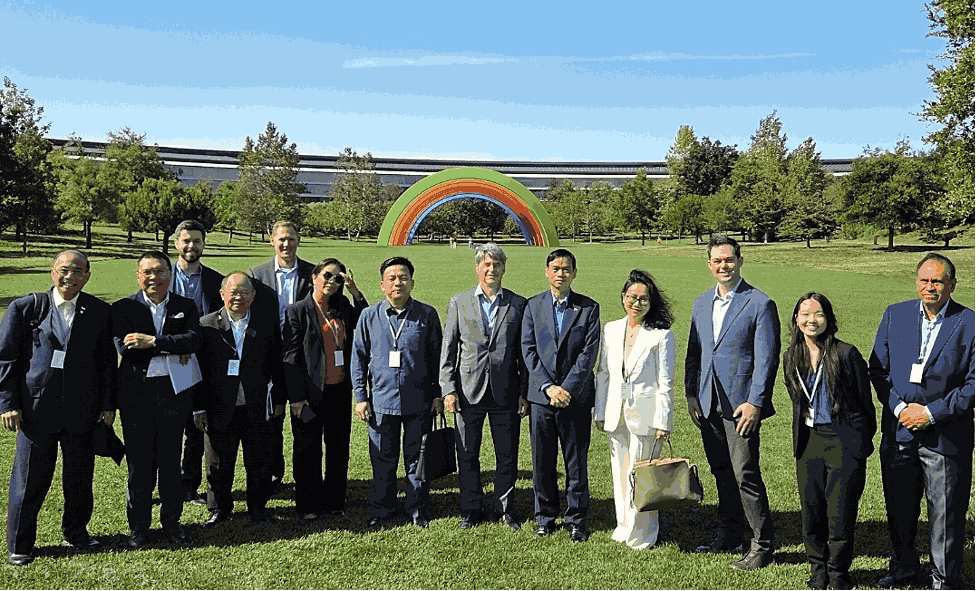
Enviro News Asia, Texas — Five undergraduate students from the University of Indonesia (UI) have demonstrated that academic level and age are not barriers to competing on the international geoscience stage. Representing the Faculty of Mathematics and Natural Sciences (FMIPA UI), Team Kenanga was invited to present its scientific work at the International Meeting for Applied Geoscience and Energy (IMAGE) 2026 in Houston, Texas, United States.
Held from August 17–20, 2026, at the George R. Brown Convention Center, IMAGE 2026 was organized by three leading international organizations: the Society of Exploration Geophysicists (SEG), the American Association of Petroleum Geologists (AAPG), and the Society for Sedimentary Geology (SEPM).
The invitation followed Team Kenanga’s intensive participation in SEG EVOLVE, a six-month professional development and geoscience training program organized by SEG in the United States. The team consists of five 2022 undergraduate students from UI’s Geology and Geophysics programs: Ellysa Dinda Nathasya and Michael Partogi from Geophysics, as well as Hishnu Ghaitsul Hudna, Luthfan Zaidan Akbar, and Muhammad Fairuz Ulya from Geology. They were accompanied by Anne M. M. Sirait, Ph.D., as the faculty adviser from the Geology and Geophysics program.
What makes the achievement particularly significant is that Team Kenanga was the first and only team in the SEG EVOLVE program consisting entirely of undergraduate students. Most participants in the program are postgraduate students from geoscience, engineering, and related disciplines.
SEG EVOLVE is designed to replicate the professional working environment of the energy industry rather than function as a conventional competition. Participants are required to work as teams, analyze real-world data, consult professional mentors, develop exploration strategies, and present their findings in a manner comparable to professional industry presentations.
The program offers two main tracks: the Energy Exploration Program, which focuses on the exploration and evaluation of oil, gas, and geothermal resources, and the Carbon Solutions Program, which addresses carbon capture, utilization, and storage (CCUS).
Team Kenanga participated in the Energy Exploration track and was tasked with evaluating hydrocarbon prospects using real-world data from the Eugene Island area in the southern Gulf of Mexico. Working alongside industry professionals from various countries, the students examined regional geological conditions, analyzed rock characteristics, interpreted seismic data, estimated potential reserves, and assessed the economic feasibility of energy prospects.
The project required the students to integrate multiple datasets to develop scientifically sound and commercially relevant assessments. They also worked with professional software commonly used in the global energy industry, including SLB, Petrel, Kingdom, DecisionSpace, Paleoscan, and RoseRA.
Team Kenanga presented its final project on June 2, 2026. The quality of their work subsequently earned them a special invitation to bring their project to IMAGE 2026 in Houston.
The program also required a significant commitment beyond academic responsibilities. Team members had to adjust their university schedules to accommodate meetings with mentors and industry professionals based in Houston. With a workload of approximately 10 to 30 hours per week, participants attended weekly mentoring sessions, underwent technical evaluations, and prepared an executive-level final presentation.
Despite the demanding schedule, Team Kenanga completed each stage by dividing responsibilities, combining geological and geophysical expertise, and developing effective communication as an international project team.
Indonesian Ambassador Indroyono Soesilo welcomed the achievement of the FMIPA UI students at the international geoscience forum. He highlighted the significance of their accomplishment given that UI’s Geology and Geophysics programs are relatively young, having developed over approximately the past decade.
The experience, he noted, is valuable in preparing Indonesia’s future workforce for changes in the energy industry, where professionals increasingly need expertise in earth sciences, digital technologies, interdisciplinary collaboration, and sustainable energy transition.
Beyond technical skills such as seismic interpretation and professional software use, SEG EVOLVE exposed the students to the broader workflow of energy exploration. The program therefore provided Team Kenanga with practical experience in multidisciplinary teamwork, international collaboration, and professional decision-making.
The achievement also adds to the growing presence of Indonesian students at international geoscience forums. Earlier, postgraduate students from the Geological Engineering program at Bandung Institute of Technology (ITB) won the Imperial Barrel Award at an AAPG meeting in Houston on August 17, 2026.
Team Kenanga now contributes another notable achievement: five Indonesian undergraduate students successfully entered an international professional development program, worked with real industry data, and presented their work to the global geoscience community.
From university classrooms in Depok to an international conference stage in Houston, Team Kenanga has demonstrated the potential of Indonesia’s young geoscience talent to learn, collaborate, and contribute to the future of the energy sector. (*)