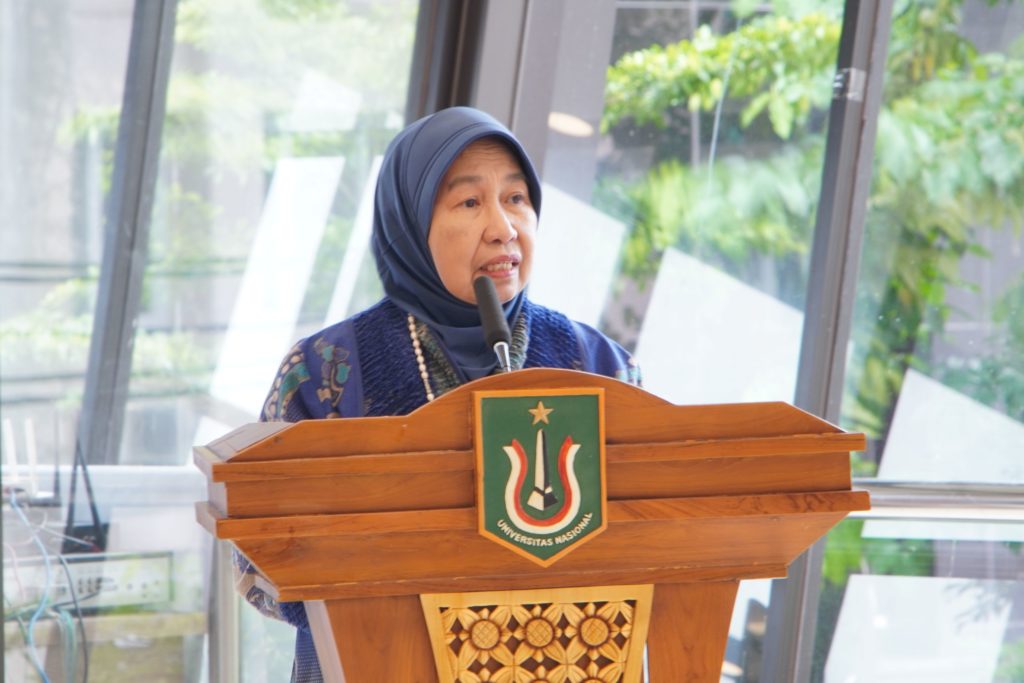
Enviro News Asia, Jakarta — The Centre for National Resilience Studies (PUSTANAS) of Universitas Nasional (UNAS) held an Environmental Resilience Series forum titled Investing Today for the Future: Community- and Environment-Based Independent Village Programme in Jakarta on Wednesday, 21 January.
The event, hosted at the UNAS Pejaten Campus, brought together academics, environmental practitioners, and private sector representatives to discuss sustainable development strategies through Natural Climate Solutions, with a focus on mangrove ecosystem protection and community-based green economic development.
Head of PUSTANAS UNAS, Iskandarsyah Siregar, stated that the forum served not only as a programme introduction but also as a platform for collective reflection on increasingly pressing environmental challenges. He encouraged participants to deepen their understanding of environmental resilience and long-term sustainability.
Vice Rector for Research, Community Service, and Cooperation at UNAS, Ernawati Sinaga, emphasized the importance of collaboration between universities and the private sector to expand the impact of sustainability initiatives. She noted that small-scale initiatives could evolve into broader movements benefiting communities and ecosystems.
President Director of PT Arunika Bumi Lestari, Cynthia Dian Astuti, presented the company’s Natural Climate Solution approach, highlighting mangrove conservation as a strategic pathway to strengthen green economic activities and support food-secure, self-reliant coastal villages.
She explained that mangroves play a critical ecological role in protecting coastlines, preserving biodiversity, and sustaining the livelihoods of coastal communities. Sustainable mangrove management, she added, delivers multiple benefits, including disaster risk reduction and improved community welfare.
Cynthia also outlined the company’s sustainability framework, which focuses on three interconnected pillars—economic, social, and environmental—to build a strong foundation for long-term resilience. The mangrove programme is designed as a long-term initiative aligned with corporate social responsibility strategies.
Through this collaboration, PUSTANAS UNAS and PT Arunika Bumi Lestari reaffirmed that environmental investment represents a long-term strategy for fostering resilient, food-secure, and competitive villages. The Environmental Resilience Series is expected to serve as a starting point for broader cooperation among academia, the private sector, and local communities in addressing climate challenges in Indonesia. (*)