Enviro News Asia, Yogyakarta — Indonesia is preparing a specialized workforce to support the development of its first nuclear power plant (PLTN), with manpower requirements expected to rise sharply as the project moves from development and construction to commissioning and operation.
The National Research and Innovation Agency (BRIN) is mapping workforce requirements for each stage of the nuclear power project as part of efforts to strengthen Indonesia’s readiness for nuclear energy development.
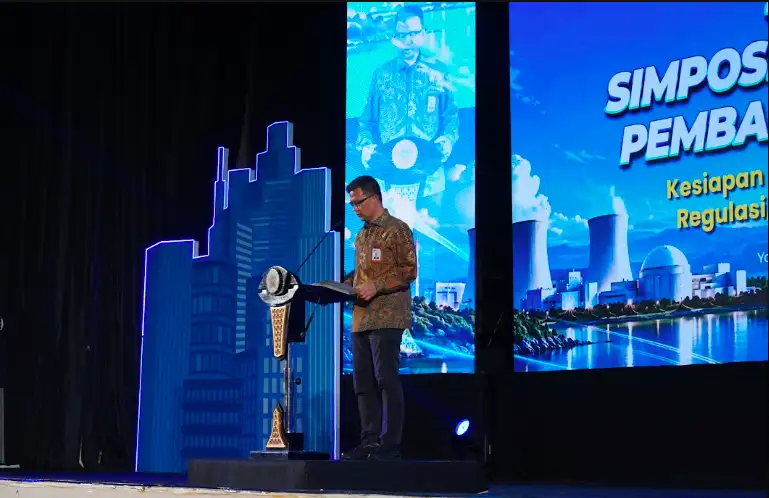
The workforce planning was discussed during the National Symposium on Nuclear Power Plant Development Consolidation in Yogyakarta, organized by a joint committee involving BRIN, state electricity company PT PLN (Persero), and Universitas Gadjah Mada (UGM).
The forum brought together government institutions, regulators, academics and professional associations to consolidate national preparedness, including a nuclear workforce development roadmap and reactor technology assessments.
BRIN Deputy Head Amarulla Octavian said Indonesia already has a foundation of nuclear research, technology and human resources that can support preparations for its first commercial nuclear power plant.
Indonesia’s experience operating three research reactors has provided expertise in nuclear science, isotope production and operator training. The facilities include the G.A. Siwabessy Multipurpose Reactor in Serpong, Banten, the Triga 2000 reactor in Bandung, West Java, and the Kartini Reactor in Yogyakarta.
According to BRIN’s workforce assessment, the number of personnel required will change significantly throughout the project lifecycle.
During the development phase, around 105 personnel are expected to be needed, mainly for feasibility studies, site licensing and basic engineering.
The workforce requirement is projected to increase to approximately 470 personnel during construction. At this stage, expertise will be required in project management, quality assurance and civil and mechanical construction.
The largest workforce requirement is expected during commissioning, when around 870 personnel will be needed. Their responsibilities will include system testing, safety inspections and pre-operational testing.
Once the plant enters commercial operation, approximately 820 personnel are projected to be required for reactor operations, routine maintenance, waste management and radiation protection.
BRIN considers workforce preparedness a critical component of the project’s schedule and risk management because the required expertise must be available at the appropriate stages.
Amarulla said Indonesia therefore needs an integrated nuclear human resources development framework covering education, training, certification and competency development.
Universities are expected to play a major role in preparing the workforce. Nuclear engineering programs at UGM, the Indonesian Nuclear Technology Polytechnic, Institut Teknologi Sepuluh Nopember (ITS), Institut Teknologi Bandung (ITB), and Universitas Negeri Yogyakarta (UNY), along with training institutions such as PLN’s training center, are expected to contribute to standardized education and professional qualification programs.
Universities will also have a broader role in strengthening public understanding of nuclear technology by disseminating objective and science-based information.
Amarulla said nuclear power development should ultimately support a reliable and sustainable supply of electricity for national industries and contribute to public welfare.
He also emphasized the importance of coordination among research institutions, universities, industry and regulators, including the Nuclear Energy Regulatory Agency (BAPETEN).
The collaboration is expected to produce a comprehensive nuclear workforce roadmap while ensuring that Indonesia’s human resources meet the technical, safety and regulatory standards required for the development and operation of a nuclear power plant. (*)