


Enviro News Asia, Jakarta — Forestry and environmental law expert Sadino has called for a review of regulations governing land clearing by burning and more objective law enforcement to address forest and land fires in Indonesia, stressing that investigations must consider the causes of fires and the responsibilities of all parties involved.
Sadino said the review should cover regulations, monitoring and support for local communities to make fire prevention more effective.
He made the remarks during a Forest Insights Indonesia podcast titled “Is Burning Two Hectares of Land Allowed? The Legal Issues Behind Forest and Land Fires.” Hosted by Sugijanto, the discussion also featured Erwansyah, vice chairman of the Indonesian Forestry Entrepreneurs Association (APHI) for legal affairs, public relations and cooperation.
Sadino said monitoring remained challenging because access to forest areas was relatively open and community activities could take place far from residential areas. Regulations prohibiting land burning, he added, therefore needed to be accompanied by approaches that addressed local livelihoods.
He urged local governments, from district and subdistrict administrations to village authorities, to work with businesses to develop alternative livelihoods and promote land-clearing methods that do not involve burning. Such measures would help reduce communities’ dependence on fire as a land management tool.
Sustained public education was also essential, Sadino said, particularly for residents who were not members of Community Fire Care Groups, known as Masyarakat Peduli Api (MPA).
“Education about the dangers of fire must be communicated more extensively,” Sadino said.
He stressed that prevention must take place before a fire breaks out, as flames become increasingly difficult to control once they spread, particularly in windy conditions.
On law enforcement, Sadino called for evidence-based investigations to establish the origin and cause of fires, including the possibility that flames had spread from another location.
“Law enforcement must be more objective,” he said.
Determining legal responsibility, he added, should be based on evidence concerning the source and cause of a fire and each party’s obligations under applicable laws and regulations.
Erwansyah said APHI supported the government’s direction to strengthen the prohibition on land clearing by burning as part of broader efforts to prevent forest and land fires.
He emphasized that companies holding Forest Utilization Business Licences (PBPH) were required to comply with forest management regulations, including obligations to prevent and control fires.
“Companies holding PBPH licences must comply with all forest management requirements, including the prohibition on clearing land by burning. APHI members are committed to implementing good forest governance and strengthening fire prevention and control systems,” Erwansyah said.
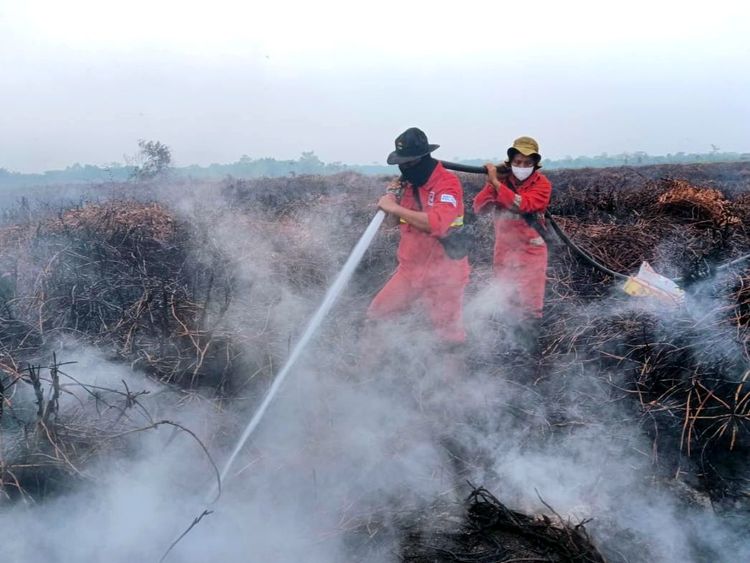
According to Erwansyah, forestry companies had allocated resources for fire management by providing equipment and infrastructure, establishing firefighting teams, monitoring hotspots, conducting patrols and carrying out prevention activities with local communities.
He also noted that companies could be affected by fires originating outside their concessions. Fires that spread into company-managed areas could cause financial losses, environmental damage and disruption to forest management operations.
“Companies can also be victims of fires originating outside their concessions. Cases must therefore be handled objectively by tracing the source of the fire, determining its cause and examining the prevention and control measures already undertaken by the company,” he said.
The presence of a fire within a concession, Erwansyah added, did not automatically establish that the company was responsible. Legal accountability must nevertheless take into account whether the company had fulfilled its fire prevention and control obligations under applicable regulations.
He said companies also contributed to firefighting beyond their concession boundaries by deploying personnel and equipment, providing logistical assistance and coordinating with government agencies and local communities.
“Companies’ contributions to fire management are not limited to protecting their own concessions. They also help tackle fires outside their operating areas as part of their responsibility and concern for public safety and environmental protection,” Erwansyah said.
He called for these contributions to be considered as part of collective fire management efforts and when assessing companies’ obligations in a proportionate manner.
Erwansyah also urged the government to strengthen the institutional framework for fire prevention and suppression to improve coordination and command during operations.
“I believe this institutional framework needs to be followed up through regulations so that command and implementation can become more effective,” he said.
Fire management units have been established at various levels, including forest management units, plantation companies and local governments. However, coordination and command arrangements between these units still need to be clarified, he added.
“Fighting fires separately is not effective. It must be a collective effort,” Erwansyah said.
Although communication among companies, government agencies, village officials and residents had been established, stronger institutional arrangements were needed to coordinate resource deployment and prevent conflicting commands during firefighting operations.
As part of its preparedness measures, APHI has also distributed weather and climate forecasts to member companies to help them anticipate fire risks.
At the forest management unit level, prevention efforts include coordination with village governments and residents, direct public outreach and the installation of signs warning against land burning.
Erwansyah said stronger regulations, institutional arrangements and coordination among stakeholders could improve fire prevention and suppression while providing greater legal certainty for all parties involved in forest management and protection. (*)