

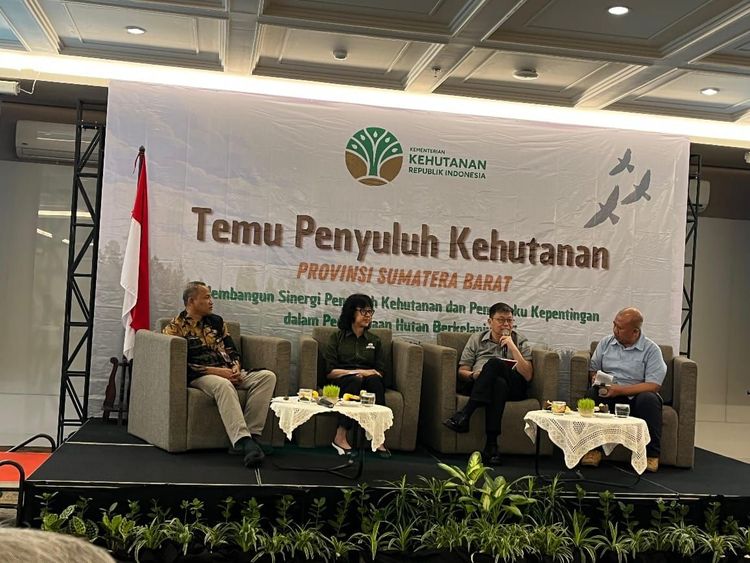
Enviro News Asia, Padang — Indonesia’s Forestry Ministry and House of Representatives Commission IV are seeking to strengthen forest extension services and engage younger generations in sustainable forest management, with an emphasis on community welfare and the economic value of forest-based products.
The initiative was discussed at the 2026 Forestry Extension Technical Meeting for West Sumatra, held in Padang on Oct. 15. The meeting brought together Commission IV Deputy Chair Alex Indra Lukman, acting head of the ministry’s Agency for Extension and Human Resources Development Indra Exploitasia, regional forestry officials, forest extension workers and members of the Forest Conservation Generation, known as Genries.
Alex said community participation was essential to forest conservation and called for more extension workers, better training and stronger operational support to help them reach remote areas.
“If communities are expected to help protect forests, then the number of forest extension workers must increase,” Alex said, stressing that forest fires also threaten public health and require active community involvement in prevention efforts.
He said budget efficiency measures should not undermine field operations, including the provision of transport and equipment for personnel working in difficult-to-access locations. Alex also called for dedicated discussions with Commission IV on strengthening forestry extension services.
Indra said extension workers played a strategic role in connecting government policies with the needs of local communities. Data from the Forestry Extension Management Information System, as of Oct. 12, showed that Indonesia had 10,623 forest extension workers nationwide.
The total comprised 2,710 civil servants, 6,029 community-based volunteers, 883 private-sector extension workers and 1,001 government employees under employment agreements.
West Sumatra had 150 forest extension workers supporting 564 Forest Farmers Groups, or KTH, across the province, along with 14 groups assisted by ministry technical units.
Beyond conservation, the ministry is seeking to improve the economic performance of communities supported by these groups. Their economic transaction value in West Sumatra was estimated at around Rp 5 billion, which officials said could increase through stronger institutions, product processing, improved quality and packaging, branding and expanded market access.
The ministry also encouraged the development of Wanawiyata Widyakarya, a learning platform for forestry-based businesses, and the establishment of forest farmer cooperatives where groups are ready. The aim is to help communities move beyond selling raw materials toward producing higher-value goods.
During the meeting, extension workers raised challenges involving staffing shortages, limited transport and difficulties marketing products. A representative working in Siberut National Park, for example, described problems reaching island communities because of rough seas and limited transportation, as well as obstacles to selling honey, chips and souvenirs.
Participants also raised concerns among some community groups that formalizing their businesses could affect their eligibility for social assistance. Alex said the government needed to ensure people retained their entitlements throughout the process.
Young people also featured prominently in the meeting through Genries, whose members had previously participated in the Forest Youthverse and Forest Youthpreneurship programs. The initiative, supported by the ministry’s Center for Forest Conservation Generation Development, aims to connect youth creativity with the experience of extension workers in the field.
Indra said young people could contribute through innovation, environmental education and public communication on forest conservation. He also called for stronger Saka Wanabakti programs to provide young people with forestry education and practical skills.
During the discussion, a Genries representative named Rahmi asked how about 60 ideas developed through Forest Youthverse could be translated into practical projects. Another participant, Andrean, expressed interest in contributing more directly to forestry work, including becoming a forest extension worker.
Syerlina presented an idea for a waste-processing application based on circular economy principles, highlighting potential economic opportunities. Such initiatives could support forest farmer groups through product development, digital marketing and community education.
Indra said collaboration between extension workers and Genries should extend beyond meetings and develop into practical networks for mentoring and innovation. He added that young people could help communicate successful conservation practices to wider audiences, particularly their peers.
Closing the meeting, Alex praised the commitment of extension workers and young people and urged authorities to respond to their enthusiasm with concrete policy support.
The ministry said cooperation among government agencies, extension workers, communities and younger generations would be important to achieving sustainable forest management while improving livelihoods. (*)