

Enviro News Asia, Jakarta — Indonesia’s high-confidence forest and land fire hotspots fell to 147 on October 25, down 170 from 317 a day earlier, as rainfall began in several fire-prone areas. The Forestry Ministry said firefighting and monitoring operations would continue to ensure fires and underground embers were fully extinguished.
Data from the ministry’s SiPongi monitoring system showed that hotspot numbers across six priority provinces declined from 226 to 26. West Kalimantan recorded 15 hotspots, Central Kalimantan five, South Kalimantan four and South Sumatra two. Jambi and Riau reported no high-confidence hotspots.
The ministry cautioned that fewer hotspots did not necessarily mean all fires had been extinguished. Satellite observations from NASA Terra/Aqua, SNPP and NOAA-20 detect surface temperature anomalies, and a single fire may generate multiple hotspot readings. Field verification is therefore required to establish actual fire conditions.
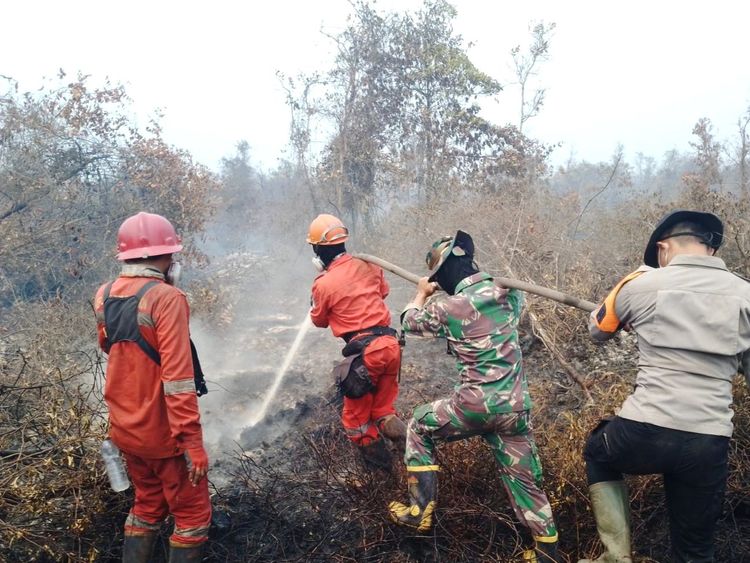
According to the ministry’s October 25 operational report, firefighting and patrols continued at several locations. In Jambi, a fire in Sungai Abang, Sarolangun, had been declared extinguished, while teams continued searching for residual heat in peatland in East Tanjung Jabung, where smoke spread had been brought under control.
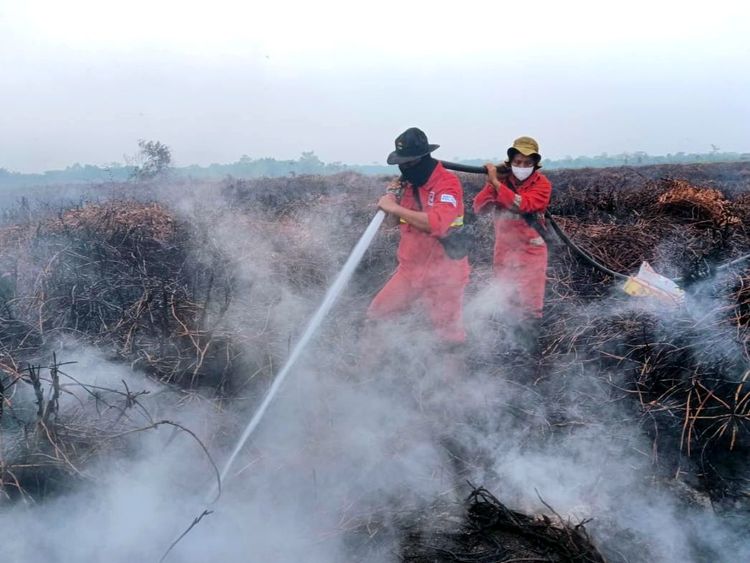
In South Sumatra, a fire in Air Itam Timur, Penukal Abab Lematang Ilir (PALI), had also been extinguished. Operations continued in Putak village, Muara Enim, and at several locations in Ogan Komering Ilir, Banyuasin and Musi Banyuasin. Peatland conditions at some sites required further suppression, wetting and searches for embers to prevent fires from reigniting.
In West Kalimantan, Manggala Agni firefighting teams reported that a fire in Natai Kuini village, Kendawangan district, Ketapang Regency, had been extinguished. Monitoring continued because embers can persist beneath the surface of peatland.
Firefighting operations were also ongoing in Tanjung Taruna village, Jabiren Raya district, Pulang Pisau Regency, Central Kalimantan. In South Kalimantan, teams had brought fires under control in parts of Landasan Ulin Barat, Banjarbaru, although smoke remained visible at some points. Joint teams used drones to monitor a fire area on a mountain peak in Salikung, Tabalong Regency, where access for ground crews was difficult. A fire in Sarigadung, Tanah Bumbu Regency, had been declared extinguished.
Rainfall provided some support for suppression efforts on October 25. In South Sumatra, rain was reported near the Forestry Ministry’s Manggala Agni operational office in Ogan Komering Ilir. In Central Kalimantan, rainfall occurred in Camp Leakey and Sungai Buluh Besar in Tanjung Puting National Park. Rain was also observed around Trans Gunung Kupang in Cempaka district, Banjarbaru, and near the local airport in South Kalimantan.
The ministry warned that rainfall and declining hotspot numbers did not eliminate the risk of renewed fires, particularly in peatlands, where embers can smoulder underground even when flames are no longer visible.
Manggala Agni crews are continuing patrols, ground checks, direct firefighting, firebreak operations, wetting, ember searches and final cooling alongside the National Disaster Management Agency, military, police, weather agency, regional authorities, community fire brigades and private-sector partners.
Air support remains on standby, with 49 aircraft assigned to fire-control operations: 32 for water bombing and 17 for aerial patrols and weather modification. The government, working with disaster management and weather agencies and the military, is also continuing cloud-seeding operations using dry ice and sodium chloride (NaCl) when suitable cloud formations are available.
The ministry said success would be measured by actual conditions on the ground, including complete extinguishment of fires and embers, prevention of reignition, reduced smoke impacts, public safety and protection of forests and biodiversity. (*)