

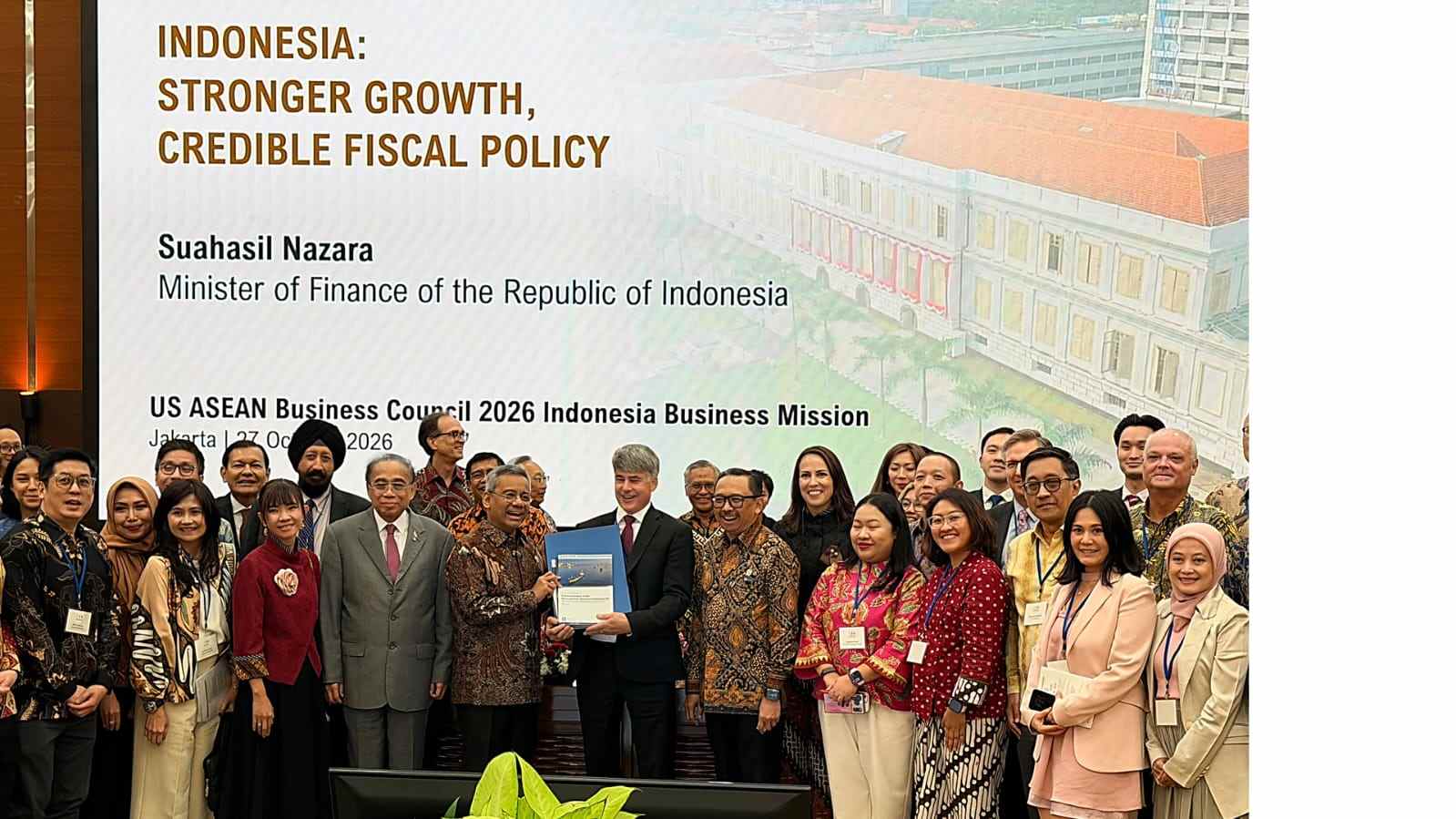
Enviro News Asia, Jakarta — Indonesia remains an attractive investment destination for United States businesses, with representatives from 31 US companies expressing strong interest in the country during a business mission meeting with Finance Minister Suahasil Nazara in Jakarta on Oct. 27, 2026.
Suahasil, accompanied by Deputy Finance Minister Juda Agung and senior ministry officials, received the delegation from the US-ASEAN Business Council (US-ABC) Mission to Indonesia 2026, led by Ambassador Brian McFeeters. Indonesia’s Ambassador to the United States, Indroyono Soesilo, also attended the meeting.
The delegation included representatives from major companies such as Boeing, ExxonMobil, Citi, Visa, Mastercard, Google, IBM, Meta, Oracle, Netflix and PepsiCo.
Suahasil said Indonesia’s economic fundamentals remained solid, with economic growth reaching 5.45 percent in the first half of 2026. Inflation remained under control, while state budget performance was maintained amid global uncertainty.
He also highlighted coordination among the Finance Ministry, which manages fiscal policy; Bank Indonesia, responsible for monetary policy; and Danantara, which supports strategic investment.
Responding to questions from US business representatives, Suahasil discussed Indonesia’s adoption of artificial intelligence (AI) and growing interest among US technology companies in investing in the country, particularly in data centre development.
He also outlined the implementation of Coretax, an integrated digital tax administration platform designed to improve efficiency. The system is expected to streamline tax administration, including making tax refund processes faster and more accurate.
The finance minister invited US investors to support the government’s priority programmes, including food self-sufficiency, energy self-sufficiency and industrial downstreaming.
In the oil and gas sector, he encouraged US companies to expand exploration activities, noting that the government was preparing various policy incentives to support investment.
He also pointed to opportunities in healthcare, as Indonesia seeks to expand services for its population of approximately 285 million. The sector offers potential for investment in medical technology and modern healthcare services.
Indroyono said US industrial representatives were closely monitoring several policy and industry developments, including revisions to the Copyright Law and Oil and Gas Law, the development of Indonesia’s semiconductor industry and the country’s participation in global supply chains.
He noted that Indonesia’s strategic natural resources, large population and central position in the Indo-Pacific region could support its ambition to become part of global technology and manufacturing networks.
The objective, he said, was for Indonesia to become more than a consumer market by strengthening its role as a production and innovation partner.
The meeting highlighted several factors underpinning US business interest in Indonesia, including its large domestic market, steady economic growth, ongoing digital transformation, natural resource wealth and efforts to accelerate deregulation to simplify licensing and improve business certainty.
US investment in Indonesia reached US$3.4 billion in the first three quarters of 2026, up from approximately US$3 billion in 2025, according to figures presented in the meeting.
The discussions concluded with an emphasis on turning bilateral engagement into concrete investment that can create jobs, strengthen domestic industries, accelerate industrial downstreaming and expand Indonesia’s participation in global supply chains. (*)