

Enviro News Asia, Jakarta — The Indonesian Association of Communication Science Lecturers and Researchers (ADPIKI) is strengthening fact-based storytelling skills through its sixth ADPIKI Masterclass, themed “Storytelling in the Era of Artificial Intelligence,” held on Friday (October 30, 2026). The event explored the importance of in-depth observation, empathy, and verification in producing meaningful writing amid the rapid development of artificial intelligence (AI).
ADPIKI Deputy Chairman Prof. Dr. M. Najieb emphasized the importance of strengthening the competencies of communication lecturers and researchers in responding to technological developments. He said that the ability to process information must be accompanied by an understanding of social contexts and a responsibility to communicate facts to the public.
“Mastering technology must go hand in hand with critical thinking, understanding human experiences, and maintaining information integrity. Storytelling is an important skill for communicating knowledge in a way that brings it closer to the public,” Najieb said.
Najieb noted that strengthening writing skills could help lecturers and researchers communicate their research findings in ways that are easier for the public to understand. The use of AI must be accompanied by careful information verification and the ability to identify angles relevant to readers’ needs.
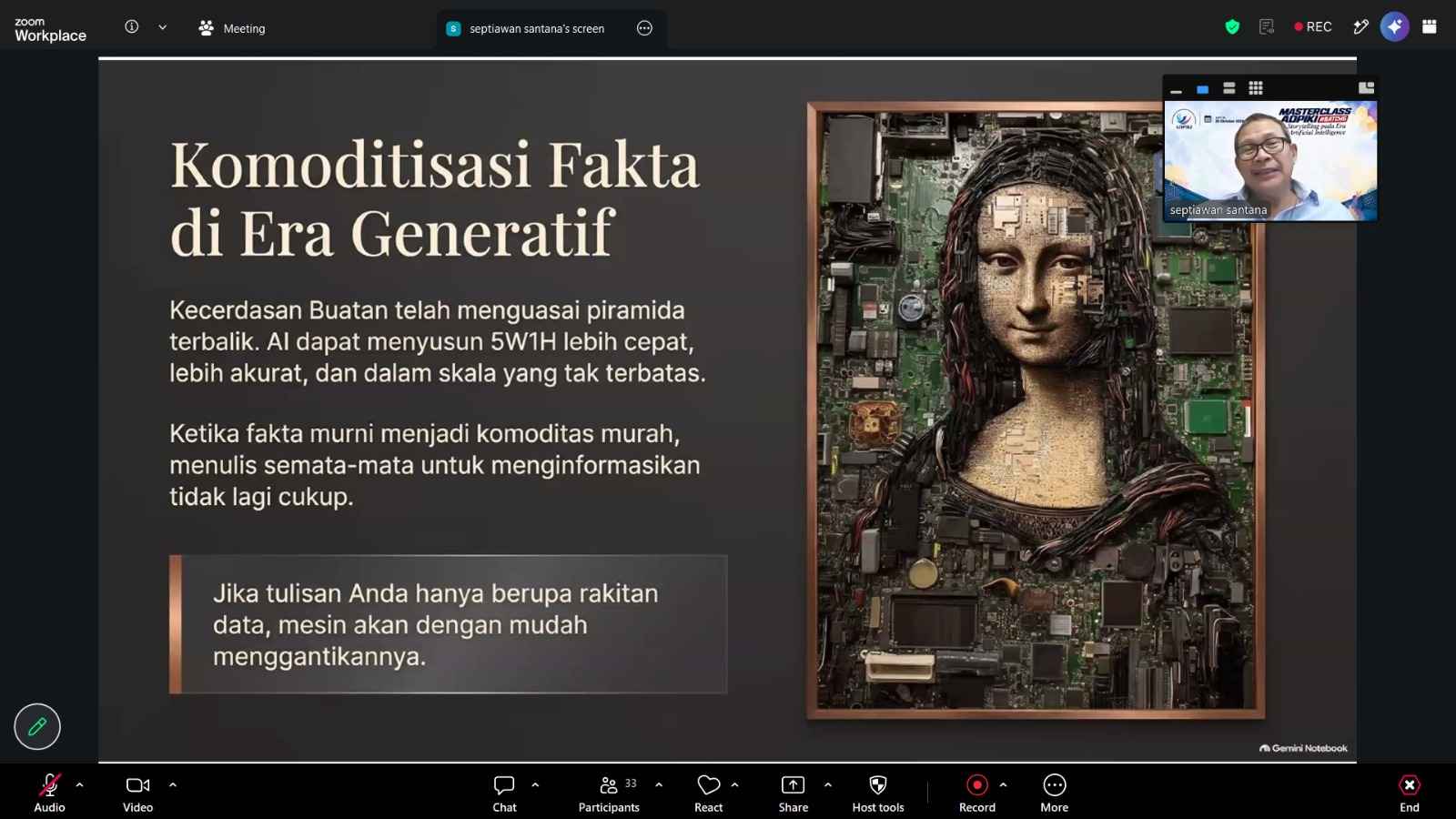
Meanwhile, Prof. Dr. Septiawan Santana Kurnia, a professor at the Faculty of Communication Sciences at the Islamic University of Bandung, emphasized during the masterclass that literary storytelling combines factual strength with narrative techniques that help readers connect with human experiences.
“It is neither fiction nor falsehood, but an account that brings facts to life,” Septiawan wrote.
According to Septiawan, narrative writing should present people as subjects with their own experiences, hopes, and life challenges. This allows readers to understand the human dimension behind an event, including the relationship between individual experiences and broader social issues.
He outlined several approaches, including direct observation, participant observation, in-depth interviews, and the writer’s own experience as a witness. These methods help gather details that enrich a story while keeping it grounded in research and verification.
Septiawan also highlighted the importance of immersion, which involves a writer’s deep engagement with the lives of sources. Spending sufficient time in the field enables writers to understand routines, atmospheres, and experiences that may not emerge during brief interviews.
“The best way to find a more compelling report is not merely to conduct an interview, but to immerse yourself in it,” he said.
Beyond observation, he explained the importance of developing a distinctive writing voice, structuring a narrative, and building scenes. Details about settings, actions, and actual dialogue can bring writing to life without altering the facts.
“Do not manipulate facts, but interpret the reality behind them,” Septiawan stressed.
In discussing AI, Septiawan described firsthand experience and a writer’s sensitivity as important strengths in storytelling. The ability to understand context, recognize irony, and build relationships with sources remains essential to producing authentic stories.
Through Masterclass Batch 6, ADPIKI is providing a learning platform that connects technological developments with fact-based writing skills. Strengthening research, verification, and field observation is expected to help lecturers and researchers communicate knowledge in ways that are engaging, accessible, and accountable. (*)