

Enviro News Asia, Depok — Indonesia, October 10, 2026 — The Institute for Advanced Science, Social, and Sustainable Future (IASSSF) held a webinar on Friday, October 9, exploring how people can build meaningful relationships in an increasingly digital world through the principles of Islam, digital communication and communication psychology.
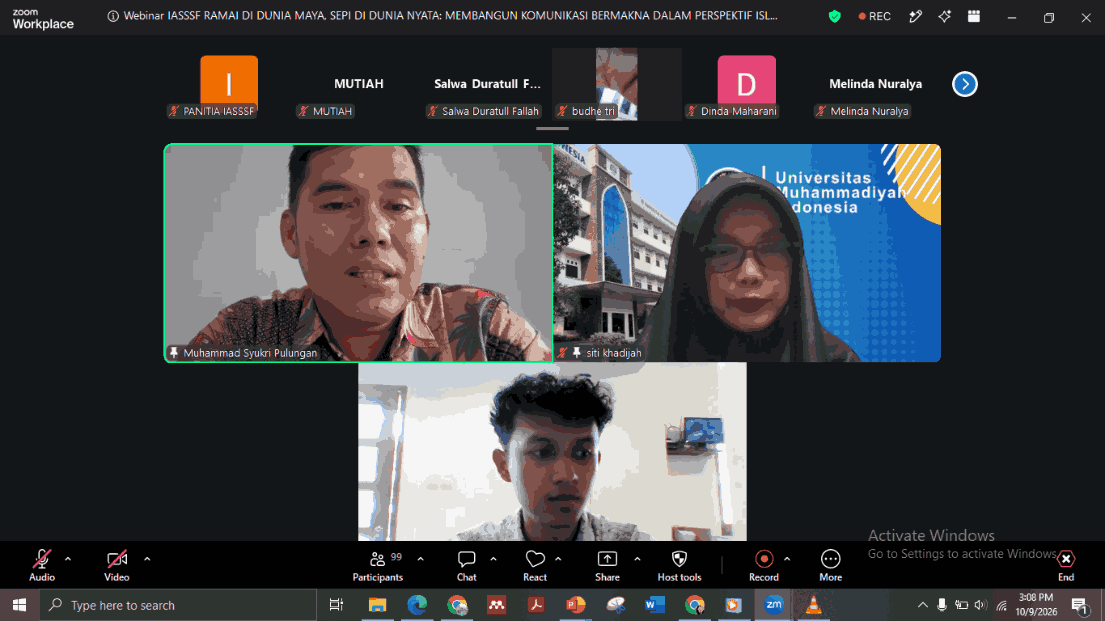
Titled “Ramai di Dunia Maya, Sepi di Dunia Nyata: Membangun Komunikasi Bermakna dalam Perspektif Islam” (“Busy Online, Lonely Offline: Building Meaningful Communication from an Islamic Perspective”), the webinar was conducted via Zoom from 1:30 p.m. to 3:30 p.m. Western Indonesia Time (UTC+7). It brought together students, lecturers, researchers, practitioners and members of the public.
The discussion addressed a growing paradox in modern society: although technology enables people to connect more easily than ever, genuine emotional closeness can become increasingly difficult to maintain. Three speakers examined how digital connectivity can be transformed into meaningful human relationships.
Environmental communication expert Dr. Trisia Megawati Kusuma Dewi, S.Sos., M.Si., opened the discussion by highlighting the importance of responsibility and purpose in social media use. Addressing the challenges of sustainability communication, she encouraged participants to consider how communication strategies could incorporate Islamic values, particularly the concept of humans as stewards, or khalifah, of the Earth.
“Life comes from nothing, becomes something, and returns to nothing,” she said. She added that people should understand their responsibilities and take appropriate action before they are held accountable for their choices. Social media, she noted, can serve as one of several channels for pursuing these goals.
Siti Khadijah, S.Sos., M.Si., of Universitas Muhammadiyah Indonesia, continued the discussion by emphasizing that the solution was not to withdraw from digital platforms but to use them responsibly.
“Social media is not something we should avoid. In this era, we have to step into technology,” she said. “But we must use it wisely.”
She stressed that technology is fundamentally a tool to support human life. Whether it strengthens relationships or creates greater distance ultimately depends on how people choose to use it.
The final session, led by Dr. Syukri Pulungan, S.Sos.I., M.Psi., executive director of PUSKESTAL, focused on the human need for genuine presence and understanding.
“Our generation does not lack connections. We have plenty of them,” he told participants, encouraging them to prioritize being genuinely present in their interactions.
He explained that meaningful communication cannot be measured solely by the frequency or speed of messages exchanged. Instead, it is defined by whether people feel acknowledged, understood and valued.
“It is communication in which people feel heard and seen, and in which they matter to someone else,” he said.
Together, the three presentations underscored a common message: meaningful communication begins with clear intentions, is sustained through the responsible use of technology and ultimately depends on the quality of attention people give one another.
The webinar also encouraged participants to translate their ideas into written work, providing an opportunity for their perspectives to be shared, discussed and recognized. This objective aligns with IASSSF’s 2026 National Scientific Writing Competition, known in Indonesian as Lomba Karya Tulis Ilmiah (LKTI), which carries the theme “Integrating Religion, Communication, and Psychology in Addressing the Challenges of Contemporary Society.”
The competition invites students and academics to develop scholarly papers examining contemporary social issues through interdisciplinary perspectives. Winners will receive awards, while their papers may also have opportunities for further development toward journal publication.
About IASSSF
The Institute for Advanced Science, Social, and Sustainable Future (IASSSF), based in Depok, West Java, Indonesia, provides a platform for academics, researchers, practitioners, professionals, students and communities to develop their knowledge and skills under the motto “Morality Before Knowledge.”
IASSSF also operates a scientific journal publishing platform through www.journal-iasssf.com. The organization oversees 90 peer-reviewed journals registered with ISSN and DOI/Crossref and indexed or listed in various scholarly databases and directories, including Google Scholar, Dimensions, Garuda, EuroPub, Scilit, BASE, EZB, Harvard Dataverse and CORE.
Twenty-five IASSSF journals have received accreditation under Indonesia’s national journal accreditation system, SINTA, at levels 2, 3, 4 and 5.
Its multidisciplinary publishing platform supports scholarly dissemination through peer review, open access, double-blind review and article-in-press or publish-as-you-go publication models, with an emphasis on credibility and research integrity. (*)