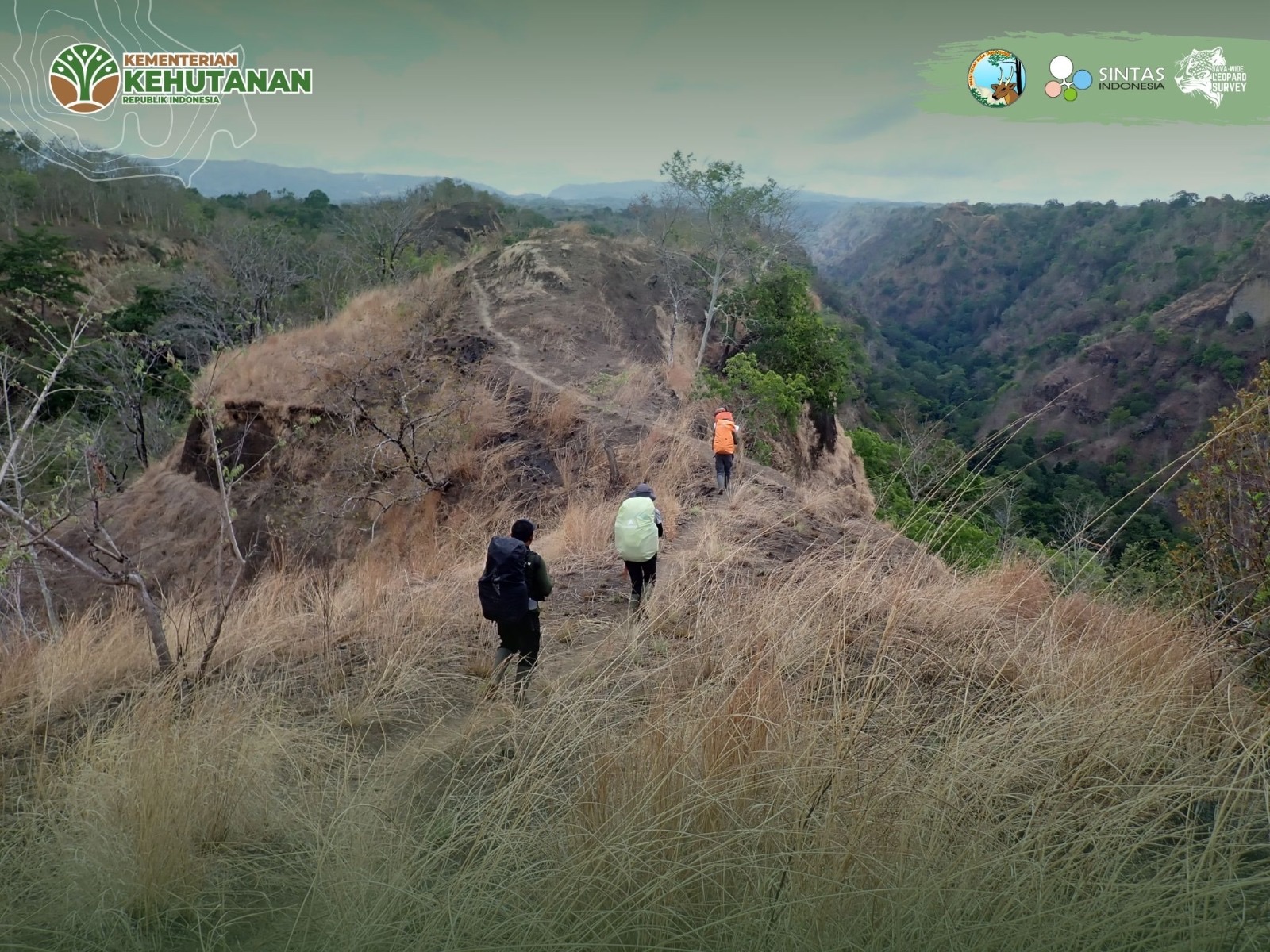
Enviro News Asia, Jakarta – The presence of the protected Javan leopard (Panthera pardus melas) is being tracked in the Raung-Ijen landscape, East Java. The tracking is conducted by installing 80 surveillance cameras at 40 stations scattered across the northern block of this area.
The installation was carried out by a survey team from SINTAS Indonesia Foundation and the East Java Natural Resources Conservation Agency (BBKSDA). The cameras were set up between October and November 2024, will operate for 90 days, and are scheduled for retrieval in February 2025. These cameras are placed along rugged trails rarely touched by humans through the Java-wide Leopard Survey (JWLS). JWLS is the first collaborative effort for a Javan leopard survey and conservation at an island-wide scale, involving the government as the area manager and policymaker, SINTAS Indonesia Foundation as the project leader, and private sector involvement from PT iForte-PT Profesional Telekomunikasi Indonesia as donors. Local organizations are also engaged as key actors at the ground level.
This tracking effort is crucial as the Javan leopard population is dwindling and nearing extinction. The Javan leopard is a subspecies of leopard found only in the tropical forests, mountains, and conservation areas of Java. It is the last remaining big cat on the island and is endemic to Central Java, West Java, and East Java. Compared to other leopard subspecies, the Javan leopard is the smallest in size. It has extremely sharp eyesight and a keen sense of smell, leading a solitary life except during the breeding season. Its primary prey includes smaller animals such as muntjacs (Muntiacus muntjak), wild boars (Sus scrofa vittatus), and Javan lutungs (Trachypithecus auratus).
“That’s why the team is not only tracking Javan leopard footprints on wet soil but also examining the interconnected ecosystem,” said Ummi Farikhah, Field Coordinator.
Data collected from the surveillance cameras recorded 126 signs of detected wildlife presence, including five fecal samples suspected to belong to the Javan leopard. These samples are currently undergoing genetic analysis at the Faculty of Forestry, Gadjah Mada University, to gain deeper insights into the population dynamics of this species and provide a comprehensive picture of its movement patterns and habitat preferences.
Ummi Farikhah emphasized that this survey is not just about numbers or mapping locations. “It’s about the story of a struggle to protect an invaluable natural heritage. The cameras installed now will serve as silent witnesses, capturing the activities of wildlife amidst looming threats.”
The Raung-Ijen landscape is more than just a stretch of green on the East Java map—it is home to life that must be preserved.