

Enviro News Asia, Uljin — In the aftermath of one of its most severe wildfires, the Republic of Korea is implementing an innovative and climate-resilient approach to forest and community restoration, combining ecological recovery with local economic needs.
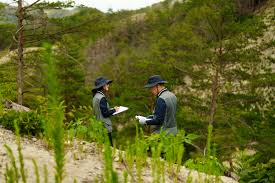
In Uljin, a mountainous region heavily affected by the 2022 wildfire, scientists from the Baekdudaegan National Arboretum are actively monitoring regrowth and assessing restoration strategies. The fire, one of the worst in the country’s history, left vast landscapes charred and vulnerable to environmental risks such as erosion and landslides.
Leading the field team, Tae-Im Heo highlighted the use of Kalopanax septemlobus, a fast-growing native species. Beyond ecological restoration, the plant supports local livelihoods, as its young shoots are harvested as edible forest products.
This dual-purpose strategy reflects a broader shift in forest management—prioritizing both environmental sustainability and community resilience.
A Holistic and Collaborative Restoration Model
The restoration effort has gained international recognition, earning the country the title of a World Restoration Flagship under the United Nations Environment Programme. The initiative emphasizes long-term ecosystem resilience rather than traditional single-species reforestation.
Following the wildfire, debates emerged between local residents—who favored replanting fire-prone pine forests—and environmental groups advocating for more climate-adaptive ecosystems. To address this, the Korea Forest Service facilitated a collaborative governance model involving scientists, civil society, and local communities.
The result is a five-year master plan to restore approximately 4,700 hectares of high-value forest by 2027.
Climate-Proofing Forests
Key strategies include:
- Replanting vulnerable areas with species such as gingko and fir to prevent erosion
- Establishing fire-resistant belts using native broad-leaved trees
- Allowing large sections of forest to regenerate naturally under scientific monitoring
This marks a transition toward more diverse and resilient forest ecosystems capable of withstanding future climate impacts.
The model has already been replicated in areas such as Jirisan National Park and Inwangsan Mountain Urban National Park.
Supporting Livelihoods and Long-Term Sustainability
To sustain restoration efforts, the government has established native plant supply centers producing climate-adapted seedlings. These initiatives not only ensure ecological success but also create employment opportunities for local communities.
Authorities are also promoting alternative forest-based products, including medicinal fungi and edible plants, to diversify income sources and reduce dependency on fire-prone ecosystems.
Looking ahead, long-term monitoring will continue until at least 2037, enabling scientists to refine restoration methods and better predict ecological outcomes in a changing climate.
As global wildfire risks intensify, the Republic of Korea’s approach demonstrates how integrating science, policy, and community participation can build forests that are not only restored—but future-ready. (*)