

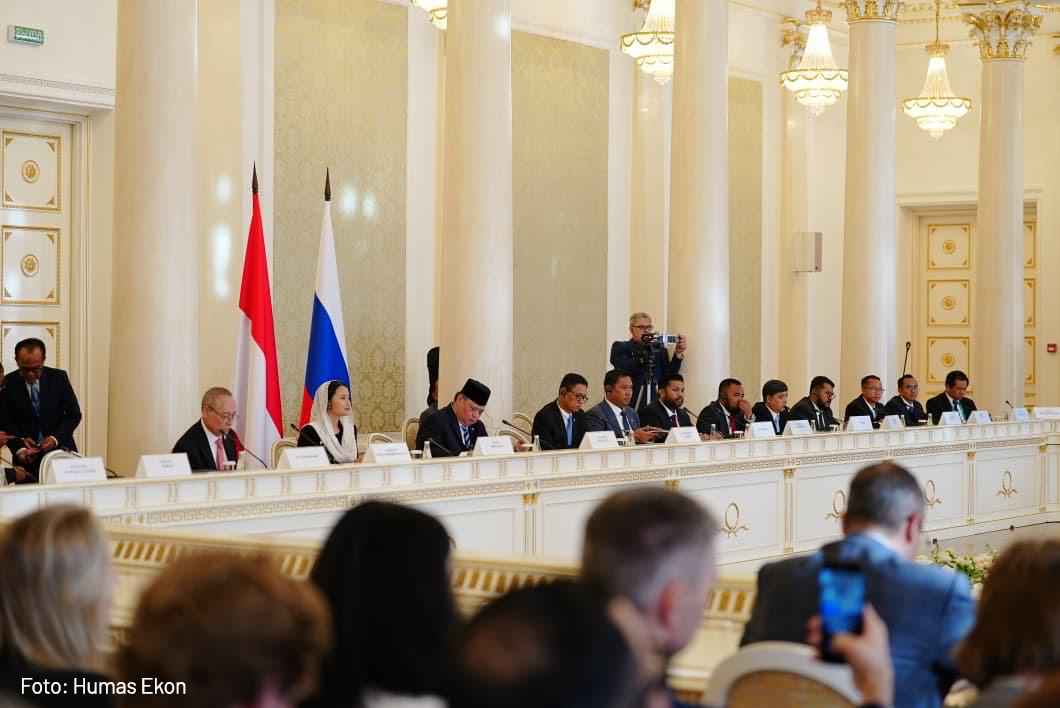
Enviro News Asia, Kazan — The Government of Indonesia reaffirmed its commitment to expanding strategic international partnerships, including with the Russian Federation, during the 14th Session of the Indonesia–Russia Joint Commission on Trade, Economic, and Technical Cooperation held in Kazan, Russia. The energy and mineral resources sector emerged as one of the key areas of discussion between the two countries.
Indonesia’s Deputy Minister of Energy and Mineral Resources (ESDM), Yuliot, accompanied Coordinating Minister for Economic Affairs Airlangga Hartarto in the meeting co-chaired with First Deputy Prime Minister of the Russian Federation Denis Manturov. The forum served as a strategic platform to strengthen bilateral cooperation across several priority sectors, including energy and mineral resources.
During the restricted Co-Chairs meeting, Deputy Minister Yuliot outlined several developments in Indonesia–Russia energy cooperation. Discussions covered follow-up plans for crude oil procurement, oil and gas field development, progress on the Grass Root Refinery (GRR) Tuban project, and cooperation in the peaceful use of nuclear energy.
At the plenary session of the 14th Joint Commission, Yuliot emphasized the importance of strengthening investment and technological cooperation in the energy sector to support Indonesia’s energy security and transition toward cleaner energy systems.
“Cooperation in the energy sector with Russia has resulted in various investment commitments in upstream oil and gas, oil refineries, renewable energy-based electricity, including plans for the development of small modular nuclear power plants. This aligns with Indonesia’s national priorities to strengthen energy security for both fuel and electricity supply,” Yuliot stated during the plenary session in Kazan on Tuesday, May 12, local time.
He also highlighted Indonesia’s commitment to accelerating clean energy development and expanding national electricity generation capacity under the Electricity Supply Business Plan (RUPTL) 2025–2034.
“Under the Electricity Supply Business Plan 2025–2034, Indonesia targets an additional 70 GW of power generation capacity, with 40 GW or 62 percent expected to come from renewable energy sources. For nuclear power, Indonesia plans to develop two units with a combined capacity of 500 MW,” Yuliot explained.
The series of meetings during the 14th Indonesia–Russia Joint Commission produced Agreed Minutes outlining several follow-up initiatives in the energy and mineral resources sectors. Areas of cooperation discussed included oil and gas, LNG and LPG development, renewable energy, peaceful nuclear energy utilization, mineral downstreaming and metallurgy, as well as industrial standardization in the oil, gas, and energy sectors.
The Indonesia–Russia Joint Commission serves as an official bilateral cooperation mechanism between the Governments of Indonesia and the Russian Federation to discuss and evaluate progress across strategic sectors. The participation of the Ministry of Energy and Mineral Resources reflects Indonesia’s broader efforts to strengthen energy diplomacy in support of national energy security, industrial downstreaming, and enhanced technology and investment cooperation in the energy and mineral resources sectors. (*)