Enviro News Asia, Jakarta — Indonesia’s Ministry of Forestry, through the Forestry Law Enforcement Agency (Gakkum) for the Java, Bali, and Nusa Tenggara Region, has detained a suspect identified as TT (59) in connection with the attempted smuggling of 3,053 kilograms of pangolin scales destined for Cambodia.
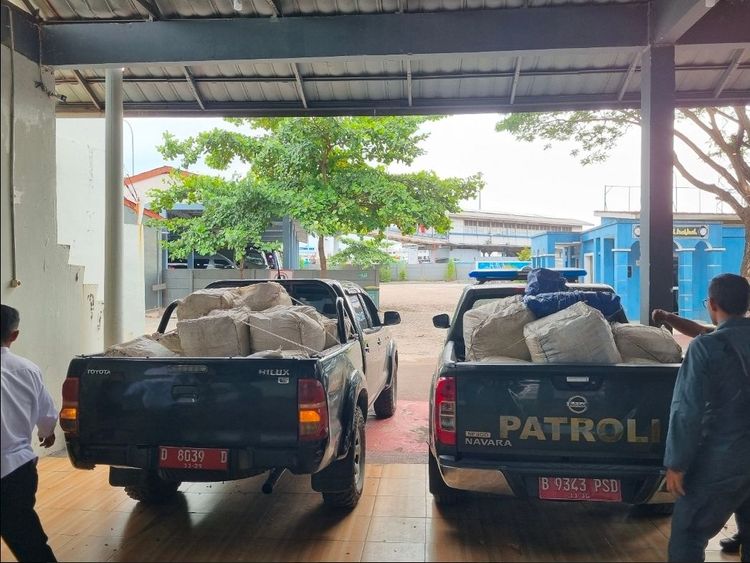
The case was uncovered following an inspection of a shipping container at Tanjung Priok Port in North Jakarta on 12 February 2026. Export documents declared the cargo as sea cucumber products and dried food items, but physical inspection revealed 99 cartons containing protected pangolin scales.
Authorities said the discrepancy between the export declaration and the actual contents of the container exposed an alleged attempt to disguise wildlife body parts through official logistics channels. Investigators believe the smuggling operation involved multiple actors responsible for collecting, storing, arranging export documents, using companies as formal exporters, and organizing overseas shipments.
Following investigations and coordination with the Metro Jaya Police supervisory unit for civil servant investigators, suspect TT was formally arrested and transferred to Salemba Detention Center in Central Jakarta. He is charged under Article 40A paragraph (1) letter f in conjunction with Article 21 paragraph (2) letter c of Law No. 32 of 2024 concerning the Conservation of Biological Natural Resources and Ecosystems.
If convicted, the suspect faces a prison sentence ranging from three to 15 years and fines between Rp200 million and Rp5 billion.
The investigation coincided with the INTERPOL Coordination Meeting on Wildlife Crime held in Jakarta from 19–21 May 2026, attended by law enforcement authorities from Indonesia, Singapore, Vietnam, and Cambodia. The meeting focused on strengthening intelligence-sharing, joint investigations, financial tracking, and legal cooperation to dismantle transnational wildlife trafficking networks.
Officials said the case highlights how protected wildlife products are increasingly concealed as legal commodities before entering international black markets through official shipping routes.
According to Forestry Gakkum data, trafficking patterns involving pangolins have shifted significantly in recent years. Earlier cases mainly involved live animal trafficking, while current operations increasingly focus on large-scale smuggling of pangolin scales, indicating the emergence of more organized international supply chains.
Head of the Forestry Gakkum Office for Java, Bali, and Nusa Tenggara, Aswin Bangun, said investigators are continuing efforts to identify the owners of the cargo, document handlers, logistics facilitators, and financial beneficiaries behind the operation.
“The method of disguising pangolin scales as sea cucumber and dried food products demonstrates an organized attempt to exploit legal export channels for illegal wildlife trade,” Aswin said.
Director General of Forestry Law Enforcement, Dwi Januanto Nugroho, emphasized that wildlife protection is part of Indonesia’s broader commitment to preserving its biodiversity and combating transnational environmental crime.
“Illegal wildlife trade does not begin at ports. The chain starts with poaching in forests, continues through storage and distribution networks, and ultimately reaches overseas markets. Therefore, law enforcement must operate from upstream to downstream,” he said.
He added that Indonesia’s role as host of the INTERPOL wildlife crime forum reflects the country’s commitment to strengthening international cooperation against cross-border wildlife trafficking.
The Ministry of Forestry stated that wildlife crime enforcement will continue to focus on protecting habitats, strengthening patrols, improving inter-agency coordination, and closing smuggling routes through warehouses, ports, airports, and export documentation systems. (*)