

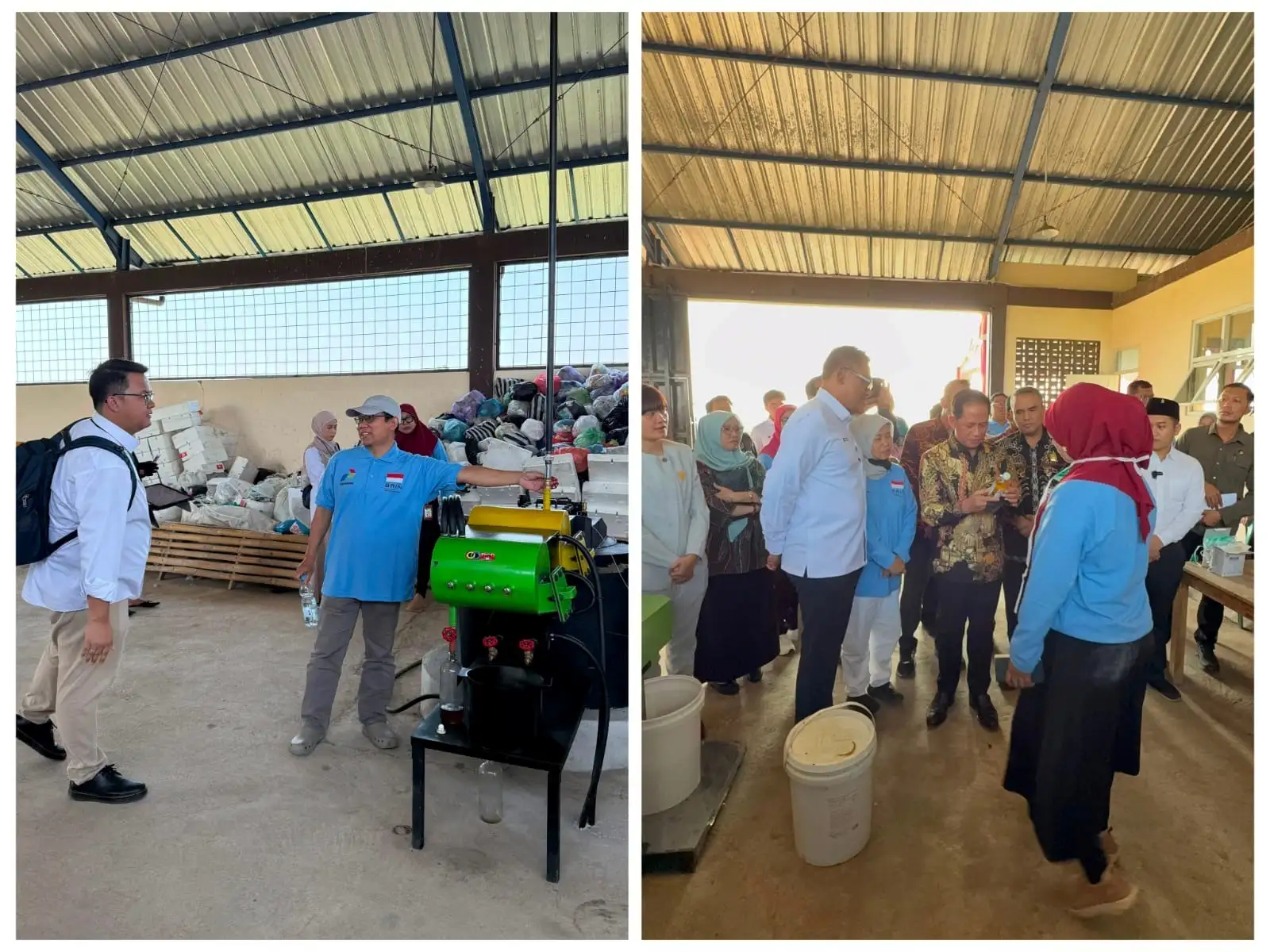
Enviro News Asia, Kendal — Indonesia’s National Research and Innovation Agency (BRIN) is accelerating the downstream application of its fifth-generation Fast Pyrolysis Multicondensor (Faspol) technology, which converts low-value plastic waste into alternative fuel. The system has been deployed at the Margorejo Reduce-Reuse-Recycle Waste Management Facility (TPS 3R) in Cepiring District, Kendal Regency, Central Java, and local authorities plan to replicate the technology at five additional sites.
The innovation drew attention during a visit by Vice Coordinating Minister for Food Affairs Hanif Faisol Nurofiq, accompanied by BRIN Steering Committee member Tri Mumpuni, representatives from the Central Java Provincial Government, Kendal Regency Government, and Pertamina Foundation during the launch of an integrated waste management program and PF Science 2026 on June 11.
Hanif said Faspol Generation 5 offers a practical answer to energy challenges, particularly in remote regions and areas with limited energy access. He noted that the technology changes the perception of waste from an environmental burden into a valuable resource that can support community energy independence.
He also praised BRIN’s readiness to commercialize the technology, citing comprehensive testing data, including emission assessments, which remain a key concern in thermal waste treatment systems.
Tri Martini, head of the Faspol development team and a researcher at BRIN’s Research Center for Sustainable Industrial and Manufacturing Systems, explained that the system integrates pyrolysis and distillation into a single process. The technology targets low-value plastic waste that is difficult to recycle through conventional methods.
According to Tri, the machine can process around 50 kilograms of plastic waste and convert 90 to 95 percent of the material into liquid crude oil. The output can undergo further processing to produce Petasol, an alternative fuel comparable to diesel that could serve as a new energy source.
BRIN Steering Committee member Tri Mumpuni said the project demonstrates how research can directly address public needs. She emphasized that innovations such as Faspol provide solutions to two major challenges simultaneously by reducing waste accumulation while supplying alternative energy.
Pertamina Foundation President Director Agus Mashud S. Asngari said Faspol was among the flagship innovations supported under the PF Science 2025 program and has successfully reached the implementation stage. He stressed that the initiative focuses on ensuring research outcomes deliver tangible benefits to communities and the environment.
Kendal Regent Dyah Kartika Permanasari welcomed the collaboration between BRIN and Pertamina Foundation, describing the pyrolysis technology as a strategic approach to tackling the region’s waste problem while generating products with economic value. She announced that the regency government intends to replicate Faspol at five locations currently facing waste emergencies as part of efforts to strengthen technology-based waste management and support sustainable development goals.
Through the deployment of Faspol Generation 5 in Kendal, BRIN aims to accelerate the commercialization of domestic research and promote a circular economy approach. The agency sees the technology as a means to address plastic waste challenges while expanding alternative energy resources that contribute to energy security, food security, and sustainable development in Indonesia. (*)