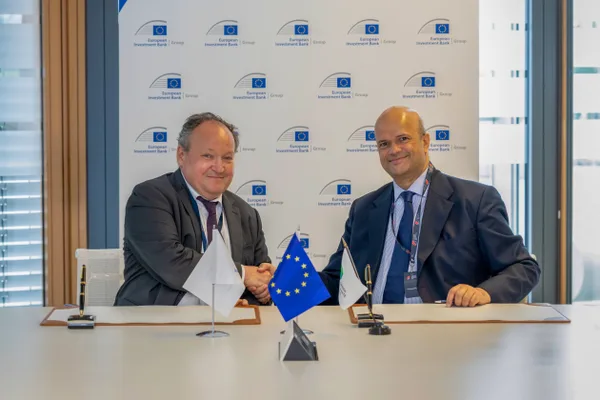
Enviro News Asia, Luxembourg — The Green Climate Fund (GCF) and the European Investment Bank (EIB) have signed a landmark financing agreement aimed at accelerating climate action and mobilizing billions of dollars in private investment for sustainable infrastructure projects in developing countries.
Under the agreement, GCF will provide an equity investment of US$233 million to the Global Green Bond Initiative (GGBI), a flagship program supported by the European Union. The initiative seeks to strengthen climate finance in 10 emerging economies by reducing investment risks and attracting private capital.
Amundi, Europe’s largest asset manager, will manage the GGBI Fund, a blended finance vehicle with a target capitalization of US$3.5 billion (€3 billion). The fund aims to leverage up to US$23.2 billion (€20 billion) in private investment to support low-carbon infrastructure projects in low- and middle-income countries.
Amer Baig, Acting Chief Investment Officer of GCF, said the fund would help stimulate country-driven green projects in critical sectors such as energy and transportation. He described the initiative as a major partnership with the European Commission and the European Investment Bank that would strengthen national ownership of climate action and address persistent financing gaps faced by developing countries.
EIB Vice-President Ambroise Fayolle said the collaboration demonstrates how multilateral cooperation can scale up climate action where it is needed most. He noted that the partnership aims to promote sustainable growth, enhance resilience, and improve living standards across low- and middle-income economies.
Amundi Chief Executive Officer Valérie Baudson said the creation of the GGBI Fund and GCF’s initial commitment show that blended finance mechanisms can effectively mobilize both public and private capital. She emphasized that cooperation, expertise, and innovation are essential to channel investment toward climate transition in emerging markets.
According to GCF, the initiative will support climate projects in Angola, Bangladesh, Brazil, Cameroon, Côte d’Ivoire, Egypt, Kenya, Namibia, Senegal, and Uganda. Investments are expected to focus on sectors that contribute to emissions reduction, sustainable transport, and climate resilience.
The agreement marks one of the latest efforts by international financial institutions to close the climate finance gap and increase private-sector participation in supporting low-carbon development and adaptation measures in vulnerable economies. (*)