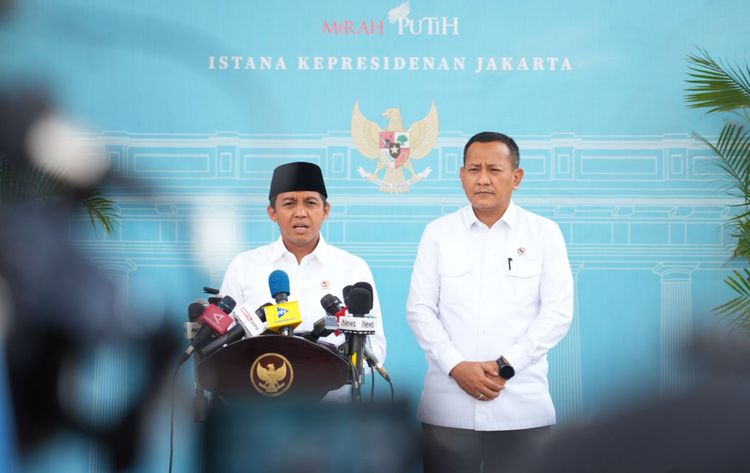


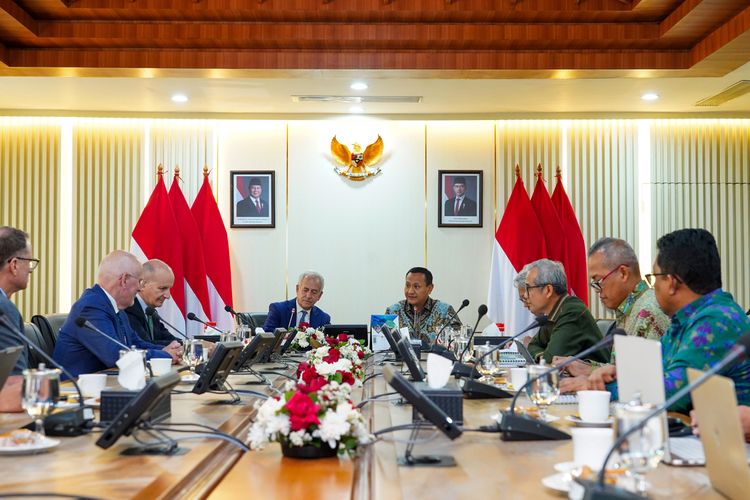
Enviro News Asia, Jakarta — Vice Minister of Forestry Rohmat Marzuki held a courtesy call meeting with several global figures in public policy, environment, and conservation, namely former President of Costa Rica José María Figueres, former Vice President of the European Commission Frans Timmermans, and former United States Senator Russ Feingold, at Manggala Wanabakti, Jakarta, on June 17, 2026.
The meeting discussed potential cooperation between Indonesia and the international community in strengthening national park management, conserving iconic species, and developing sustainable and innovative conservation financing approaches. It also served as a space for exchanging experiences on how countries rich in biodiversity can strengthen nature protection through stronger governance, financing, and global partnerships.
Vice Minister Rohmat Marzuki said Indonesia holds an important position in the global conservation and climate agenda, noting that the country’s forests are not only a national asset but also carry global value for their role in maintaining biodiversity, climate stability, water systems, and community livelihoods.
“Indonesia continues to demonstrate leadership through concrete climate action, particularly through forest conservation, strengthening conservation areas, species protection, and increasing benefits for communities around forest areas,” the Vice Minister said.
Indonesia currently has more than 27 million hectares of conservation and protected areas, including 57 national parks spread across the country. These areas are home to a range of iconic species and important ecosystems, while also contributing to climate resilience and local community welfare.
The Vice Minister affirmed that forest conservation is one of the main pillars of Indonesia’s contribution to addressing climate change. The government is also strengthening its Carbon Economic Value policy and forestry sector carbon trading governance as part of efforts to drive credible, measurable climate financing aligned with national priorities.
These efforts align with Indonesia’s FOLU Net Sink 2030 agenda, which positions the forestry and land-use sector as a backbone of greenhouse gas emissions control. Through strengthened conservation areas, natural forest protection, forest and land rehabilitation, peat and mangrove management, and community involvement in forest management, Indonesia is translating its climate commitments into action on the ground.
During the meeting, the Vice Minister also outlined the government’s steps to strengthen conservation financing, including the formation of a Task Force on Innovative Financing for National Park Management under Presidential Decree No. 8 of 2026, reinforced by Forestry Ministerial Decree No. 444 of 2026 and a decree from the Ministry’s Secretary General No. 45 of 2026.
The task force is tasked with developing frameworks, strategies, and innovative financing instruments for national park management and iconic species conservation for the 2026–2030 period. Priority sites include Komodo, Way Kambas, Ujung Kulon, Tanjung Puting, and Rinjani national parks, as well as iconic species landscapes in Aceh and Jambi.
“Innovative financing must remain within the core framework of conservation. This is not about commercializing conservation areas. The ecological function of national parks remains the priority, while financing schemes, partnerships, environmental services, philanthropy, and market instruments must serve as supporting tools to strengthen the protection of areas and species,” the Vice Minister explained.
Several instruments currently being explored include carbon-based financing, wildlife foster sponsorships, one-company-one-species schemes, species bonds, payments for environmental services, and other forms of partnership. All of these instruments are directed toward strengthening conservation area management, species protection, the capacity of forest police and rangers, monitoring systems, and benefits for communities around conservation areas, including indigenous customary communities.
The Vice Minister also stressed the importance of transparent and accountable governance in developing innovative financing, saying that support from companies, philanthropic institutions, impact investors, and technical partners must be carried out openly, credibly, and in accordance with Indonesian law.
Beyond conservation financing, the meeting also opened opportunities for cooperation in several other areas, including species conservation, strengthening conservation area governance, developing geospatial data and monitoring systems, building the capacity of area managers, and collaborating with local and indigenous customary communities.
The Vice Minister welcomed the international experience and perspectives brought by the visiting global figures, including insights on blended finance, conservation trust funds, endowment funds, and other conservation financing mechanisms that could be adapted to Indonesia’s needs and national priorities.
“We hope this discussion can enrich Indonesia’s efforts to build sustainable conservation financing, preserve the ecological integrity of national parks, protect iconic species, and ensure communities around these areas receive fair benefits,” the Vice Minister concluded. (*)