

Enviro News Asia, Medan – The Ministry of Forestry, through the Sumatra Regional Forestry Law Enforcement Center under the Directorate General of Forestry Law Enforcement (Ditjen Gakkum Kehutanan), has continued its series of operations targeting the illegal circulation of timber in North Sumatra. The operations uncovered suspected violations of timber legality at sawmill UD AAL in Hutaginjang village, Sijamapolang district, Humbang Hasundutan regency, on June 9, 2026, where a team found around 238 logs of mixed tropical timber stockpiled and concealed around the business premises.
The operation is a continuation of a broader series of timber enforcement actions across North Sumatra. Previous operations targeted several sawmills in East Kisaran, Asahan regency, and in Aek Lung village, Dolok Sanggul district, Humbang Hasundutan regency. The series of operations is aimed at tracing the origin of timber, checking document compliance, and ensuring that wood entering processing industries carries verifiable legal documentation.
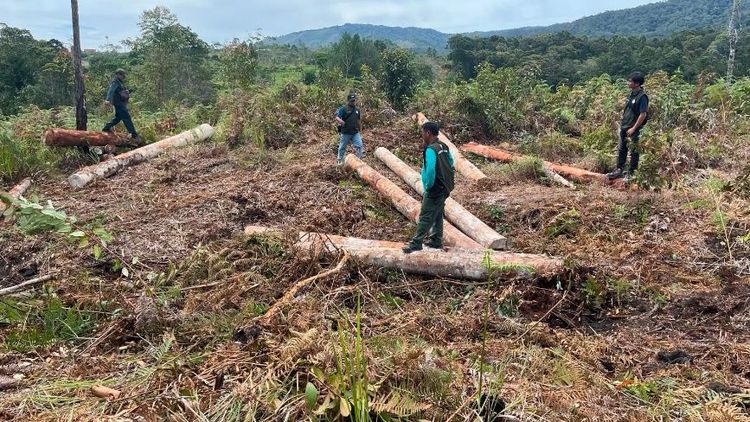
The discovery began when the team conducted a field inspection around the UD AAL sawmill to physically check the timber, examine documents, and verify legality markers on the forest products. During the initial inspection, officers found piles of logs around the business area and heavy equipment tracks leading to the back of the sawmill. The team extended its search to points outside the production area, eventually finding logs partially buried under soil and others stored separately from the processing site. Around 50 logs of mixed tropical timber were found near the sawmill at a location partially covered with soil, approximately 10 meters from the sawmill area. The manner in which the wood was buried under soil was taken as an indication of an attempt to conceal it from inspecting officers.
The team then followed the heavy equipment tracks leading to the back of the business premises, where officers found a further 188 logs of mixed tropical timber approximately 100 meters from the production site. Inside the sawmill itself, officers also found around 12 mixed tropical timber logs, about 20 pine logs, approximately 344 pieces of processed mixed tropical timber, around 368 pieces of processed pine timber, and three bandsaw machines used for timber processing. Based on the initial inspection, officers had not yet obtained valid Forest Product Legality Certificates (SKSHH) or matching barcode IDs for the logs found. Documents presented by the site manager at the time of inspection are still undergoing verification and further review. The team has conducted documentation, coordinate mapping, interviews, and data collection to trace the origin of the timber, identify who controls it, and assess the legality of accompanying documents.
Director General of Forestry Law Enforcement Dwi Januanto Nugroho said the series of operations in North Sumatra shows that forestry criminals are growing increasingly adaptive in exploiting gaps in timber supply chain governance.
“When enforcement is tightened, perpetrators adapt and find ways to evade officers. That’s why law enforcement must also move quickly to read changing crime patterns. The state must close supply chain loopholes, ensure the industry does not become a hiding place for illegal timber, and prevent the laundering of wood with no legitimate origin. This operation is not only about penalizing violations, but also about protecting forest sustainability, safeguarding compliant businesses, securing state revenue, and providing certainty for legally operating forestry businesses,” Januanto said.
Head of the Sumatra Forestry Law Enforcement Center, Hari Novianto, said the findings at UD AAL cannot be viewed merely as an administrative timber issue.
“The pattern of storing timber at multiple points, including logs buried under soil and others kept far from the production area, points to a situation that needs deeper investigation. We will be seeking statements from those in control of the premises, the sawmill manager, workers, heavy equipment operators, and others with knowledge of the timber’s origins and movements. What we are tracing is who stored it, who arranged it, what documents were used, and where the timber was headed,” Hari said.
The Ministry of Forestry said the series of illegal timber enforcement actions in North Sumatra provides an important reflection for strengthening national forestry governance, in line with efforts to achieve emissions reduction targets through Indonesia’s FOLU Net Sink 2030 program. Timber with unclear origins is not only a matter of document violations but also concerns forest sustainability, the safety of community living spaces, state revenue, business certainty, and market confidence in Indonesian forestry products. Enforcement is therefore being strengthened across the entire supply chain, from timber sources and transport routes to collection points, processing industries, and market distribution.
The Ministry of Forestry is committed to ensuring the forestry industry grows on the back of legal and responsible raw materials, so that forests remain protected, communities benefit, compliant businesses are safeguarded, and Indonesian forestry products continue to be trusted as a source of economic value and foreign exchange. (*)