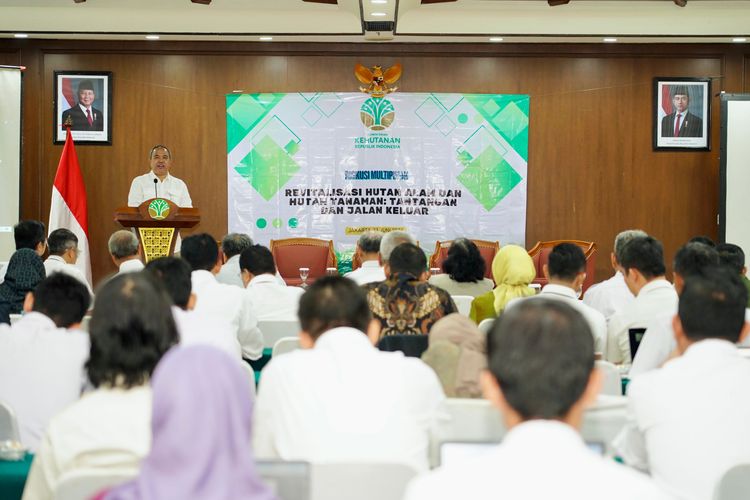
Enviro News Asia, Jakarta — The Ministry of Forestry, through its Centre for Strategic Policy (Pusjastra), is continuing to strengthen efforts toward sustainable, productive, and competitive management of natural and plantation forests. The commitment was demonstrated through the hosting of a Multi-Stakeholder Discussion themed “Natural and Plantation Forest Revitalization: Challenges and Solutions,” which served as a shared space for gathering perspectives, inputs, and strategic recommendations on forestry management.
Secretary General Mahfudz said the management of natural and plantation forests plays an important role in supporting the achievement of national development targets for the 2025–2029 period, including driving national economic growth of 8 percent.
Mahfudz outlined three key steps that need to be strengthened. First, managing forests optimally as a source of economic growth, employment, and foreign exchange earnings. Second, optimizing the implementation of forest business utilization permits (PBPH), which hold great potential for development through various multi-business forestry schemes capable of supporting food, energy, and water resilience while improving the welfare of communities around forest areas.
“This is extraordinary potential. We must push it forward and examine it together, so that the policy instruments we build can answer the problems this nation is currently facing,” Mahfudz said.
Third, transforming services based on a single data system through a Decision Support System (DSS) integrated with various partners and stakeholders, expected to improve the quality of decision-making while accelerating priority forestry sector agendas.
The government is also continuing to reform governance across production forests, protection forests, and conservation forests. In conservation areas, the Ministry of Forestry is developing more innovative and sustainable financing schemes, while in protection forests, various management aspects, including their relationship with industrial activities, are being strengthened to remain aligned with conservation principles.
“We continue to ensure forests remain sustainable, development continues, and communities become more prosperous,” Mahfudz concluded.
As part of strengthening forestry governance, the Ministry has established several strategic task forces: a Customary Forest Recognition Task Force, working with indigenous community organizations and NGOs; a Multi-Business Forestry Task Force to drive the integration of various forestry enterprises within a single area; a Carbon Task Force to strengthen the forestry sector’s role in carbon trading and the green economy; and a Digitalization Task Force tasked with reforming the forestry licensing system and expanding digital services, including non-cash payment systems and e-ticketing in conservation areas.
The multi-stakeholder discussion continued with presentations from the Ministry of Forestry’s Director for Forest Utilization Business Control, the Director of Planning and Development of Perum Perhutani, the Chairman of the Indonesian Forest Entrepreneurs Association (APHI), and forestry academics. Inputs from participants will serve as important material in formulating adaptive forest management policies.
The event forms part of ongoing efforts to refine forestry sector policy. The outcomes of the multi-stakeholder discussion will serve as strategic input in the evaluation and formulation of various forestry policies, including discussions on the revision of Law No. 41 of 1999 on Forestry, toward more effective and sustainable forest governance that delivers the greatest possible benefit to society. (*)