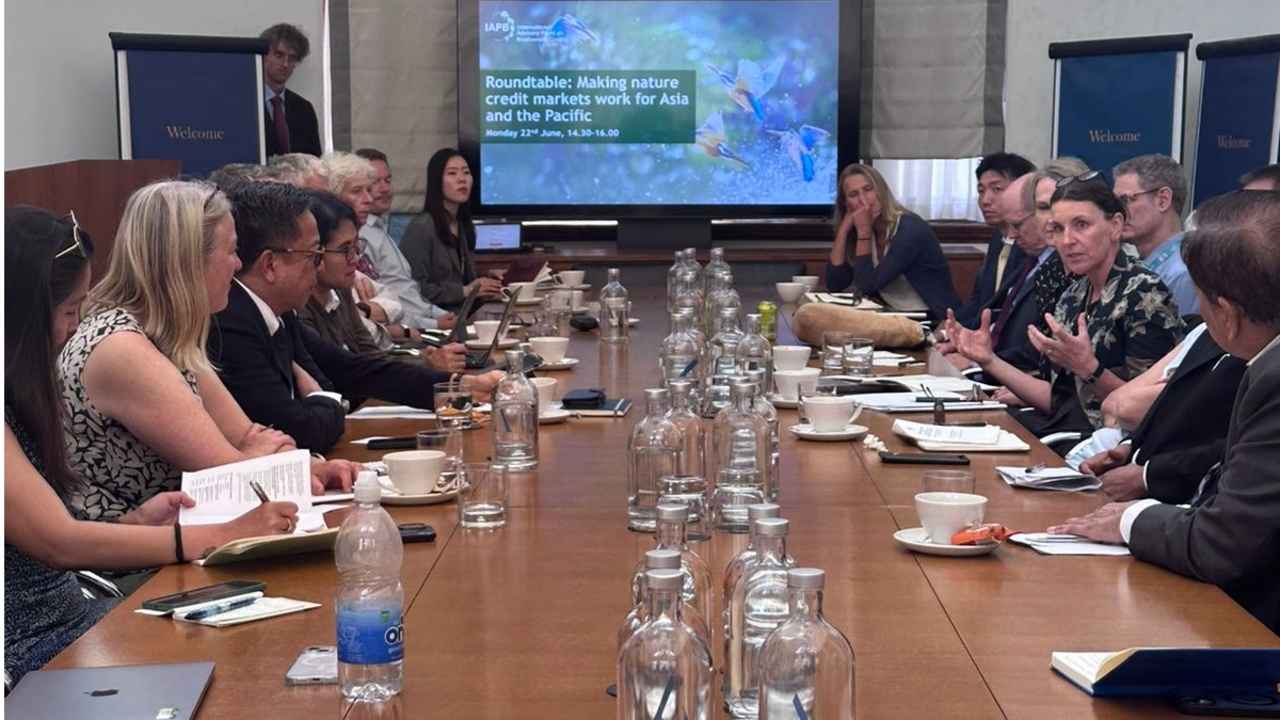
Enviro News Asia, London – The Ministry of Environment/Environmental Control Agency (KLH/BPLH) led the Indonesian delegation in formally stating the government’s position on the governance of international biodiversity markets, with Minister of Environment/Head of BPLH Moh. Jumhur Hidayat speaking at the high-level forum “Making Nature Credits Market Work in Asia and the Pacific” during London Climate Action Week.
Minister Jumhur placed particular emphasis on social integrity, warning that the design of global nature markets must not overlook those working directly on the ground.
“Let me affirm that the primary foundation of successful biodiversity credits is the fair and equitable delivery of benefits to local communities and indigenous peoples who do the real, hard work of conservation in the field,” Minister Jumhur said at the international forum.
The Indonesian delegation’s presence at the forum came at the special invitation of Dame Amelia Fawcett and Sylvie Goulard, Co-Chairs of the International Advisory Panel on Biodiversity Credits (IAPB). For KLH/BPLH, the international advisory body’s interest signals that the environmental economic instruments Indonesia is developing are regarded as sufficiently robust to serve as an important benchmark for countries across the Asia-Pacific region.
Dame Amelia Fawcett said Indonesia’s position is central to the architecture of global nature finance. “What Indonesia is doing has impact that is truly crucial and goes far beyond its own borders. The steps taken by the Indonesian government together with the Biodiversity Credits Task Force in designing a high-integrity and inclusive market capable of mobilizing new and additional finance for nature and its guardians must become a model for other countries to follow, both regionally and globally,” Amelia said.
She also underscored Indonesia’s vital ecological significance for global climate stability. “Indonesia’s coral reefs, tropical forests, and mangroves hold the most irreplaceable natural wealth on this planet. Nature credits can be a crucial instrument for preserving these rich ecosystems. IAPB supports this important work as a Knowledge Partner for Indonesia’s Task Force, and we look forward to continuing to work closely with Indonesia toward CBD COP17 and beyond,” Amelia said.
As a primary provider of natural capital, Indonesia through KLH/BPLH is pushing for the region’s ecological contributions to be valued under fair and proportionate standards. KLH/BPLH is currently designing a progressive multi-credit scheme that goes beyond measuring tree cover area to also assign economic value to the existence of endemic flora and fauna. Under this scheme, the successful protection of habitats for endangered species such as tigers and orangutans is directly integrated into the economic valuation of ecosystem markets.
In carrying out its mandate as the leading sector, KLH/BPLH is consolidating a cross-sectoral coalition involving the Ministry of Forestry, the Ministry of Marine Affairs and Fisheries, the Ministry of Agriculture, the National Research and Innovation Agency (BRIN), Bappenas, the private sector, civil society activists, and indigenous community representatives.
As a demonstration of regional leadership, Minister Jumhur initiated the formation of an “Asia-Pacific Roundtable on Biodiversity Credits” at the London forum, projected as a regional platform to harmonize regulations, share technical expertise, and ensure the interests of Asia-Pacific nations are equitably represented in the global market landscape.
Closing his remarks, Minister Jumhur delivered a reflective message on the relationship between economic growth and nature conservation.
“The time has come for our economies to finally invest back in nature. Let us work together to ensure that biodiversity credits go beyond mere financial instruments and become a genuine force for ecological revival and human well-being,” Minister Jumhur concluded. (*)