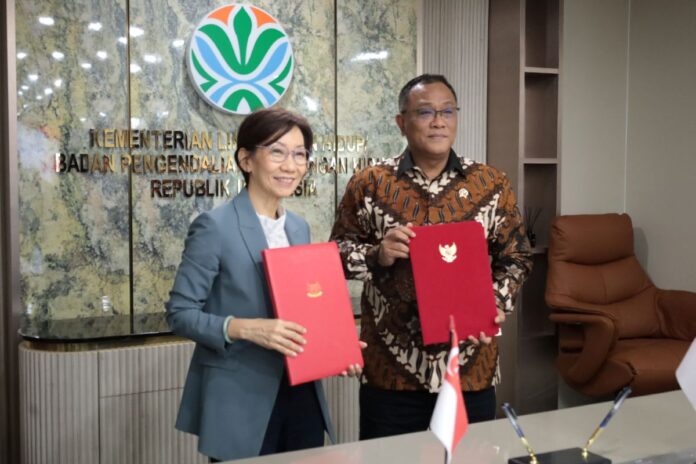
Enviro News Asia, Jakarta – The environmental crisis is not merely an ecological crisis but also a behavioral one. Without changing the way society thinks and acts, environmental policies and technologies will fail to produce sustainable change. That was the message delivered by Minister of Environment/Head of the Environmental Control Agency (KLH/BPLH) Moh. Jumhur Hidayat during a scientific oration at the 66th Dies Natalis of the Faculty of Psychology at Universitas Indonesia (UI), themed “Healing the Mind, Caring for the Earth: Psychology for a Sustainable Future,” at the UI Campus in Depok.
Minister Jumhur said KLH/BPLH is currently carrying out a major transformation in Indonesia’s environmental governance, one oriented not only toward law enforcement, pollution control, environmental restoration, and biodiversity protection, but also toward building an environmental culture as the foundation of sustainability.
“We are building an environmental culture. We believe that regulation alone is not enough. Technology alone is not enough. Investment alone is not enough. What matters most is a change in public behavior. That is why behavioral psychology has become critically important in the design of public policy,” Jumhur said.
The environmental culture the government seeks to build, he said, is one that encourages people to sort waste, reduce food waste at the household level, use low-emission transportation, instill a culture of responsible production in the business world, and make government officials role models for sustainable lifestyles.
Jumhur added that all of these changes require the support of behavioral science strengthened through psychological research. He expressed hope that UI’s Faculty of Psychology can become a center of excellence in the development of environmental psychology, behavioral insights, and evidence-based policy innovation to support environmental protection.
“All of this requires a behavioral science approach supported by psychological research. I hope the UI Faculty of Psychology can become a center of excellence in developing environmental psychology, behavioral insights, and behavioral science-based policy innovation to support environmental protection,” he said.
The Minister noted that climate change has long been discussed predominantly through the lenses of science, technology, economics, energy, and politics, while one dimension often overlooked is the psychological dimension of human behavior, which is in fact the decisive factor in the success of environmental policies.
Indonesia, he said, needs far more research on public environmental behavior, including effective climate change communication strategies and psychological approaches to building a circular economy culture, reducing waste, conserving natural resources, and increasing public participation. (*)