

Enviro News Asia, Jakarta — Researchers from Indonesia’s National Research and Innovation Agency (BRIN) have found evidence linking climate changes during the Late Miocene to Pliocene, approximately 4–7 million years ago, with increased ancient wildfire activity and a dominance of terrestrial organic material preserved in Mediterranean seafloor sediments.
The findings were presented by Ita Wulandari, a researcher at BRIN’s Research Center for Oceanography, during the seventh Oseanologi Talk Series in Jakarta on August 6. The event was themed “Unraveling Ocean Variability: Past and Present Environment to Future Climate Dynamics.”
In her presentation, “Reading Earth Environmental Story from the Mediterranean Sea Floor,” Ita explained that seafloor sediments function as natural archives that preserve evidence of environmental changes over millions of years.
The Mediterranean Sea is particularly important because its water masses flow toward the North Atlantic Ocean, making the region relevant to global carbon circulation and climate dynamics.
“Through organic geochemical biomarker analysis of sediment core samples from the Alboran Sea collected during IODP Expedition 401, we can reconstruct how ancient warm climates, changes in deep-sea conditions and increased wildfire activity on land were recorded in organic molecules,” Ita said.
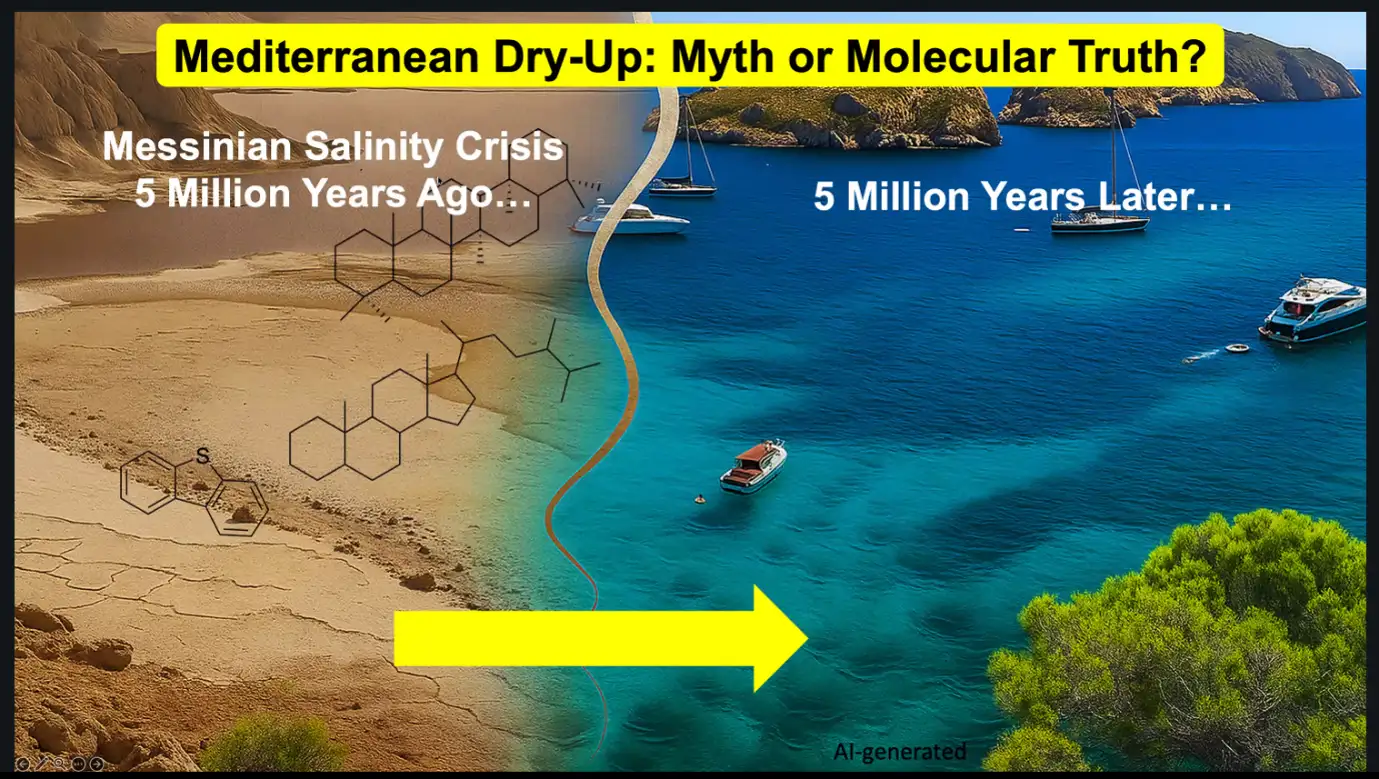
One of the geological events examined in the research was the Messinian Salinity Crisis, which occurred approximately five million years ago. During this period, the Mediterranean underwent extensive desiccation, resulting in the formation of salt deposits, or halite, that reached nearly 1.5 kilometers in thickness and accounted for an estimated five percent of the world’s marine salt deposits.
To reconstruct environmental conditions during the period, the research team extracted and purified sediment samples before separating their aliphatic and aromatic fractions. The samples were subsequently analyzed using Gas Chromatography-Mass Spectrometry (GC-MS) and GC-MS/MS.
The analysis showed that the organic matter preserved in the sediments remained thermally immature, indicating that ancient biomarkers had been well preserved and could still provide information about environmental conditions millions of years ago.
GC-MS analysis identified approximately 100 aromatic compounds in each sediment sample. Researchers recorded increased concentrations of five pyrogenic polycyclic aromatic hydrocarbon (PAH) proxies: coronene, benzo(a)pyrene, triperylene, chrysene and benzo(bjk)fluoranthene.
These compounds indicate an increase in the frequency of ancient wildfires during the third phase of the Messinian Salinity Crisis.
The researchers also found high concentrations of biomarkers such as retene and cadalene, indicating substantial inputs of terrestrial vegetation, particularly gymnosperms, including woody plants such as conifers.
“The high abundance of biomarkers such as retene and cadalene confirms the dominance of terrestrial higher-plant inputs, particularly gymnosperms, transported into the sea under the warm and humid climatic conditions of that period,” Ita said.
The study also revealed changes in the conditions of the Mediterranean seafloor. Based on the pristane/phytane ratio, the bottom-water environment shifted from anoxic, or oxygen-poor, conditions during the Messinian period to more oxygen-rich, or oxic, conditions during the Pliocene.
To further strengthen the findings, Ita received an international research grant from Elsevier. In November 2026, she and her team are scheduled to conduct stable carbon isotope analysis using Compound-Specific Isotope Analysis (CSIA) at Curtin University in Australia.
The analysis will help determine the source of perylene compounds and establish whether they originated from wood-degrading fungi or were also influenced by marine algae.
The results are expected to be presented at the Australian Organic Geochemical Conference (AOGC).
The research demonstrates that seafloor sediments preserve not only records of past oceanographic conditions but also evidence of interactions among climate, terrestrial vegetation and ancient wildfire activity. Such records provide valuable insights into Earth’s climate system and environmental responses to climate change over geological timescales. (*)