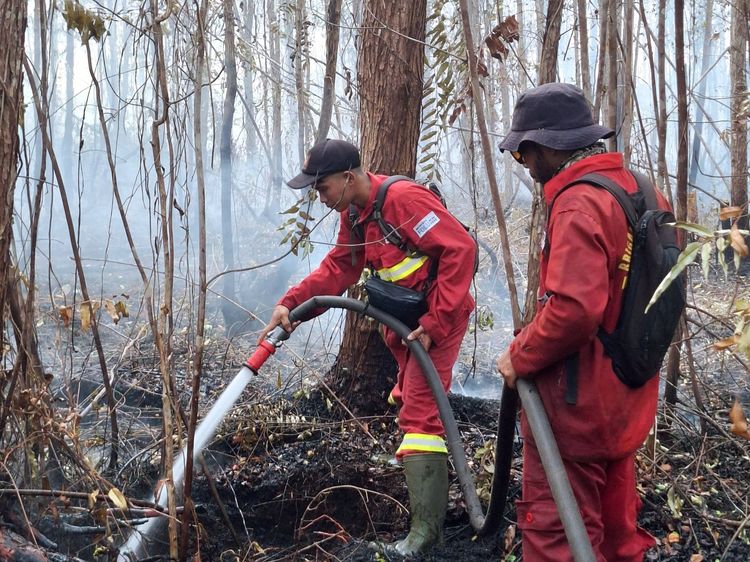


Enviro News Asia, Fakfak — PT Kesatuan Mas Abadi (KMA), a member of the Indonesian Forestry Entrepreneurs Association (APHI), assisted forest and land fire suppression efforts in Tomage and along the Tomage–Aroba corridor in West Papua during August and September 2026.
The operations involved deploying personnel and equipment and coordinating with local authorities and communities. Firefighting activities covered both sides of the Trans-Papua Highway along the Tomage–Aroba corridor, as well as an area behind Sanggwar Village in Aroba District.
Yulius Yawena, an elder of the Yawena clan, said he and other Yawena residents had frequently helped PT KMA extinguish fires along both sides of the Trans-Papua Highway in the Tomage–Aroba corridor. Their involvement formed part of a joint effort to tackle fires around the route connecting the two districts.
“We and other Yawena residents often help PT KMA put out fires on both sides of the Trans-Papua Highway. Cooperation between communities and companies is necessary to ensure that firefighting efforts in the field are carried out jointly,” Yulius said.
He expressed hope that cooperation among communities, companies, district governments and local authorities would continue to strengthen in both fire suppression and prevention. He said communication about fire locations and assistance requirements needed to be maintained so that responses could be coordinated promptly to protect settlements, road access and the surrounding environment.
PT KMA Forest Management Manager Hengky explained that the company had worked with the Bomberay Tomage Military Subdistrict Command and the 808 Tomage Territorial Development Battalion to support forest and land fire control. The cooperation also included firefighting training and capacity building for battalion personnel.
“We deploy personnel and equipment to support firefighting operations while coordinating with local stakeholders. Records of field activities are also valuable for making implementation easier to track,” Hengky said.
He explained that firefighting behind Sanggwar Village in Aroba District was conducted jointly with local residents. Meanwhile, firefighting personnel and vehicles were deployed to tackle fires along the Tomage–Aroba corridor.
Beyond suppression operations, KMA coordinated with the Aroba and Tomage district governments and conducted public outreach to raise awareness of forest and land fire prevention. These activities included distributing warnings and brochures prohibiting land burning.
Preparedness measures included routine patrols, hotspot monitoring, and inspections of firefighting equipment and water reservoirs. The company also updated records of firefighting facilities and infrastructure and reported its fire control activities to relevant government agencies and APHI.
“We have also established and trained three Community Fire Care Groups in Wasa Mulia, Tomage and Wamosan, each consisting of 15 members. Community involvement is intended to strengthen prevention, increase vigilance against potential fires and accelerate information sharing so that responses can be coordinated at an early stage,” Hengky said.
Haryoto, head of APHI’s regional chapter for West Papua and Southwest Papua, said company participation needed to be supported by adequate personnel, equipment and clear activity reporting.
“Encouraging companies to play an active role must translate into operational readiness, equipment availability and coordination. Every activity also needs to be documented so that regional governments have clear information about the support available,” Haryoto said.
He added that activity reports should specify locations, implementation periods, and the types of personnel and equipment deployed. Such information is necessary to assess each party’s contribution and identify outstanding operational needs.
“Data on forest and land fire management will be highly valuable in strengthening coordination and collaboration, enabling every stakeholder to contribute as effectively as possible,” he said.
The involvement of companies, security personnel, district governments, clan elders and local communities is expected to strengthen forest and land fire prevention and suppression in Tomage, Aroba and surrounding areas. Continued coordination and information sharing will help ensure that firefighting assistance is delivered according to operational needs while protecting communities, road access and the environment. (*)