Enviro News Asia, North Maluku – The Indonesian Forest Concession Holders Association (APHI) has called for the development of forest carbon environmental services as a key driver of forestry business transformation in Maluku and North Maluku, following the declining performance of natural forest concession holders (PBPH).
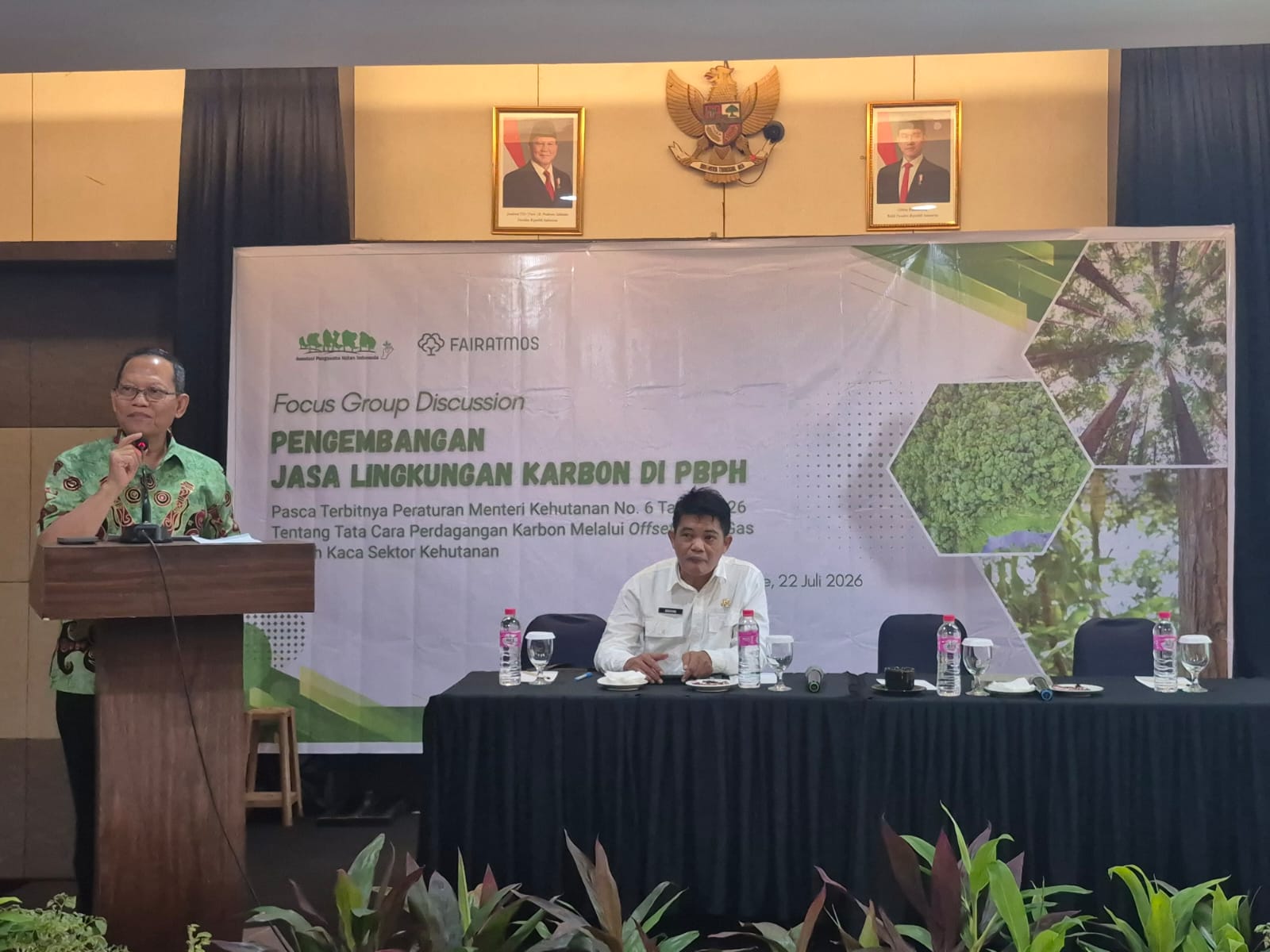
The initiative was highlighted during a Focus Group Discussion (FGD) on Forest Carbon Environmental Services for PBPH concession holders following the issuance of the Ministry of Forestry Regulation No. 6 of 2026 on Carbon Trading through Greenhouse Gas Emission Offsets in the Forestry Sector, held in Ternate on Wednesday.
APHI Chairman Soewarso said the new regulation represents a significant milestone by providing legal certainty for forestry businesses seeking to develop carbon environmental services as part of a sustainable business model.
“Ministry of Forestry Regulation No. 6 of 2026 confirms that forests generate not only timber but also carbon environmental services with substantial economic value,” Soewarso said.
He noted that Maluku and North Maluku possess significant carbon sequestration and storage potential. However, carbon project development continues to face challenges, including high project costs, the need for credible data and methodologies, market certainty, and balancing conservation, production, and community interests.
APHI urged the government to ensure that carbon trading implementation remains simple, efficient, and supported by clear business regulations. The association also called for streamlined licensing procedures, stronger human resource capacity, improved data availability, and better market access.
“APHI is ready to serve as a strategic partner to the government in supporting the implementation of carbon trading and strengthening communication between businesses and all relevant stakeholders,” Soewarso said.
APHI North Maluku Regional Chair Arief Budiantoro described the new regulation as an important opportunity for PBPH concession holders to diversify their business activities.
“The declining performance of natural forest concessions must be addressed through business transformation. Carbon environmental services under the Multi-Business Forestry framework can become one of the main entry points,” Arief said.
He explained that carbon projects have the potential to integrate forest conservation, greenhouse gas emission reductions, community empowerment, and improved business performance. The discussion was intended to strengthen participants’ understanding of carbon regulations, project development, methodologies, financing mechanisms, and market opportunities.
Head of the North Maluku Provincial Forestry Office Basyuni Thahir welcomed the initiative, commending APHI and its regional chapter for organizing the discussion to enhance the forestry sector’s understanding of carbon environmental services.
“The North Maluku Provincial Government welcomes the issuance of Ministry of Forestry Regulation No. 6 of 2026 and is currently preparing a jurisdictional carbon trading framework. We look forward to APHI’s support throughout this process,” Basyuni said.
He expressed hope that carbon environmental services would strengthen the forestry sector’s contribution to the provincial economy while supporting forest conservation and improving community welfare.
The Ternate forum marked the third event in APHI’s carbon trading discussion series organized in collaboration with Fairatmos, following previous sessions in Papua and Riau.
Through the initiative, APHI aims to strengthen collaboration among government institutions, forestry businesses, academia, local communities, and other stakeholders to develop a credible, transparent, and sustainable forestry carbon market in Indonesia. (*)