

Enviro News Asia, Samarinda — The Indonesian Forest Concessionaires Association (APHI) has stepped up efforts to prevent forest and land fires in East Kalimantan by strengthening hotspot early-warning systems, improving the readiness of forest concession holders and providing clean water to communities affected by drought during the 2026 El Niño period.
The measures include issuing preparedness circulars, reinforcing fire prevention teams and their equipment, monitoring daily hotspots through the Forestry Ministry’s SIPONGI platform, ensuring compliance with reporting requirements through SIPASHUT, and supporting firefighting operations beyond company concession areas.
APHI’s East Kalimantan regional chapter said its approach extended beyond protecting individual Forest Utilisation Business Permit (PBPH) areas to safeguarding surrounding ecosystems and communities.
Preparations began on April 17, 2026, when APHI issued Circular Letter No. 040/SI/Komda Kaltim-APHI/PUK/IV/2026 on early preparations for forest and land fires amid the anticipated El Niño conditions.
The letter urged all member companies holding PBPH permits to strengthen their readiness ahead of the dry season peak. The move followed the Meteorology, Climatology and Geophysics Agency’s (BMKG) forecast that El Niño could develop from May 2026, potentially reducing rainfall and increasing fire risks in several regions, including East Kalimantan.
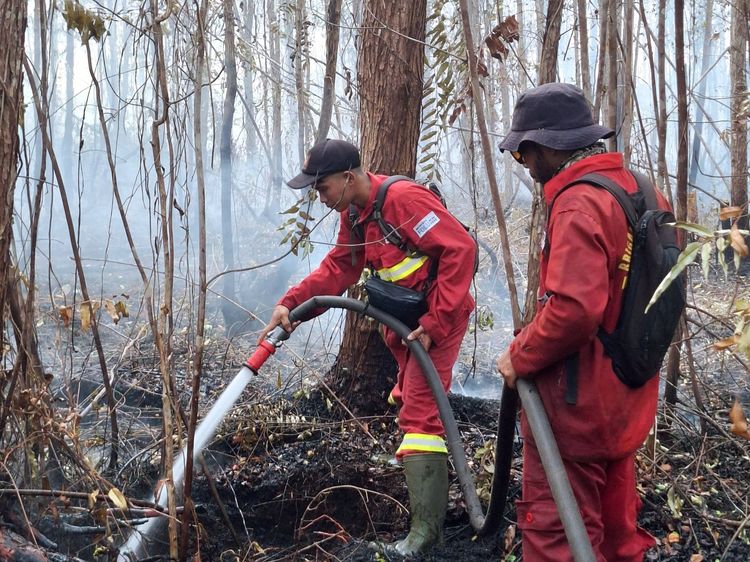
Companies were instructed to ensure the availability and readiness of firefighting equipment, pumps, hoses, water sources, reservoirs, observation towers and early-detection systems.
They were also asked to activate their fire prevention teams, prepare personnel and field command systems, intensify integrated patrols in fire-prone areas, and strengthen coordination with the East Kalimantan Forestry Office, the 13th Regional Forest Management Office in Samarinda, regional disaster management agencies, the military, police and other relevant institutions.
The companies were further urged to educate local communities about the prohibition on land clearing through burning and submit preparedness reports to APHI’s East Kalimantan chapter before the peak of the dry season.
Readiness requirements were reinforced through another circular, No. 082/SE/Komda Kaltim-APHI/OKE/IX/2026, issued on Sept. 18, 2026. It called for improved firefighting infrastructure and rapid responses to hotspot early warnings.
Under the directive, member companies must ensure that firefighting equipment, pumps, hoses, nozzles, operational vehicles, water supplies, communication facilities, patrol equipment and firefighting personnel are available and ready for deployment. Regular inspections must also be conducted and documented.
APHI said effective fire response depended heavily on the speed of personnel mobilisation, equipment availability, access to water sources and the ability to verify potential fires in the field.
APHI East Kalimantan chapter chairman Asrul Anwar emphasised that prevention and preparedness must be established well before fires occur.
“Preparedness cannot be built only after a fire breaks out. Prevention, monitoring, early detection and resource readiness must be in place from the outset so that every potential fire can be addressed promptly in the field,” he said.
As part of its early-warning system, APHI’s East Kalimantan chapter regularly distributes daily hotspot information to member companies using data from the Forestry Ministry’s Forest and Land Fire Monitoring System, known as SIPONGI.
The alerts focus particularly on hotspots detected within or near company concession areas. Each report must be followed up immediately by checking the coordinates, comparing the location with concession boundaries and conducting field verification.
The process is intended to determine whether a satellite detection represents a surface-temperature anomaly or an actual fire requiring suppression.
APHI’s broader response also includes assistance for communities facing water shortages. The association has supported the provision of clean-water storage facilities, including a 5,500-litre water tank for residents of Sotek in Penajam Paser Utara district affected by prolonged drought.
Through these measures, APHI aims to strengthen coordination between forestry companies, government agencies and local communities to reduce fire risks, protect forest areas and improve resilience during prolonged dry conditions. (*)