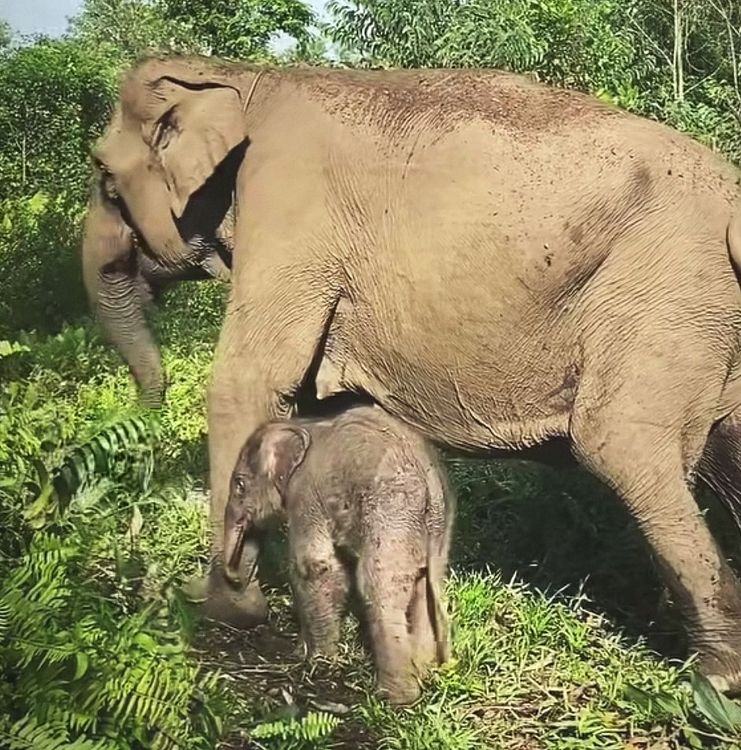
Enviro News Asia, Riau — Encouraging news has emerged from Tesso Nilo National Park, where a female Sumatran elephant calf has been born at the Elephants Flying Squad Camp, marking another milestone in Indonesia’s efforts to conserve one of the world’s most endangered mammals.
The calf was discovered at approximately 7:30 a.m. local time on Wednesday by mahout Erwin Daulay while transferring elephants from their tethering area to a grazing site. About one kilometer from the Sumatran Elephant Conservation Resort post, he found the newborn calf alongside its placenta. Initial observations by the mahout and subsequent examinations by veterinarians confirmed that the calf was active, capable of standing, and nursing normally, with no signs of physical abnormalities.
Head of Tesso Nilo National Park Heru Sutmatoro said both the mother, named Ria, and the calf are under close observation to ensure their continued health and recovery.
“This newborn and its mother are being continuously monitored by our veterinary team to ensure both remain in good condition,” Heru said.
The calf is the fifth offspring born to Ria through breeding with wild elephants. Her previous calves were named Tesso, Tino, Harmoni, and Domang.
Indonesia’s Ministry of Forestry, through the Directorate General of Natural Resources and Ecosystem Conservation (KSDAE), described the birth as evidence of the success of long-term conservation efforts in the park.
Over the past eight years, the Elephants Flying Squad at Tesso Nilo National Park has recorded four births from two domesticated female elephants, Lisa and Ria. The successive births reinforce the importance of Tesso Nilo as a critical habitat contributing to the recovery of the Sumatran elephant population.
In 2011, the International Union for Conservation of Nature classified the Sumatran elephant as Critically Endangered (CR). The species is also protected under Indonesia’s Ministerial Regulation No. P.106/MENLHK/SETJEN/KUM.1/12/2018.
With the arrival of the new calf, the total elephant population at the Elephants Flying Squad Camp has increased to eight individuals, consisting of three adult elephants, two juveniles, and three calves.
The Ministry of Forestry emphasized that the birth serves as further motivation to strengthen conservation measures aimed at protecting Sumatran elephants and preserving the forest ecosystems that sustain them. (*)