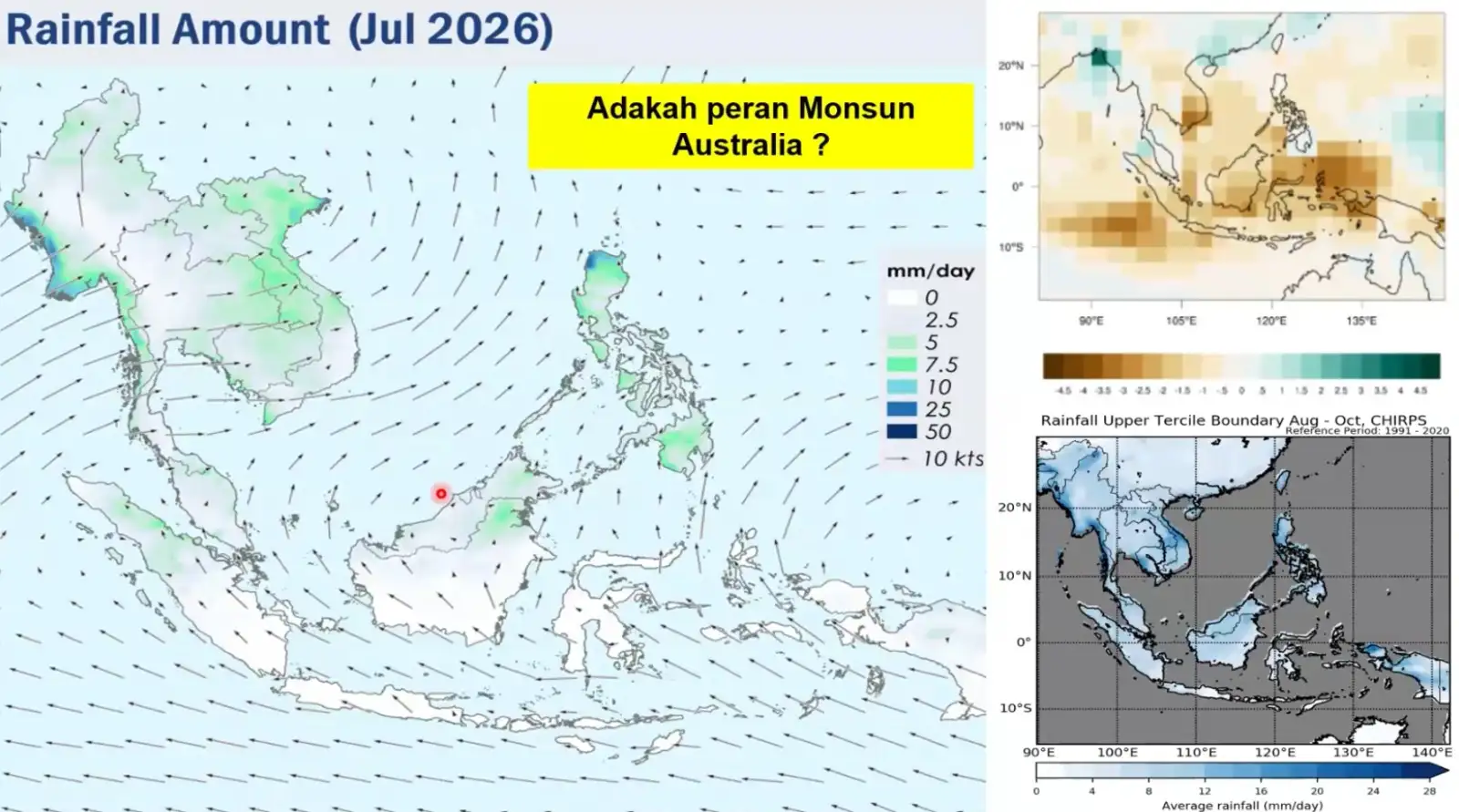
Enviro News Asia, Bandung — The Indonesian National Research and Innovation Agency (BRIN) has emphasized the importance of understanding climate dynamics and the interaction of multiple climate indicators to anticipate increasing risks of forest and land fires (karhutla), particularly as El Niño is projected to strengthen in 2026. The issue was discussed during BRIN’s Center for Climate and Atmospheric Research webinar, “Peat Wildfires: A 3-Part Special Series,” held online on Friday, August 28, 2026. BRIN Principal Researcher Eddy Hermawan said assessing El Niño based solely on sea surface temperatures in the Niño 3.4 region could provide an incomplete picture of potential impacts on Indonesia. He said the Indian Ocean Dipole (IOD) and the presence of cold pools around Indonesia should also be considered. “If the analysis is based only on Niño 3.4, we could be misled. Including the IOD provides a more accurate analysis,” Eddy said while presenting his study, “Super El Niño, Long Dry Season, and Warming of the Indonesian Maritime Continent.” According to Eddy, the IOD deserves attention comparable to the El Niño-Southern Oscillation (ENSO). If the IOD does not reinforce El Niño conditions and cold pools remain over Indonesian waters, the resulting impacts could be less severe than those experienced during the major El Niño events of 1997 and 2015. The interaction between Niño 3.4, the IOD and cold pools can influence the strength of the Australian monsoon, which carries dry air toward Indonesia. This can increase the vulnerability of areas with monsoonal rainfall patterns, including parts of Sumatra and Kalimantan, particularly when prolonged dry conditions coincide with peatland ecosystems that are highly susceptible to fire. Eddy based his analysis on approximately 76 years of observational data, combining conventional analytical methods with machine learning to examine El Niño patterns, intensity and the periods when its impacts on Indonesia could become most critical. He identified October to December 2026 as a period requiring particular attention as scientists continue to monitor developments in climate conditions. Eddy also highlighted the importance of studying cold pools in eastern Indonesia because their presence and movement could influence the development and impacts of El Niño. Beyond seasonal climate variability, Eddy stressed that global climate change presents an additional challenge. Increasing extreme events underline the need to strengthen monitoring and mitigation systems to reduce potential impacts on ecosystems, public health and food production. He cautioned that terms such as “Super El Niño” or “Godzilla El Niño” should be supported by comprehensive scientific analysis rather than being determined by a single climate indicator. For Indonesia, a deeper understanding of interactions among ENSO, the IOD, atmospheric conditions and ocean dynamics is particularly important for improving preparedness for prolonged dry conditions and potential forest and land fires. Strengthening climate monitoring and early assessment, BRIN said, can help provide a stronger scientific basis for anticipating environmental risks and supporting mitigation measures before extreme conditions develop. (*)