

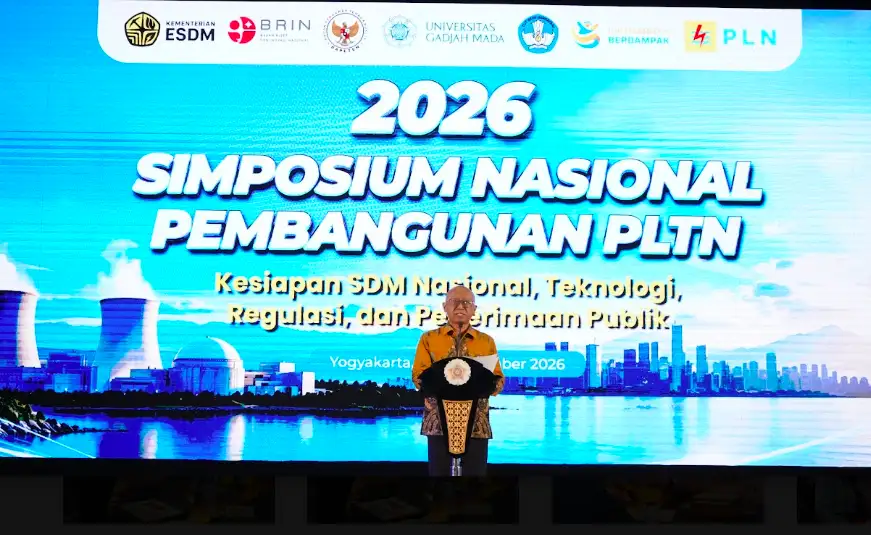
Enviro News Asia, Yogyakarta — Indonesia is consolidating national readiness for the development of its first nuclear power plant (PLTN), with the National Research and Innovation Agency (BRIN) identifying four key areas that must advance simultaneously: human resources, technological and industrial independence, regulatory and licensing readiness, and social-economic preparedness.
The commitments emerged from the National Symposium on Nuclear Power Plant Development in Yogyakarta, which brought together government institutions, regulators, research organizations, universities, businesses, industry representatives, professional associations, and other stakeholders.
BRIN Head of Nuclear Energy Research Organization Syaiful Bakhri said Indonesia already has important foundations, including nuclear research capabilities, experienced personnel, institutional capacity, and a regulatory framework that continues to be strengthened. The challenge, he said, is to consolidate these resources into an integrated national capacity.
“Nuclear power plant development is a strategic step that cannot be postponed. Our readiness is not only about mastering nuclear technology, but also about integrated national preparedness,” Syaiful said.
The first commitment focuses on human resources. PLTN development requires qualified personnel throughout the project cycle, from preparation and design to construction, commissioning, and operation. BRIN therefore considers education, training, competency development, and inter-institutional cooperation essential to building a sustainable nuclear workforce.
The second commitment concerns technological and industrial independence. The development of the first PLTN is expected to become more than an electricity-generation project by strengthening Indonesia’s domestic technological capabilities and industrial capacity. Greater participation from national industries is considered important for building long-term capabilities.
The third area involves regulatory and licensing certainty. Indonesia needs an integrated legal and regulatory framework to provide clarity for the program while maintaining independent oversight and applying the principles of safety, security, and safeguards.
The fourth commitment covers social and economic preparedness. Local communities and regional governments are expected to be involved from the early stages to build public trust and legitimacy while ensuring that the economic benefits of the project can reach communities around the development area.
Syaiful said the four areas cannot be developed separately. Advanced nuclear technology, he noted, would not be sufficient without competent personnel, capable domestic industries, clear regulations and institutions, as well as public acceptance and confidence.
The symposium also called for the preparation of an Integrated Nuclear Power Plant Readiness Roadmap. The document is expected to serve as a common reference for aligning policies, programs, institutional capacities, and resources toward the development of Indonesia’s first PLTN.
Through the roadmap, stakeholders are expected to establish clearer roles, measurable targets, and a coordinated approach to addressing remaining capacity gaps.
BRIN said the consolidation of national readiness is also intended to support Indonesia’s transition toward a cleaner, reliable, and sustainable energy system. Beyond electricity supply, nuclear power development is expected to generate broader economic benefits, including employment and more balanced regional development. (*)