

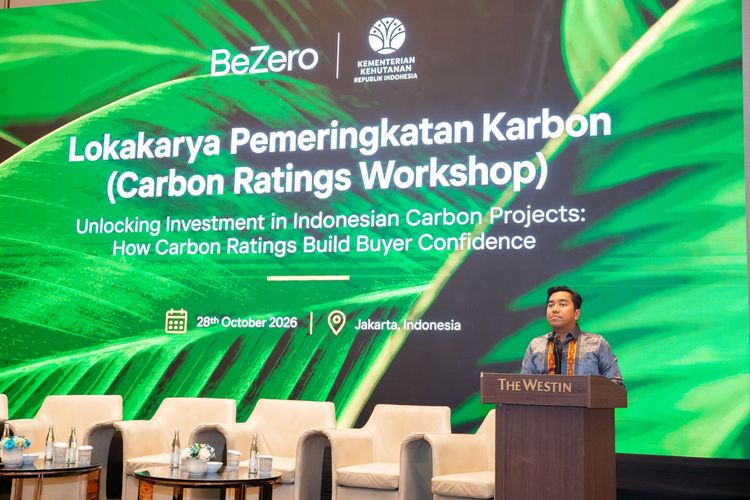
Enviro News Asia, Jakarta — Indonesia’s Forestry Ministry and carbon-rating agency BeZero have joined forces to strengthen buyer confidence in forest-based carbon credits and attract investment into the country’s carbon projects through independent assessments of project quality.
The two organizations held a Carbon Rating Workshop titled “Unlocking Investment in Indonesian Carbon Projects: How Carbon Rating Builds Buyer Confidence” in Jakarta on Oct. 28. Organized through the Indonesia Forestry Carbon Hub (IFCH), the event brought together government representatives, project developers, business associations, civil society organizations and carbon market participants.
The workshop was opened by Ilham, Director of Forest Utilization Business Development, and closed by Forestry Minister’s Senior Adviser Edo Mahendra.
Ilham said Indonesia’s substantial potential for forest-based carbon projects must be supported by market integrity and accountable credit quality. He emphasized that buyers and investors consider not only the volume of carbon credits generated but also their quality, transparency, credibility and long-term environmental and social benefits.
Each carbon credit, he said, must represent measurable, verifiable and accountable emissions reductions or increased carbon removals.
Credible ratings can help narrow information gaps between project developers and prospective buyers, support investment decisions and improve the competitiveness of Indonesian carbon projects in international markets. Carbon trading also offers opportunities to develop environmental services as part of multi-business forestry activities within Forest Utilization Business Licensing (PBPH) areas.
Indonesia’s forestry carbon trading framework is supported by Presidential Regulation No. 110 of 2025 and Forestry Ministerial Regulation No. 6 of 2026 on procedures for greenhouse gas emissions offset trading in the forestry sector.
The regulations are intended to strengthen sustainable forest management, support the FOLU Net Sink 2030 target and Indonesia’s Second Nationally Determined Contribution (NDC), while delivering tangible benefits to communities.
Carbon ratings provide independent assessments of the quality and risks associated with carbon credits. They offer additional information for buyers and investors but do not replace certification standards or formal validation and verification processes.
BeZero General Manager for Asia-Pacific Finn O’Muircheartaigh presented the agency’s rating methodology, international buyers’ demand for third-party assessments and the relationship between project quality and carbon credit prices.
According to BeZero’s presentation, six of the eight Indonesian nature-based solutions projects it has rated received grades of A or higher.
The agency also presented a case study of the Katingan peatland project. Market data shared during the workshop showed that after the project’s rating was upgraded from A to AA in February 2025, the price of its 2020-vintage credits increased from approximately US$4 to more than US$7 per ton of carbon dioxide equivalent (CO₂e).
The example illustrated how information about project quality can influence buyer perceptions and market demand.
The workshop continued with group discussions and panel sessions covering project quality, carbon credit marketing strategies, financing access and experiences from businesses and communities involved in forestry carbon projects.
In his closing remarks, Edo Mahendra said Indonesia must translate progress in regulatory development into concrete activities that reduce emissions and increase carbon removals.
He argued that the main challenge was no longer simply developing policies but ensuring their implementation produced measurable results on the ground.
Edo also highlighted the importance of collaboration and a strong knowledge-based community capable of designing, financing and implementing high-quality carbon projects.
Independent ratings, he said, could help clarify risk perceptions, strengthen buyer interest and support price formation while connecting government policies with project development.
He expressed hope that the workshop would lead to practical improvements in Indonesia’s carbon trading implementation rather than remain solely a learning exercise.
The Forestry Ministry expects stronger cooperation among government institutions, project developers, rating agencies, buyers, investors and local communities to improve project quality and transparency, expand financing access and strengthen the international competitiveness of Indonesia’s forestry carbon credits. (*)