

Enviro News Asia, Jakarta — Indonesia’s National Research and Innovation Agency (BRIN) has developed a cassava-based fire suppressant that showed greater effectiveness than water in a limited field trial targeting peatland fires in Central Kalimantan.
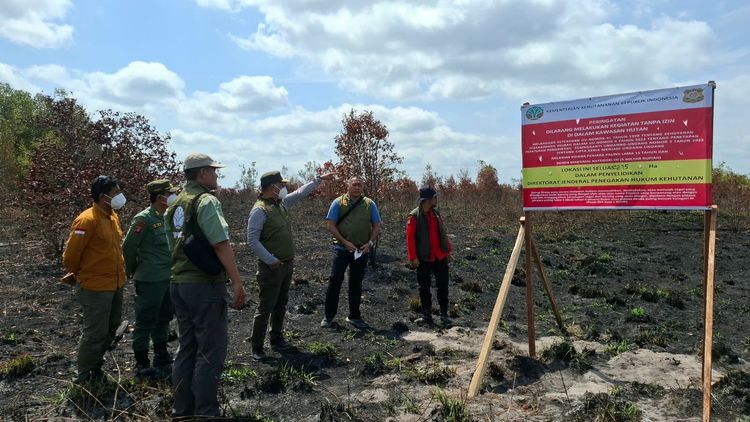
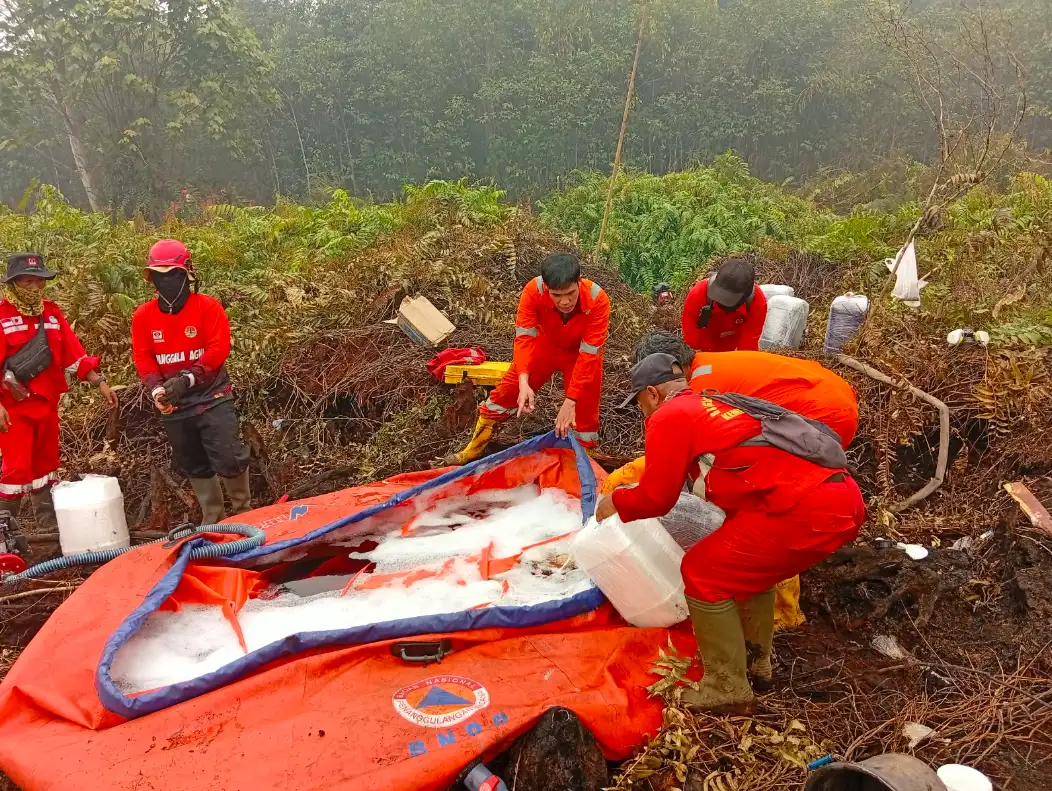
The formulation, known as Singkong-APP, extinguished all detected hotspots across four test plots in Jabiren village, Pulang Pisau regency, during a field test on Nov. 5, 2026. By comparison, plots treated with ordinary water still had seven remaining hotspots.
The trial also recorded a significant difference in subsurface temperatures. At a nominal depth of 60 centimetres, the average temperature after treatment with Singkong-APP was around 31 degrees Celsius, compared with approximately 106 degrees Celsius in areas treated with water.
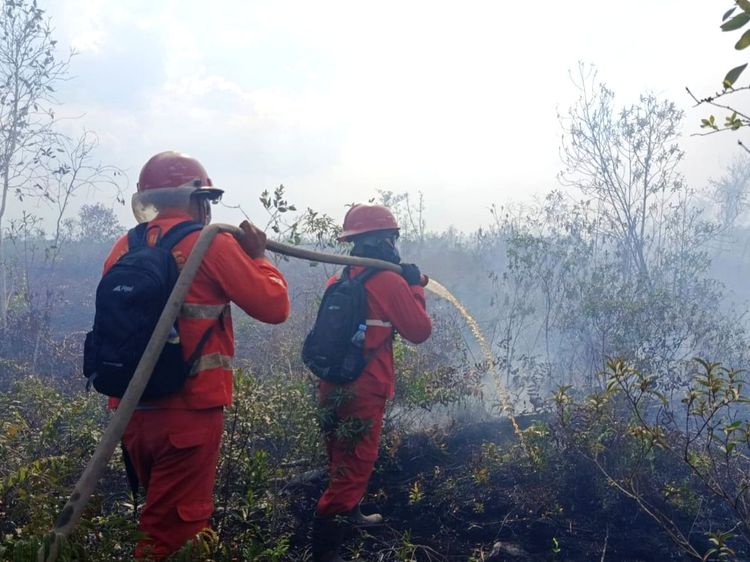
The findings could offer a new approach to tackling peatland fires, which are difficult to extinguish because burning material can remain smouldering beneath the surface even after visible flames have disappeared.
Julinton Sianturi, a researcher at BRIN’s Molecular Chemistry Research Centre, said the formulation was developed to address the limitations of conventional firefighting methods in peat ecosystems.
“Water alone sometimes cannot reach all parts of the peat that are burning. As a result, embers remaining underground can trigger fires again,” he said in an interview with BRIN on Nov. 9.
Singkong-APP combines cassava starch, ammonium polyphosphate (APP) and a wetting agent known as APG. The formulation is designed to cool burning material while improving the penetration of firefighting liquid into peat and helping suppress combustion.
During the Jabiren trial, researchers compared four treatments: ordinary water, water mixed with APG, Singkong-APP and Flame Freez, a commercial fire suppressant.
Each treatment was applied to four plots measuring 2.5 by 2.5 metres. The researchers used the same volume of 125 litres per plot, applying the solutions through surface spraying and direct injection into the peat.
Post-treatment observations found no remaining hotspots in any of the four plots treated with Singkong-APP. Water mixed with APG left four hotspots, while Flame Freez left two. Ordinary water recorded seven remaining hotspots.
The researchers said the results indicated that Singkong-APP could help control residual combustion, which often allows peat fires to reignite after initial firefighting efforts.
How the Cassava-Based Formula Works
Cassava was selected because it is widely available in Indonesia and contains starch with properties that can help form a protective layer when exposed to high temperatures.
In the formulation, water cools the burning material, while APG improves wetting so the liquid can penetrate peat more effectively.
Cassava starch and APP serve as additional components intended to inhibit combustion. Under high temperatures, APP can produce phosphate compounds that promote the formation of a protective carbon layer, or char, from the starch.
This layer can help limit heat transfer and reduce the fuel’s exposure to oxygen, slowing the combustion process.
Unlike conventional surface spraying alone, Singkong-APP can also be injected directly into peat to reach burning material below ground.
Further Testing Needed
BRIN reported another promising result from a separate 12-hour observation. No combustion was detected in material treated with Singkong-APP, which recorded a temperature of around 28 degrees Celsius. By contrast, material treated with ordinary water still contained embers reaching 650 degrees Celsius.
The findings suggest that the formulation may be more effective than water in suppressing underground smouldering under the tested conditions.
However, Julinton cautioned that its ability to prevent recurring fires over longer periods still requires further monitoring and verification of subsurface temperatures.
Additional trials are needed across different peat depths, moisture levels, fire intensities and affected areas. Researchers must also assess the product’s environmental safety and long-term performance before it can be considered ready for wider operational use.
Julinton said the research could eventually support the development of an effective and affordable firefighting product based on domestic resources.
“We hope Singkong-APP can be developed into an effective, economical forest and land fire suppressant using local resources and manufactured independently in Indonesia,” he said.
Beyond improving firefighting operations, the technology could help reduce ecosystem damage, greenhouse gas emissions and smoke exposure associated with peatland fires.
BRIN said the next stage would involve larger-scale field trials, long-term effectiveness assessments, environmental safety evaluations and production development. Collaboration with the government and industrial partners would also be needed to accelerate its development and potential deployment. (*)