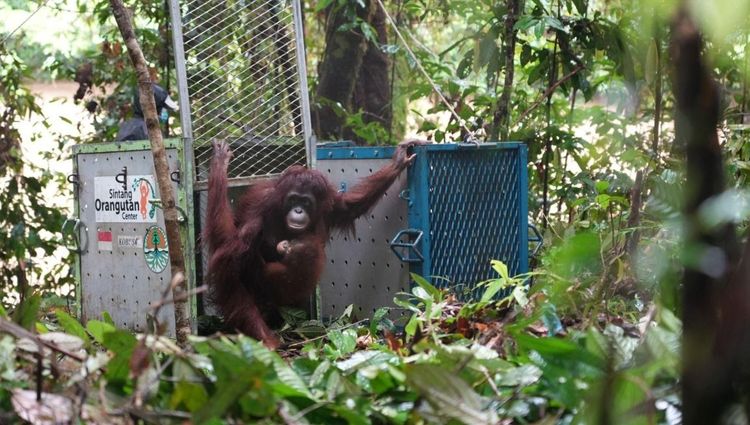
Enviro News Asia, Kapuas Hulu – The Ministry of Forestry, through the West Kalimantan Natural Resources Conservation Agency (BKSDA) together with the Betung Kerihun and Danau Sentarum National Park Agency (BBTNBKDS) and the Sintang Orangutan Conservation Foundation (YPOS/SOC), have once again joined forces to conserve protected wildlife. On June 30, 2026, five rehabilitated orangutans, comprising one male and four females, were released back into their natural habitat in the Mendalam Sub-Watershed, Betung Kerihun National Park.
The five individuals are Benazir (14 years old), Jamilah (25 years old) together with her offspring Ulin (1 year old), and Sinta (13 years old) together with her offspring Sabine (2 years old). All were declared physically and behaviorally ready following intensive rehabilitation at the Jerora Forest School, along with medical examinations and one month of pre-release quarantine.
The release marks the 18th stage of the Orangutan Release Program. Since the collaboration began in 2017 through December 2025, 17 release stages have been successfully carried out, with a total of 39 individual orangutans, comprising 37 rehabilitated and two translocated, released in the Betung Kerihun National Park area. The released orangutans belong to the subspecies Pongo pygmaeus pygmaeus and Pongo pygmaeus wurmbii.
Pre-departure preparations were carefully designed to minimize stress on the animals. Transportation covered both land and water routes from Sintang to Putussibau and on to the release station, totaling around 10 to 12 hours. Before being fully released, the orangutans rested in habituation enclosures to allow physical and psychological recovery after the journey.
The Mendalam Sub-Watershed in Betung Kerihun National Park was selected as the release site based on a comprehensive ecological study, which found an abundance of orangutan food vegetation, accounting for 52 percent of total flora species found, along with highly adequate habitat carrying capacity. Beyond strengthening the conservation of protected wildlife, the effort to restore orangutan populations in their natural habitat also aligns with the FOLU Net Sink 2030 agenda, reinforcing the forest area’s function as a carbon absorber, biodiversity guardian, and ecosystem buffer.
Post-release monitoring commitments remain in place. A monitoring team of eight to twelve personnel will conduct intensive surveillance using the nest-to-nest method, following the orangutans from the time they wake up in the morning until they return to their nests in the afternoon, for up to three months. The monitoring aims to ensure all five orangutans are able to adapt, forage independently, and survive in the wild without dependence on humans.
Head of the Betung Kerihun and Danau Sentarum National Park Agency Titik Wurdiningsih expressed hope that the release of five orangutans, and future releases at Betung Kerihun, will ensure the species’ continued survival so that future generations can still see them in the wild.
“Camp Mentibat, PTN Nanga Hovat Resort is hoped to be developed in the future as a research and education center, especially related to orangutans. Likewise, the natural beauty along the route to the release site can be developed for white-water rafting eco-tourism,” Titik said.
Head of the West Kalimantan BKSDA Murlan Dameria Pane said the success of the 18th release is the fruit of long-standing consistency and dedication in the animal rehabilitation process, stressing that the return of the five orangutans to their natural habitat in Betung Kerihun National Park is not merely the end of rehabilitation but a new beginning for strengthening the Bornean orangutan population in the wild.
Going forward, the West Kalimantan BKSDA Head expressed hope that multi-party synergy and collaboration of this kind can continue to be strengthened, not only in release activities but also in tightening habitat protection and intensifying public education, so that threats to protected wildlife can be further reduced and a harmonious relationship between humans and nature can be sustainably realized in West Kalimantan. (*)