


Enviro News Asia, Jakarta — Preventing forest and land fires in peatland ecosystems requires a comprehensive approach that considers both technical and non-technical factors. Experts also emphasize that each fire incident should be objectively verified before being attributed to particular parties or considered to provide economic benefits to companies.
IPB University Professor Budi Indra Setiawan said peatland fires cannot be explained by a single factor. Technically, fires occur when a heat source or ignition, fuel and oxygen are present, particularly when peat becomes dry during the dry season.
“Peatland fires are a complex problem. Lower groundwater levels, dry weather, reduced peat moisture, surface fuel loads, wind speed and the presence of ignition sources can interact and increase fire risks,” Budi said in Jakarta.
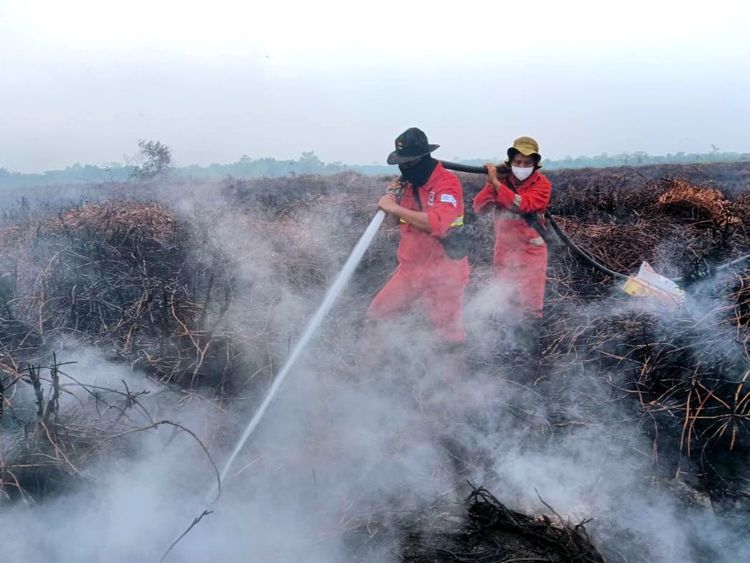
According to Budi, peat becomes highly flammable when it loses moisture. Fires can also spread underground and persist for extended periods, making them difficult to detect and extinguish through surface firefighting alone.
Technical prevention measures should therefore include maintaining groundwater levels, managing canals and canal blocks, providing water reservoirs and other water sources, monitoring peat moisture and ensuring adequate firefighting equipment is available in high-risk areas.
Weather conditions, hotspots and field conditions should also be monitored through an integrated system involving satellite imagery, groundwater-level sensors, observation towers, ground patrols and unmanned aerial vehicles or drones.
“Monitoring technology is very helpful, but hotspot data still needs to be verified directly in the field. Not every hotspot represents a fire, and not every fire can immediately be detected by satellites, particularly when the fire is burning beneath the peat surface,” Budi said.
Beyond technical measures, Budi said wildfire prevention is also influenced by non-technical factors, including human behavior, land-clearing practices, limited access to alternatives to slash-and-burn methods, land tenure issues, tenure conflicts, community welfare and coordination among stakeholders.
Therefore, patrols and firefighting efforts should be accompanied by public education, community economic empowerment, access to no-burn land-clearing technologies, stronger village institutions and continuous risk communication.
Meanwhile, soil expert Dr. Basuki Sumawinata said claims that companies benefit economically from forest or land fires should be tested through field verification and scientific evidence.
According to Basuki, the presence of hotspots inside or near a concession area alone is insufficient to determine the cause, perpetrator or motive behind a fire.
A comprehensive investigation should examine the fire’s point of origin, wind direction, soil type, land-use history, vegetation conditions, area boundaries, access routes, patrol records and measures taken to control the fire.
“It is important to clearly distinguish between the location of a fire, its cause, the party that started it and the party responsible for controlling it. Conclusions should not be based on a single piece of information or simply because a fire was found within a particular area,” Basuki said.
Basuki added that for forestry companies developing plantations, trees are assets and sources of raw materials that require significant investment and approximately five years before they can be harvested.
“Rationally and economically, forestry companies would not intentionally burn plantations that have been maintained for around five years. Fires can instead destroy raw materials, damage infrastructure, increase firefighting costs, disrupt operations and cause reputational losses,” he said.
However, Basuki stressed that economic arguments should not replace investigation and verification. Each case must still be handled transparently, professionally and based on evidence to prevent unfounded accusations while ensuring that responsibilities for fire prevention and control are not overlooked.
He said verification should ideally involve government authorities, law enforcement agencies, fire and peatland experts, local communities and area managers. Satellite data, weather information, groundwater-level records, patrol documentation, response timelines and field findings should be analyzed collectively.
“If there is a narrative that a company benefits from a fire, that narrative must be supported by evidence concerning the motive, mechanism of benefit, source of ignition and direct connection between the perpetrator and the incident,” Basuki said.
The two experts emphasized that successful peatland fire prevention depends on collaboration among government institutions, businesses, communities, academics and law enforcement authorities.
Prevention should be carried out throughout the year through water management, early detection, stronger community capacity, rapid response and accurate, evidence-based public communication.
Such a collaborative approach is expected to reduce fire risks, protect communities and ecosystems, and ensure that each incident is handled fairly, transparently and without relying on unverified assumptions. (*)