Enviro News Asia, Jakarta – The workshop titled “Forests and Mangroves Rise, a Strong Nation: Forestry Transformation toward Indonesia Gold 2045” was held at Artotel Suites Mangkuluhur, Jakarta, on Monday (15/12/2025), serving as a multi-stakeholder dialogue forum to formulate the direction of national forest and mangrove management transformation. The event aimed to map stakeholder roles and develop initial initiatives for a national strategy to ensure that the forestry and mangrove sectors make a significant contribution to Indonesia’s economic, social, and environmental development toward Indonesia Gold 2045.
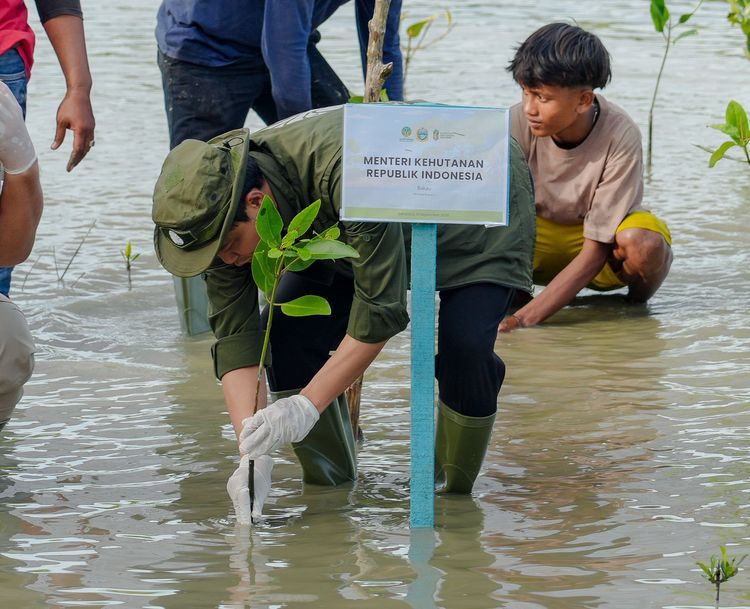
The workshop was jointly organized by the Strategic Studies Division of DPP HAE-IPB, the Directorate of Environmental, Maritime, Natural Resources, and Nuclear Energy Policy of the National Research and Innovation Agency (BRIN), the Faculty of Forestry and Environment of IPB University, and the Directorate of Mangrove Rehabilitation of the Ministry of Forestry through the Mangrove for Coastal Resilience (M4CR) Program. The forum also formed part of broader efforts to strengthen integrated mangrove rehabilitation and management to enhance the social, economic, and ecological resilience of coastal communities.
In opening remarks delivered by the Acting Deputy for Development Policy, Prof. Dr. Anugerah Widiyanto, on behalf of the Head of the National Research and Innovation Agency (BRIN), Prof. Dr. Arif Satria emphasized the importance of synergy among research, innovation, and policy in the transformation of Indonesia’s forestry sector.
“This activity is not merely an academic forum, but a strategic momentum to integrate research, innovation, and policy in strengthening Indonesia’s forestry and mangrove sectors,” he stated.
Arif Satria further underlined that the revitalization of forests and mangroves is a critical foundation for achieving Indonesia Gold 2045 amid climate change challenges and evolving land-use dynamics.
“Science-based innovation and governance in forestry are imperative, as forests and mangroves are strategic national assets that support climate change mitigation, food and energy security, and the green economy,” he said.
Director of Mangrove Rehabilitation at the Ministry of Forestry, Ristianto Pribadi, noted that forestry transformation requires the orchestration of roles across all stakeholders.
“Forestry transformation cannot be undertaken by a single institution alone. Clear stakeholder mapping is essential to prevent overlap, conflict, or gaps in roles,” he explained.
Ristianto added that the initial national strategy initiatives formulated through the workshop are designed to safeguard ecological functions while generating fair and sustainable added value.
“Forestry transformation is not only about keeping forests standing, but also about ensuring that forests and mangroves deliver tangible contributions through the green economy, bioeconomy, and strengthened social justice and science-based governance,” he said.
During the panel discussion session, Secretary General of the Association of Indonesian Forest Concessionaires (APHI), Purwadi Soeprihanto, expressed the private sector’s commitment to supporting forestry transformation and mangrove rehabilitation.
“Forestry businesses have transformed from timber utilization toward ecosystem service-based management, including carbon services, non-timber forest products, and ecotourism, in support of national emission reduction targets,” he stated.
Purwadi also highlighted the importance of expanding collaboration and leveraging technology to accelerate mangrove rehabilitation.
“Given the vast areas of mangroves requiring rehabilitation, private sector involvement through corporate social responsibility and the application of technology—from planning to monitoring using drones and satellite imagery—must continue to be expanded,” he added.
Through this workshop, participants are expected to produce a comprehensive mapping of stakeholder roles, an initial framework for the direction and national strategy of forestry and mangrove transformation, and operational policy recommendations. These outputs are intended to strengthen forest and mangrove governance and foster a shared understanding among government, academia, the private sector, and communities in support of Indonesia Gold 2045. (*)