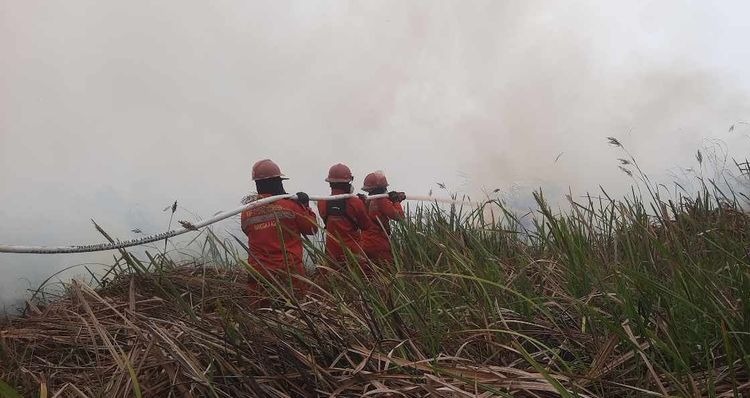
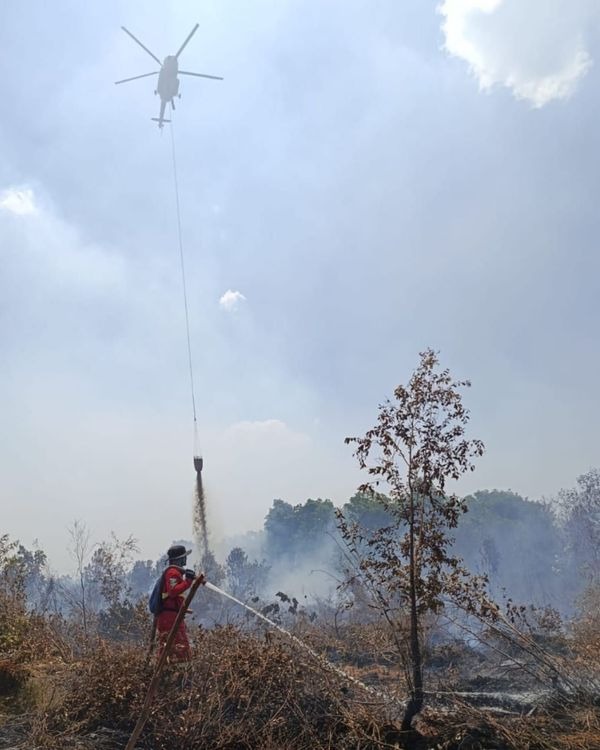
Enviro News Asia, Jakarta — Forest and land fire hotspots have declined sharply in Central and West Kalimantan, although firefighting operations remain active in several regions as dry conditions continue to pose a wildfire risk.
The Ministry of Forestry said its joint teams are maintaining ground operations, water bombing, aerial patrols and weather modification operations to control forest and land fires across Indonesia.
Data from the Ministry of Forestry’s SiPongi monitoring system, based on NASA Terra/Aqua, SNPP and NOAA-20 satellite observations, recorded 592 high-confidence hotspots nationwide as of 9:20 p.m. local time on September 13. The figure increased from 567 hotspots recorded a day earlier.
Among six priority provinces, Central Kalimantan recorded 89 high-confidence hotspots, down substantially from 197. West Kalimantan also recorded a major decline, from 91 to 14 hotspots.
South Sumatra recorded 49 hotspots, down from 62, while South Kalimantan increased from seven to 28. Jambi recorded 17 hotspots after reporting none the previous day. Riau remained at zero high-confidence hotspots.
The Ministry of Forestry stressed that satellite-detected hotspots indicate surface temperature anomalies and do not automatically represent active fires. A single fire can generate multiple hotspot detections, making ground verification essential to determine actual conditions.
Manggala Agni, together with the Indonesian Military, National Police, BNPB, BMKG, regional disaster management agencies, local governments, communities and businesses, continues to conduct patrols, ground checks, direct firefighting, fire-spread containment, mopping-up and cooling operations.
Firefighting remains particularly active in South Sumatra. On September 13, Manggala Agni continued suppressing a fire that had entered its eighth day. Joint teams were also strengthening efforts to control fires on peatlands and protect conservation areas.
The Ministry warned that falling hotspot numbers do not necessarily mean all fires have been extinguished. Fires on peatlands can continue smoldering below the surface, requiring sustained suppression, wetting and cooling until areas are fully secured.
The government has deployed 53 aircraft to support operations in the six priority provinces. Of these, 34 aircraft are assigned to water bombing operations, while 19 support aerial patrols and weather modification operations.
Japan has also provided three CH-47 Chinook helicopters, which have arrived in West Kalimantan and are being prepared for water bombing operations as part of Indonesia’s broader fire-control efforts.
Weather modification operations in West and Central Kalimantan are also continuing to support peatland wetting and fire control. As of September 11, the Ministry of Forestry had conducted nine sorties in West Kalimantan using 7,200 kilograms of sodium chloride (NaCl), with estimated rainfall of 87.9 million cubic meters.
In Central Kalimantan, seven sorties had been conducted using 5,600 kilograms of NaCl, generating an estimated 22.9 million cubic meters of rainfall.
The operations support President Prabowo Subianto’s directive to respond as early as possible to every detected hotspot rather than wait for it to develop into an active fire. The government has also emphasized community education down to the village level and stronger law enforcement against deliberate burning, including fires linked to corporations.
Despite improvements in several hotspot indicators, air quality remains uneven. Most parts of Indonesia are experiencing good to moderate conditions, while some areas of Sumatra and Kalimantan remain in unhealthy to very unhealthy categories. Some parts of Kalimantan have also recorded hazardous air-quality conditions.
BMKG monitoring showed hazy conditions in several locations. Visibility in Pontianak was around three kilometers during the early hours of September 13, while Banjarmasin recorded visibility of about two kilometers.
In South Sumatra, visibility around Tanjung Api-Api fell to approximately two to four kilometers from the early morning into the morning of September 13. The conditions indicate that particulate pollution and haze remain a concern even as hotspot levels fluctuate.
BMKG has warned that smoke remains present in several areas amid the dry season, although localized rainfall remains possible. Dry conditions, high temperatures and combustible vegetation continue to increase the risk of fire.
Authorities have urged residents in areas experiencing deteriorating air quality to reduce outdoor activities and wear masks when going outside. Children, pregnant women, older people and those with respiratory conditions are advised to take additional precautions.
The Ministry of Forestry also reminded the public not to clear or open land by burning. Residents who see smoke, fire or suspected burning activities are encouraged to report them immediately so authorities can respond at an early stage. (*)